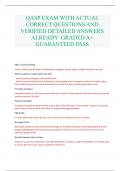
NSPN 7150 – The Breastfeeding Experience
Final Exam (2025/2026 Latest Update) |
Complete Study Guide & Verified Q&A PDF
The most important measures of preventive health for mothers and infants? - correct
answerBreastfeeding
What is Primary Healthcare? (3) - correct answerMulti-sectoral policy and action,
empowered people and communities, and primary care and essential public health
functions as the core of integrated health services
Wet Nurses - correct answerWomen who breastfeed another's child
BF rates in Canada - correct answerIn 2018, even though 92% of Canadian women
initiated breastfeeding at birth, close to 25% of these women stopped breastfeeding
before their infant was one month old.
In 2018, 38% of mothers in Canada breastfed exclusively for six months (or more)
Maternal benefits of breastfeeding - correct answer- Enhances normal postpartum
hormonal state (weight loss, faster involution, amenorrhea) & protects against post-
partum depression
- Oxytocin helps the mother gain confidence in mothering, decreases stress, increases
attachment
- Improved long term health (decrease risk of breast CA, Ovarian CA, osteoporosis,
heart disease, and DM2)
- Improves food security as available and safe
Infants Benefit of Breastfeeding - correct answer- Promotes optimal brain development
and learning potential: increased IQ
- Reduces the impact of infections & reduces hospital admissions
- Protection for ill infants
- Protection for premature infants against NEC and sepsis
- Improves psychological and physiological well-being
- Protects from SIDS, DM1, asthma, lymphoma, Crohn's, Ulcerative Colitis, Lymphoma
and Allergies
- Provides ideal growth and nutrition
Family and Social Benefits of Breastfeeding - correct answer- Cost effective for families,
reduction on health care costs due to less infant infections, environmentally friendly,
productivity improvement
,Risks of Human Milk Substitute - correct answercontamination (not sterile), errors of
preparation, infant morbidity/mortality (malnutrition deficiencies and obesity), toxic
chemicals, and allergies.
Reasons for decline of BF - correct answerAbout 44% of women surveyed felt that they
had insufficient breast milk, while 18% reported that they had difficulty with
breastfeeding technique. The third reason was due to medical conditions of the mother
or infant (9%)
Todays issues contributing to BF difficulties - correct answer- Aggressive marketing of
formula & Hospital practices (nurseries, separation of mother and infant)
- Unnecessary Supplementation & Bundling infant
- Lack of breastfeeding role models & Nuclear families-no support
- Lack of follow up support & Breastfeeding challenges (sore nipples, low supply)
- Cultural and societal challenges & Employment policies
Strategies to Support Breastfeeding - correct answersupport groups, breastfeeding as a
norm, prenatal education, educational materials to support education, professional
support in hospital and community, improved practices in hospital, public awareness
promotion, legislative marketing practices, adequate maternity benefits, and human
rights legislation to protect working women.
How much milk does an infant need? - correct answerIt's important to remember that
the infant just needs enough milk
Each mother's milk is..? - correct answer-is unique,
-changes to meet the needs of her infant, and
-changes depending on gestational age and health of her infant, time of day, and the
time during feeding.
What does not change in breastmilk - correct answerThe quality of milk for the infant
Changes in breastmilk: gestational age - correct answerPreterm milk is higher in protein
and anti-infective properties to meet the need of preterm infants.
Changes in breastmilk: stages of lactation - correct answerStage I—Most women begin
to produce colostrum in the last trimester of pregnancy and for about 2-4 days after
birth. Colostrum has higher concentration of protein, minerals, and immunoglobulins but
has less fat than mature milk
Find out more about Colostrum here:
Stage II—the onset of copious milk secretion after birth (days 2-3 to 8 postpartum)
Stage III—secretion of mature milk
Colostrum - correct answeris the first milk available to the infant. Most women begin to
produce colostrum in the last trimester of pregnancy and for about the first 2-3 days
after birth. It has high density and low volume, which is perfect for newborn stomach
, capacity. It also is very high in immunoglobulins, especially IgA. Colostrum is often
considered the "first immunization" as infants are born with an immature immune
system. Immunoglobulins and other anti-infective properties are even higher in preterm
colostrum. This is especially important for preterm infants.
Changes in breastmilk: time of day - correct answerMothers often feel fuller and have
more milk in the morning, and by the evening, they feel less full. In the night, human
milk tends to be higher in fat content and lower in volume. This helps the infant have
more extended periods of sleep throughout the night.
Changes in breastmilk: maternal diet - correct answerThe total amount of fat in the
mother's diet does not affect the amount of fat in human milk, but the types of fat in her
diet influence the fatty acids in her human milk.
Changes in breastmilk: age of infant - correct answerEach mother's milk continually
changes to meet the needs of her infant from neonate to toddler. The infant's salivary
amylase fine-tunes what is in the breast milk to provide exactly what the infant needs.
Changes in breastmilk: between breasts - correct answerBreastfeeding two siblings of
different ages is called tandem nursing. In this case, the body always compensates to
meet the needs of the infant and the colostrum quickly changes to milk. Because each
breast produces milk independently of the other, the breast milk will adapt to feeding
two children with different needs if each nurses only on one breast.
Changes in breastmilk: illness in mother or infant - correct answerThe mother's immune
system will create antibodies in response to pathogens her infant is exposed to. These
specific anti-infective factors go into her milk to help protect her infant.
Changes in breastmilk: volume of human milk - correct answerIt is well known that
human milk production is dependent on infant demand. The breast balances supply to
meet the infant's demand for human milk. Mothers should feed their infants based on
cues that demonstrate hunger/appetite
-first 24 hours, colostrum, 37 mls
-25-96 hrs, increase
-day 5, 500mls/day
-month 6, 800mls a day
Changes in breastmilk: stages of feed - correct answerForemilk (95% of
volume)/hindmilk (5% of volume)
The level of lactose is relatively stable throughout the feed; an increase in the fat
concentration is the main difference. Although diet can affect some nutrients in milk,
mothers who are not always able to eat proper food produce nutritious milk. Having a
proper diet is the best way to ensure that the mother remains healthy and has the
energy she needs to care for herself and her infant.
What are the 4 stages if lactation? - correct answer1) Mammogenesis
Final Exam (2025/2026 Latest Update) |
Complete Study Guide & Verified Q&A PDF
The most important measures of preventive health for mothers and infants? - correct
answerBreastfeeding
What is Primary Healthcare? (3) - correct answerMulti-sectoral policy and action,
empowered people and communities, and primary care and essential public health
functions as the core of integrated health services
Wet Nurses - correct answerWomen who breastfeed another's child
BF rates in Canada - correct answerIn 2018, even though 92% of Canadian women
initiated breastfeeding at birth, close to 25% of these women stopped breastfeeding
before their infant was one month old.
In 2018, 38% of mothers in Canada breastfed exclusively for six months (or more)
Maternal benefits of breastfeeding - correct answer- Enhances normal postpartum
hormonal state (weight loss, faster involution, amenorrhea) & protects against post-
partum depression
- Oxytocin helps the mother gain confidence in mothering, decreases stress, increases
attachment
- Improved long term health (decrease risk of breast CA, Ovarian CA, osteoporosis,
heart disease, and DM2)
- Improves food security as available and safe
Infants Benefit of Breastfeeding - correct answer- Promotes optimal brain development
and learning potential: increased IQ
- Reduces the impact of infections & reduces hospital admissions
- Protection for ill infants
- Protection for premature infants against NEC and sepsis
- Improves psychological and physiological well-being
- Protects from SIDS, DM1, asthma, lymphoma, Crohn's, Ulcerative Colitis, Lymphoma
and Allergies
- Provides ideal growth and nutrition
Family and Social Benefits of Breastfeeding - correct answer- Cost effective for families,
reduction on health care costs due to less infant infections, environmentally friendly,
productivity improvement
,Risks of Human Milk Substitute - correct answercontamination (not sterile), errors of
preparation, infant morbidity/mortality (malnutrition deficiencies and obesity), toxic
chemicals, and allergies.
Reasons for decline of BF - correct answerAbout 44% of women surveyed felt that they
had insufficient breast milk, while 18% reported that they had difficulty with
breastfeeding technique. The third reason was due to medical conditions of the mother
or infant (9%)
Todays issues contributing to BF difficulties - correct answer- Aggressive marketing of
formula & Hospital practices (nurseries, separation of mother and infant)
- Unnecessary Supplementation & Bundling infant
- Lack of breastfeeding role models & Nuclear families-no support
- Lack of follow up support & Breastfeeding challenges (sore nipples, low supply)
- Cultural and societal challenges & Employment policies
Strategies to Support Breastfeeding - correct answersupport groups, breastfeeding as a
norm, prenatal education, educational materials to support education, professional
support in hospital and community, improved practices in hospital, public awareness
promotion, legislative marketing practices, adequate maternity benefits, and human
rights legislation to protect working women.
How much milk does an infant need? - correct answerIt's important to remember that
the infant just needs enough milk
Each mother's milk is..? - correct answer-is unique,
-changes to meet the needs of her infant, and
-changes depending on gestational age and health of her infant, time of day, and the
time during feeding.
What does not change in breastmilk - correct answerThe quality of milk for the infant
Changes in breastmilk: gestational age - correct answerPreterm milk is higher in protein
and anti-infective properties to meet the need of preterm infants.
Changes in breastmilk: stages of lactation - correct answerStage I—Most women begin
to produce colostrum in the last trimester of pregnancy and for about 2-4 days after
birth. Colostrum has higher concentration of protein, minerals, and immunoglobulins but
has less fat than mature milk
Find out more about Colostrum here:
Stage II—the onset of copious milk secretion after birth (days 2-3 to 8 postpartum)
Stage III—secretion of mature milk
Colostrum - correct answeris the first milk available to the infant. Most women begin to
produce colostrum in the last trimester of pregnancy and for about the first 2-3 days
after birth. It has high density and low volume, which is perfect for newborn stomach
, capacity. It also is very high in immunoglobulins, especially IgA. Colostrum is often
considered the "first immunization" as infants are born with an immature immune
system. Immunoglobulins and other anti-infective properties are even higher in preterm
colostrum. This is especially important for preterm infants.
Changes in breastmilk: time of day - correct answerMothers often feel fuller and have
more milk in the morning, and by the evening, they feel less full. In the night, human
milk tends to be higher in fat content and lower in volume. This helps the infant have
more extended periods of sleep throughout the night.
Changes in breastmilk: maternal diet - correct answerThe total amount of fat in the
mother's diet does not affect the amount of fat in human milk, but the types of fat in her
diet influence the fatty acids in her human milk.
Changes in breastmilk: age of infant - correct answerEach mother's milk continually
changes to meet the needs of her infant from neonate to toddler. The infant's salivary
amylase fine-tunes what is in the breast milk to provide exactly what the infant needs.
Changes in breastmilk: between breasts - correct answerBreastfeeding two siblings of
different ages is called tandem nursing. In this case, the body always compensates to
meet the needs of the infant and the colostrum quickly changes to milk. Because each
breast produces milk independently of the other, the breast milk will adapt to feeding
two children with different needs if each nurses only on one breast.
Changes in breastmilk: illness in mother or infant - correct answerThe mother's immune
system will create antibodies in response to pathogens her infant is exposed to. These
specific anti-infective factors go into her milk to help protect her infant.
Changes in breastmilk: volume of human milk - correct answerIt is well known that
human milk production is dependent on infant demand. The breast balances supply to
meet the infant's demand for human milk. Mothers should feed their infants based on
cues that demonstrate hunger/appetite
-first 24 hours, colostrum, 37 mls
-25-96 hrs, increase
-day 5, 500mls/day
-month 6, 800mls a day
Changes in breastmilk: stages of feed - correct answerForemilk (95% of
volume)/hindmilk (5% of volume)
The level of lactose is relatively stable throughout the feed; an increase in the fat
concentration is the main difference. Although diet can affect some nutrients in milk,
mothers who are not always able to eat proper food produce nutritious milk. Having a
proper diet is the best way to ensure that the mother remains healthy and has the
energy she needs to care for herself and her infant.
What are the 4 stages if lactation? - correct answer1) Mammogenesis