Financial Risk Management
Introduction to risk management
Return without risk doesn’t exist. So to generate return, risks are necessary.
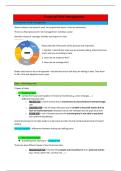
There is a fixed process for risk management: (endless cycle)
Identify, measure, manage, monitor and report on risks.
Especially the 3 first parts of the process are important.
1. Identify = identify the risks you are actually taking, determine how
much risk you are willing to take
2. how can we measure this?
3. how can we manage this?
Banks also have to do a risk appetite = decide how much risk they are willing to take. They have
to fill in this risk appetite once a year
Step 1: Identifying risks
2 types of risks:
- Financial risks:
➔ comes from your participation in financial markets (e.g.. price changes, …)
Different financial risks:
o Market risk = risk of losses due to movement in prices/interest rate/exchange
rate
o Liquidity risk = risk of losses because you’re unable to buy/sell assets due to
lack of market demand (hierdoor kan je niet verkopen aan de prijs die je wil)
o Credit risk = risk of losses because the counterparty is not able to pay back
(non-performing debts)µ
Any financial barrier to trade leads to a dip (Look at when Trump introduced all kinds of import
duties).
Bid-ask spreads = difference between buying and selling price
- Non-financial risks:
➔ Everything else. Synonym = residual risk
There are also different types of non-financial risks:
o Operational risk = the fact that people aren’t perfect or from external events
(e.g.: fraud, cyber risk, country risk, …)
, o Reputation risk = damage in reputation which lead to losses
Non-financial risks are very wide. They can have big financial consequences!!! (e.g. cyber-
attacks)
➔ Getting more and more important
Step 2: measuring financial risks
!!! Risk ≠ uncertainty !!!
Risk = your outcome is uncertain
Donald Rumsfeld: The risk/uncertainty framework
“There are known knowns; there are things we know we know. We also know there are known
unknowns; that is to say we know there are some things we do not know. But there are also
unknown unknowns, the ones we don’t know we don’t know”
RISKS = known unknowns
= You know what might happen, but you don’t know if it’s going to happen
→ A known unknown = we can calculate expected values
(e.g.: you have shares of AB-Inbev, worth €50. 50% probability that the price will go up to €80 en
50% probability that the price will go down to €30 by tomorrow. ➔ expected value = 50%*80 +
50%*30 = 40+15 = €55)
“you can measure risks, so you can manage it”
UNCERTAINTY = unknown unknown
➔ Means you just don’t know what is going to happen
“If you can’t measure it, you can’t manage it”
(e.g. in the hospital: if they don’t know yet what is wrong with the patient = uncertainty. BUT
when they found what the disease is, they can watch the risk of it)
Step 3: managing risks
Once financial risks are quantified, you need tools to manage risks:
With the help of derivate instruments = Contracts whose value is derived from an underlying
asset
Derivates mainly get used for interest rate risk and foreign exchange rate risk
, ➔ So derivates are essential to manage risks
The derivates market is roughly 3 times larger than the bond and equity market combined!
Step 4: monitor risks
We use a 3 lines of defense model to monitor risks
- 1st line = person that is actually taking the risk (= internal risk limits)
- 2nd line = risk management at the entity, at the level of the bank looks at the total
amount of the risks, so it’s not exceeded (= central risks controls)
- 3rd line = risk managers (= internal audits)
Step 5: reporting risks
Monitoring and measuring of risks need to be reported to the board of directors
Most Financial Institutions have a Chief Risk Officer (CRO).
There is a dual purpose:
1) board of directors need a risk appetite framework before taking risks
2) board of directors need to be informed on the current risks
Challenges for risk management in the future:
• Incorporating non-financial risks
• Hiring and developing talent
• New ‘uncertainties’ in the world
o Climate change
o Changing business models (online, …)
o Trade uncertainties
o Geopolitical risks
!!! ALWAYS A TRADE-OFF BETWEEN RISK AND RETURN !!!
Interest rates
Valuing financial assets is something really important in risk management. It’s very important to
know the value of your investment.
There are 2 ways to determine a fair value of any financial asset:
1. DCF-approach = Discounted cash flow approach
➔ For bonds, stocks, derivatives
, = you estimate the value of asset/investment as the present value of expected future cash flows,
by using a discount (interest) rate (zie financiële rekenkunde)
2. Arbitrage price / replicating portfolio approach
€100 today has not the same worth as €100 in 1 year!
➔ This is because you can obtain a (risk-free) interest on it (e.g. (risk-free) interest rate is
5%: €100 today is €105 in 1 year)
The present value of expected future cash flows:
FORMULE
(e.g.: face value = €1.000 ; 6% coupon a year, paid semi-annual ; 2 years before expiry date
➔ fair value if discount rate is 2% = )
Discount rate = interest rate with which we can discount the future cash flows
BUT: there is not ONE single interest rate, there are many rates:
- Treasury rates
= Rates on instruments issued by a government in its own currency
➔ Regarded as risk-free, because we usually assume there is no chance a government
would default
- Overnight rates
Banks do have to keep an amount of reserves at the central bank. They have to do it daily.
Some banks have a surplus of funds in reserve at the end of the day, while some banks have
need for funds
➔ this leads to overnight lending/borrowing reserves
Overnight rate in the US: federal funds rate (monitored by the FED)
Overnight rate in the eurozone: short-term rate (STR) (vroeger EONIA)
Introduction to risk management
Return without risk doesn’t exist. So to generate return, risks are necessary.
There is a fixed process for risk management: (endless cycle)
Identify, measure, manage, monitor and report on risks.
Especially the 3 first parts of the process are important.
1. Identify = identify the risks you are actually taking, determine how
much risk you are willing to take
2. how can we measure this?
3. how can we manage this?
Banks also have to do a risk appetite = decide how much risk they are willing to take. They have
to fill in this risk appetite once a year
Step 1: Identifying risks
2 types of risks:
- Financial risks:
➔ comes from your participation in financial markets (e.g.. price changes, …)
Different financial risks:
o Market risk = risk of losses due to movement in prices/interest rate/exchange
rate
o Liquidity risk = risk of losses because you’re unable to buy/sell assets due to
lack of market demand (hierdoor kan je niet verkopen aan de prijs die je wil)
o Credit risk = risk of losses because the counterparty is not able to pay back
(non-performing debts)µ
Any financial barrier to trade leads to a dip (Look at when Trump introduced all kinds of import
duties).
Bid-ask spreads = difference between buying and selling price
- Non-financial risks:
➔ Everything else. Synonym = residual risk
There are also different types of non-financial risks:
o Operational risk = the fact that people aren’t perfect or from external events
(e.g.: fraud, cyber risk, country risk, …)
, o Reputation risk = damage in reputation which lead to losses
Non-financial risks are very wide. They can have big financial consequences!!! (e.g. cyber-
attacks)
➔ Getting more and more important
Step 2: measuring financial risks
!!! Risk ≠ uncertainty !!!
Risk = your outcome is uncertain
Donald Rumsfeld: The risk/uncertainty framework
“There are known knowns; there are things we know we know. We also know there are known
unknowns; that is to say we know there are some things we do not know. But there are also
unknown unknowns, the ones we don’t know we don’t know”
RISKS = known unknowns
= You know what might happen, but you don’t know if it’s going to happen
→ A known unknown = we can calculate expected values
(e.g.: you have shares of AB-Inbev, worth €50. 50% probability that the price will go up to €80 en
50% probability that the price will go down to €30 by tomorrow. ➔ expected value = 50%*80 +
50%*30 = 40+15 = €55)
“you can measure risks, so you can manage it”
UNCERTAINTY = unknown unknown
➔ Means you just don’t know what is going to happen
“If you can’t measure it, you can’t manage it”
(e.g. in the hospital: if they don’t know yet what is wrong with the patient = uncertainty. BUT
when they found what the disease is, they can watch the risk of it)
Step 3: managing risks
Once financial risks are quantified, you need tools to manage risks:
With the help of derivate instruments = Contracts whose value is derived from an underlying
asset
Derivates mainly get used for interest rate risk and foreign exchange rate risk
, ➔ So derivates are essential to manage risks
The derivates market is roughly 3 times larger than the bond and equity market combined!
Step 4: monitor risks
We use a 3 lines of defense model to monitor risks
- 1st line = person that is actually taking the risk (= internal risk limits)
- 2nd line = risk management at the entity, at the level of the bank looks at the total
amount of the risks, so it’s not exceeded (= central risks controls)
- 3rd line = risk managers (= internal audits)
Step 5: reporting risks
Monitoring and measuring of risks need to be reported to the board of directors
Most Financial Institutions have a Chief Risk Officer (CRO).
There is a dual purpose:
1) board of directors need a risk appetite framework before taking risks
2) board of directors need to be informed on the current risks
Challenges for risk management in the future:
• Incorporating non-financial risks
• Hiring and developing talent
• New ‘uncertainties’ in the world
o Climate change
o Changing business models (online, …)
o Trade uncertainties
o Geopolitical risks
!!! ALWAYS A TRADE-OFF BETWEEN RISK AND RETURN !!!
Interest rates
Valuing financial assets is something really important in risk management. It’s very important to
know the value of your investment.
There are 2 ways to determine a fair value of any financial asset:
1. DCF-approach = Discounted cash flow approach
➔ For bonds, stocks, derivatives
, = you estimate the value of asset/investment as the present value of expected future cash flows,
by using a discount (interest) rate (zie financiële rekenkunde)
2. Arbitrage price / replicating portfolio approach
€100 today has not the same worth as €100 in 1 year!
➔ This is because you can obtain a (risk-free) interest on it (e.g. (risk-free) interest rate is
5%: €100 today is €105 in 1 year)
The present value of expected future cash flows:
FORMULE
(e.g.: face value = €1.000 ; 6% coupon a year, paid semi-annual ; 2 years before expiry date
➔ fair value if discount rate is 2% = )
Discount rate = interest rate with which we can discount the future cash flows
BUT: there is not ONE single interest rate, there are many rates:
- Treasury rates
= Rates on instruments issued by a government in its own currency
➔ Regarded as risk-free, because we usually assume there is no chance a government
would default
- Overnight rates
Banks do have to keep an amount of reserves at the central bank. They have to do it daily.
Some banks have a surplus of funds in reserve at the end of the day, while some banks have
need for funds
➔ this leads to overnight lending/borrowing reserves
Overnight rate in the US: federal funds rate (monitored by the FED)
Overnight rate in the eurozone: short-term rate (STR) (vroeger EONIA)