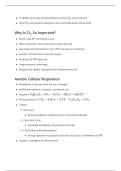
3.5 Billion years ago photosynthesis evolved, O2 was produced
Once O2 was present, eukaryotic cells and multicellular life evolved
Why Is O2 So Important?
All life uses ATP as energy source
When organisms stop producing energy, they die
Glycolysis and fermentation net 2 ATPs per glucose molecule
Aerobic cell respiration requires oxygen
Produces 36 ATPs/glucose
Huge energetic advantage
Oxygen and cellular respiration are fundamental to life
Aerobic Cellular Respiration
Breakdown of glucose with the use of oxygen
Additional reactants: enzymes, coenzymes, etc.
Equation: C6 H12 O6 + 6O2 → 6CO2 + 6H2 O + 36ATP
Photosynthesis: 6 CO2 + 6 H2 O + ATP→ C6 H12 O6 + 6 O2
3 Steps:
1. Glycolysis
Partial breakdown of glucose into 2 pyruvate molecules
2. Citric Acid Cycle
Complete breakdown of pyruvate molecules
3. ETS/Oxidative Phosphorylation
Energy captured in glycolysis and citric acid cycle is transferred to ATP
Location: cytoplasm & mitochondria
Once O2 was present, eukaryotic cells and multicellular life evolved
Why Is O2 So Important?
All life uses ATP as energy source
When organisms stop producing energy, they die
Glycolysis and fermentation net 2 ATPs per glucose molecule
Aerobic cell respiration requires oxygen
Produces 36 ATPs/glucose
Huge energetic advantage
Oxygen and cellular respiration are fundamental to life
Aerobic Cellular Respiration
Breakdown of glucose with the use of oxygen
Additional reactants: enzymes, coenzymes, etc.
Equation: C6 H12 O6 + 6O2 → 6CO2 + 6H2 O + 36ATP
Photosynthesis: 6 CO2 + 6 H2 O + ATP→ C6 H12 O6 + 6 O2
3 Steps:
1. Glycolysis
Partial breakdown of glucose into 2 pyruvate molecules
2. Citric Acid Cycle
Complete breakdown of pyruvate molecules
3. ETS/Oxidative Phosphorylation
Energy captured in glycolysis and citric acid cycle is transferred to ATP
Location: cytoplasm & mitochondria