Contract Law Notes
Introduction
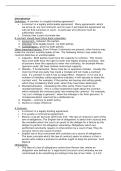
Definition: ‘A contract is a legally binding agreement’
A contract is a legally enforceable agreement. Many agreements, which
we arrive at, are not contracts, and so even if we break the agreement we
will not find ourselves in court. In particular all contracts must be
sufficiently certain.
Contract law is part of private law
A contract should have three basic essentials:
1. Agreement - between the parties.
2. Intention to be legally bound - by both parties.
3. Consideration - given by both parties.
Other Important Factors: Even if these 3 elements are present, other factors may
make the contract unenforceable at law. The following factors may make the
contract defective or unenforceable
1. Capacity - Both parties must have the capacity to contract. This means
they must both have the right to enter into legally binding contracts. Not
all persons have the capacity to enter into contracts, for example Minors
(persons under 18) have limited contractual capacity.
2. Mistake - if fundamental. There must be no operative mistake. Usually the
mere fact that one party has made a mistake will not make a contract
void. If a contract is void it has no legal effect. However, if it is one of a
number of mistakes called operative mistakes, it will operate to make the
contract void. For example, if the parties are buying and selling goods,
which they mistakenly think exist, when they have been destroyed.
3. Misrepresentation - misleading the other party. There must be no
misrepresentation. This is a false statement made about the contract,
which misleads the innocent party into making the contract. For example,
"my car's mileage is genuine", when the mileage is far from genuine! A
misrepresentation need not be a deliberate lie.
4. Illegality - contrary to public policy.
5. Duress or undue influence.
A Contract:
A contract is a legally binding agreement.
It is usually a commercial agreement.
Moschi v Lep Air Services [1973] AC 331: ‘The law of contract is part of the
law of obligations. The English law of obligations is about their sources and
the remedies which the court can grant to the obligee for a failure by the
obligor to perform his obligation voluntarily. Obligations which are
performed voluntarily require no intervention by a court of law. They do
not give rise to any cause of action.
English law is thus concerned with contracts as a source of obligations.
The basic principle which the law of contract seeks to enforce is that a
person who makes a promise to another ought to keep his promise.’ Lord
Diplock
Obligations:
The idea of a law of obligations comes from Roman law, where an
obligation was defined as ‘a legal bond (vinculum iuris) whereby we are
constrained to do something according to the law of our state. (J.3.13)
, Meaning under English Law: The term ‘law of obligations’ covers three
main areas of law; contract; tort and restitution, which is often referred to
as unjust enrichment. It is helpful to briefly outline these areas of law.
A Tort:
A tort is usually defined as a civil wrong. A tort is a wrongful act causing
harm, to a person, his property, reputation, or trade.
Distinguish a Tort from a Contract: However, a contract is also a civil
wrong. A contract and a tort can be easily distinguished. A contract can
only arise after a transaction entered into by the parties, for example the
contract of employment. While a tort may arise from an undesired and
unlooked for course of events. For example, an accident on a building
site. One particular event may at times involve both a breach of contract,
and a tort. For example, an employer owes a duty of care to those
employed by him under contracts of employment. If he breaks that duty
an action can be bought by the employee for breach of contract, or more
usually under the tort of negligence.
Negligence:
Negligence is the most important tort.
The tort of negligence has developed to protect the interests of the
individual from the wrongful acts of others. It does this by requiring that
the wrongdoer shall pay compensation for the injury he/she has caused.
For example, a surveyor who negligently fails to spot a defective wall in a
property they are inspecting will be liable for the cost of the damage.
It is important to grasp at an early stage that negligence is based on the
idea of ‘fault’. In order to recover compensation someone must be proved
to be at ‘fault’.
To establish negligence a duty of care needs to exist. The modern tort of
negligence was established by the leading case of: Donoghue v Stevenson
[1932] AC 562
Restitution:
If a contract is with a minor (below 18) the contract may be void. The law
treats it as if it never existed. There is then a danger of the minor keeping
the goods and not paying for them.
This is prevented as property acquired by the minor under a contract in
which he defaults can be reclaimed by the other party to the agreement
provided the Court decides that this is ‘just and equitable’. This is the
concept of restitution.
Introduction
Definition: ‘A contract is a legally binding agreement’
A contract is a legally enforceable agreement. Many agreements, which
we arrive at, are not contracts, and so even if we break the agreement we
will not find ourselves in court. In particular all contracts must be
sufficiently certain.
Contract law is part of private law
A contract should have three basic essentials:
1. Agreement - between the parties.
2. Intention to be legally bound - by both parties.
3. Consideration - given by both parties.
Other Important Factors: Even if these 3 elements are present, other factors may
make the contract unenforceable at law. The following factors may make the
contract defective or unenforceable
1. Capacity - Both parties must have the capacity to contract. This means
they must both have the right to enter into legally binding contracts. Not
all persons have the capacity to enter into contracts, for example Minors
(persons under 18) have limited contractual capacity.
2. Mistake - if fundamental. There must be no operative mistake. Usually the
mere fact that one party has made a mistake will not make a contract
void. If a contract is void it has no legal effect. However, if it is one of a
number of mistakes called operative mistakes, it will operate to make the
contract void. For example, if the parties are buying and selling goods,
which they mistakenly think exist, when they have been destroyed.
3. Misrepresentation - misleading the other party. There must be no
misrepresentation. This is a false statement made about the contract,
which misleads the innocent party into making the contract. For example,
"my car's mileage is genuine", when the mileage is far from genuine! A
misrepresentation need not be a deliberate lie.
4. Illegality - contrary to public policy.
5. Duress or undue influence.
A Contract:
A contract is a legally binding agreement.
It is usually a commercial agreement.
Moschi v Lep Air Services [1973] AC 331: ‘The law of contract is part of the
law of obligations. The English law of obligations is about their sources and
the remedies which the court can grant to the obligee for a failure by the
obligor to perform his obligation voluntarily. Obligations which are
performed voluntarily require no intervention by a court of law. They do
not give rise to any cause of action.
English law is thus concerned with contracts as a source of obligations.
The basic principle which the law of contract seeks to enforce is that a
person who makes a promise to another ought to keep his promise.’ Lord
Diplock
Obligations:
The idea of a law of obligations comes from Roman law, where an
obligation was defined as ‘a legal bond (vinculum iuris) whereby we are
constrained to do something according to the law of our state. (J.3.13)
, Meaning under English Law: The term ‘law of obligations’ covers three
main areas of law; contract; tort and restitution, which is often referred to
as unjust enrichment. It is helpful to briefly outline these areas of law.
A Tort:
A tort is usually defined as a civil wrong. A tort is a wrongful act causing
harm, to a person, his property, reputation, or trade.
Distinguish a Tort from a Contract: However, a contract is also a civil
wrong. A contract and a tort can be easily distinguished. A contract can
only arise after a transaction entered into by the parties, for example the
contract of employment. While a tort may arise from an undesired and
unlooked for course of events. For example, an accident on a building
site. One particular event may at times involve both a breach of contract,
and a tort. For example, an employer owes a duty of care to those
employed by him under contracts of employment. If he breaks that duty
an action can be bought by the employee for breach of contract, or more
usually under the tort of negligence.
Negligence:
Negligence is the most important tort.
The tort of negligence has developed to protect the interests of the
individual from the wrongful acts of others. It does this by requiring that
the wrongdoer shall pay compensation for the injury he/she has caused.
For example, a surveyor who negligently fails to spot a defective wall in a
property they are inspecting will be liable for the cost of the damage.
It is important to grasp at an early stage that negligence is based on the
idea of ‘fault’. In order to recover compensation someone must be proved
to be at ‘fault’.
To establish negligence a duty of care needs to exist. The modern tort of
negligence was established by the leading case of: Donoghue v Stevenson
[1932] AC 562
Restitution:
If a contract is with a minor (below 18) the contract may be void. The law
treats it as if it never existed. There is then a danger of the minor keeping
the goods and not paying for them.
This is prevented as property acquired by the minor under a contract in
which he defaults can be reclaimed by the other party to the agreement
provided the Court decides that this is ‘just and equitable’. This is the
concept of restitution.