NR554 Week 1 Discussion, Problem Identification for Public and Policy Decision Makers
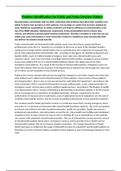
Problem Identification for Public and Policy Decision Makers Nursing leaders and bedside staff are often confronted with problems that affect their workflow and ability to deliver best practices to their patients. One example of a policy that has been adopted by many healthcare organizations to reduce confusion and improve efficiency in communication is the use of the SBAR (Situation, Background, Assessment, & Recommendation) tool to ensure clear, concise, and effective communication between professions. Describe a situation or issue that you see within your work environment or local community related to a healthcare issue and describe what you believe the solution would look like. Today, mental health and behavioral health patients seem to be broad focus among healthcare professionals across the U.S. Georgia is no exception to this focus as many of the inpatient facilities closed across Georgia and the mental health crisis is a growing issue and a stigma for most people that do not truly understand the mental health crisis. According to the Agency for Healthcare Research and Quality (2010), nearly 12 million hospital emergency room visits were mental health issues and substance abuse. Due to the shut down of multiple mental health facilities, emergency rooms continue to see more patients that are in a mental health/substance abuse crisis taking away from other emergency room patients. As a result of the increase of mental health patients, emergency rooms are faced with patients who become boarders in the department or patients that fall through the cracks that are to follow-up with outpatient mental health services. Patients who receive mental health services through the emergency room often require more time than other patients as it is often hard to find placement for these patients. Due to many of these patients becoming boarders, there is also an increase demand for staff within the department. According to The Joint Commission (2015), mental health boarders increase staffing needs, create a financial burden for emergency rooms, and increases costs to ancillary hospital services. According to The Division of Health Care Improvement (2015), “factors contributing to the boarding of psychiatric patients in the ED include lack of screening tools or evaluations by qualified psychiatric clinicians, requirements for prior authorization of insurance prior to admission, a lack of appropriate levels of outpatient care, the lack of available mental health services, and the scarcity of qualified professionals to treat psychiatric patients.” The constant need for better psychiatric services is a continuous issue that is causing emergency rooms across the U.S. to become oversaturated with mental health/psychiatric patients. This crisis has sparked an interest and actions to be taken by patient advocates, health care providers, health care systems, professional organizations, and policymakers across the U.S. Many health care facilities gave developed outpatient clinics to help combat this issue as well as initiating the use of telemedicine so that patients can connect with outpatient mental health providers. The use of telemedicine can decrease the amount of mental health patients being seen in emergency rooms as well as provide more in-depth care for mental health patients that do not require inpatient treatment. The Georgia Department of Public Health has begun to implement the usage of telehealth services for outpatient mental health patients so that there are more treatment options available to these patients as well as decreasing emergency room visits. References: Agency for Healthcare Research and Quality. (2010). Mental disorders and/or substance abuse related to one of every eight emergency department cases. Retrieved from Georgia Department of Public Health. (n.d.). Office of telehealth & telemedicine. Retrieved from The Joint Commission. (2015). Alleviating ED boarding of psychiatric patients. Retrieved from

Geschreven voor
- Instelling
- Chamberlain College Nursing
- Vak
- NR 554 (NR554)
Documentinformatie
- Geüpload op
- 4 februari 2021
- Aantal pagina's
- 2
- Geschreven in
- 2020/2021
- Type
- Case uitwerking
- Docent(en)
- Professor
- Cijfer
- A+
Onderwerpen
-
nr554 week 1 discussion
-
problem identification for public and policy decision makers
-
problem identification for public and policy decision makers nursing leaders and bedside staff are often confronte

Ook beschikbaar in voordeelbundel