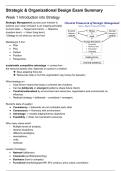
Strategic & Organizational Design Exam Summary
Week 1 Introduction into Strategy
Strategic Management: pursue your mission to
achieve your vision (mission is an ongoing principle)
Current state → Target (short term) → Objective
(medium term) → Vision (long term).
! Stategy is not what you do but how
Mintzberg’s 5 Ps=
• Plan
• Ploy
• Pattern
• Position
• Perspective.
sustainable competitive advantage -> comes from
the resource-based view, depends on cycles in a market
➔ Slow adapting firms die
➔ Resources help or hurt the organization (eg money for lawsuits)
What strategy is=
• Goal-driven means that imply a coherent set of actions.
• Can be deliberate or emergent (patterns shape future intent).
• Constrained/enabled by environment and resources; organization and environment co-
influence.
• Realized strategy = deliberate – unrealized + emergent.
Rumelt’s tests of quality=
● Consistency -> Elements do not contradict each other
● Consonance -> Harmony with environment
● Advantage -> creates edge/achieves objectives
● Feasibility -> Does not overwhelm resources
Why many views exist=
- Multiple levels of analysis,
- diverse disciplines,
- different paradigms,
- assumptions,
- units,
- methods.
Levels of strategy=
• Network (alliances)
• Corporate (portfolio/parenting)
• Business (how to compete)
• Functional (marketing/ops/HR; 4Ps: product, price, place, promotion)
,Schools of Thought: Mintzberg
- Design
- Planning
- Positioning
- Entrepreneurial
- Cognitive
- Learning
- Power
- Cultural
- Environmental
- Configuration
(Porter) What is Strategy?
Core idea
• Operational effectiveness ≠
Strategy. Operational effectiveness (doing similar activities
better) is necessary but not sufficient for sustainable
advantage.
• Strategy = Positioning. Choose a distinctive activity system to
deliver a unique value mix
Operational Effectiveness (OE)=
• Performing similar activities better than rivals
• Practices: Total Quality Management (TQM), benchmarking,
outsourcing, reengineering.
• Moves the firm toward the productivity frontier (best
achievable value at a given cost).
o The frontier itself is constantly shifting outward due to new technologies and management
approaches.
• Easy to imitate → competitive convergence and margin erosion.
o Sustainable advantage comes from unique combinations of activities that are hard to
imitate
Why Operational Effectiveness (OE) alone fails=
1. Rapid imitation of best practices.
2. Convergence: firms look alike, compete on the same dimensions.
3. Diminishing returns: homogeneity → price pressure; hard to sustain investment.
Strategic positioning (the essence)=
• Perform different activities or perform similar activities differently.
• Basis of sustainable advantage when activities are hard to copy as a system.
• This contrasts with OE, which is about performing similar activities better.
,Three bases of position=
1) Variety-based: narrow product/service subset (e.g., index funds focus).
2) Needs-based: serve most needs of a segment with tailored activities (e.g., IKEA for young,
price-sensitive home furnishers).
3) Access-based: reach similar needs via different access (e.g., small-town theaters).
• Scope can be broad or focused; maps onto cost leadership, differentiation, focus.
Consequences of Misplaced Focus=
- Hypercompetition: Companies compete on the same dimensions, eroding profitability.
- Industry consolidation: Mergers driven by lack of strategic vision, not true advantage.
- Profit erosion: Even leaders lose margins despite productivity gains.
- Strategic vacuum: OE tools replace strategic thinking, leading to stagnation.
Trade-offs (make positions durable)=
• Trade-offs occur when activities are incompatible, meaning "more of one thing necessitates less
of another".
• Imitation modes:
o Repositioning: move to the winner’s position.
o Straddling: add features while keeping the old position.
• Why trade-offs arise: image/reputation limits; activity incompatibilities; coordination/control limits.
• Strategy is choosing what not to do.
Fit among activities (source of advantage)=
1) 1st-order fit: activity–strategy consistency.
2) 2nd-order fit: activities reinforce each other.
3) 3rd-order fit: system-wide optimization, no redundancy.
• Tight fit raises imitation costs (rivals must copy the whole system).
• Fit creates value as activities reinforce one another, lowering costs or increasing value.
Losing and restoring strategy=
• Why it gets lost: belief trade-offs aren’t needed, herd imitation for OE, and the growth trap
(Pursuit of growth blurs strategic focus).
• Restore: return to the core position, focus on the most distinctive/profitable
customers/products/channels, strengthen fit, and avoid distractions.
Leadership’s role=
• Define and communicate the unique position.
• Enforce trade-offs and align the activity system.
• Maintain strategic continuity; change only with new trade-offs and a new reinforcing system.
Bottom line=
• OE = Continuous improvement, flexibility, no trade-offs. short-term performance improvement.
• Strategy = unique position + clear trade-offs + tight activity fit → long-term, sustainable
advantage.
(Sathe) The Controller’ s Role in Management
The Controller's Dual Responsibilities
• Management-service (MS): act as an active partner in decisions (planning/budgeting, pricing,
investments, working capital, etc.).
, • Financial reporting & internal control (FR/IC): assure accuracy and policy/legal compliance.
Local controller provides continuous vigilance beyond periodic internal audit.
Central dilemma: Involvement vs independence. Sathe argues a Strong Controller can deliver
both.
Role Primary Control Key benefits Main risks
emphasis timing
Involved Management- Mostly Better decision quality; Can stifle managers’ initiative;
service before sound analysis on perceived infringement
decisions costs/assets/investments
Independent Reporting & Mostly after High assurance of Seen as outsider; limited
control decisions accuracy and controls access; reactive “after-the-fact”
control
Split Two people, Mixed Focus on each mandate Duplication; weak coordination;
high emphasis inherits risks of Involved &
on both Independent
Strong One person, Before-the- Active involvement and Hard to staff; requires
high emphasis fact credible independence; exceptional
on both (anticipatory) stop bad actions early interpersonal/leadership
strength
Choosing the role -> key criteria=
• For Management-service emphasis
o Higher when: net benefits of controller’s contribution are high; other managers’
finance/analysis expertise is low.
• For Reporting & control emphasis
o Higher when: concern about accuracy/controls is high; confidence in managers’
integrity/judgment is low.
• Decision guide
o High MS / Low RC → Involved
o Low MS / High RC → Independent
o High MS / High RC → Prefer Strong (anticipatory control) over Split
(coordination/duplication risks)
Building Strong Controllers=
• Core attributes
o Personal: energy, integrity, resilience, professional commitment.
o Technical: solid accounting and analytical skills.
o Business judgment: anticipate problems, synthesize beyond the numbers, recommend
actions, think like a GM.
o Communication: concise, managerial language, clear recommendations.
o Interpersonal influence: trusted counselor, constructive challenger, relationship builder.
o Dual accountability: balance division and corporate expectations.
• Development levers
o Recruit & select for mixed profiles (e.g., MBA/CPA) and people skills.
o Rotations through audit, operations, corporate/division roles.
o Training focused on interpersonal/leadership, not just technical.
o Talent reviews & weeding to back high-potential candidates.
o Career paths that make controllership a route to top management.
Week 1 Introduction into Strategy
Strategic Management: pursue your mission to
achieve your vision (mission is an ongoing principle)
Current state → Target (short term) → Objective
(medium term) → Vision (long term).
! Stategy is not what you do but how
Mintzberg’s 5 Ps=
• Plan
• Ploy
• Pattern
• Position
• Perspective.
sustainable competitive advantage -> comes from
the resource-based view, depends on cycles in a market
➔ Slow adapting firms die
➔ Resources help or hurt the organization (eg money for lawsuits)
What strategy is=
• Goal-driven means that imply a coherent set of actions.
• Can be deliberate or emergent (patterns shape future intent).
• Constrained/enabled by environment and resources; organization and environment co-
influence.
• Realized strategy = deliberate – unrealized + emergent.
Rumelt’s tests of quality=
● Consistency -> Elements do not contradict each other
● Consonance -> Harmony with environment
● Advantage -> creates edge/achieves objectives
● Feasibility -> Does not overwhelm resources
Why many views exist=
- Multiple levels of analysis,
- diverse disciplines,
- different paradigms,
- assumptions,
- units,
- methods.
Levels of strategy=
• Network (alliances)
• Corporate (portfolio/parenting)
• Business (how to compete)
• Functional (marketing/ops/HR; 4Ps: product, price, place, promotion)
,Schools of Thought: Mintzberg
- Design
- Planning
- Positioning
- Entrepreneurial
- Cognitive
- Learning
- Power
- Cultural
- Environmental
- Configuration
(Porter) What is Strategy?
Core idea
• Operational effectiveness ≠
Strategy. Operational effectiveness (doing similar activities
better) is necessary but not sufficient for sustainable
advantage.
• Strategy = Positioning. Choose a distinctive activity system to
deliver a unique value mix
Operational Effectiveness (OE)=
• Performing similar activities better than rivals
• Practices: Total Quality Management (TQM), benchmarking,
outsourcing, reengineering.
• Moves the firm toward the productivity frontier (best
achievable value at a given cost).
o The frontier itself is constantly shifting outward due to new technologies and management
approaches.
• Easy to imitate → competitive convergence and margin erosion.
o Sustainable advantage comes from unique combinations of activities that are hard to
imitate
Why Operational Effectiveness (OE) alone fails=
1. Rapid imitation of best practices.
2. Convergence: firms look alike, compete on the same dimensions.
3. Diminishing returns: homogeneity → price pressure; hard to sustain investment.
Strategic positioning (the essence)=
• Perform different activities or perform similar activities differently.
• Basis of sustainable advantage when activities are hard to copy as a system.
• This contrasts with OE, which is about performing similar activities better.
,Three bases of position=
1) Variety-based: narrow product/service subset (e.g., index funds focus).
2) Needs-based: serve most needs of a segment with tailored activities (e.g., IKEA for young,
price-sensitive home furnishers).
3) Access-based: reach similar needs via different access (e.g., small-town theaters).
• Scope can be broad or focused; maps onto cost leadership, differentiation, focus.
Consequences of Misplaced Focus=
- Hypercompetition: Companies compete on the same dimensions, eroding profitability.
- Industry consolidation: Mergers driven by lack of strategic vision, not true advantage.
- Profit erosion: Even leaders lose margins despite productivity gains.
- Strategic vacuum: OE tools replace strategic thinking, leading to stagnation.
Trade-offs (make positions durable)=
• Trade-offs occur when activities are incompatible, meaning "more of one thing necessitates less
of another".
• Imitation modes:
o Repositioning: move to the winner’s position.
o Straddling: add features while keeping the old position.
• Why trade-offs arise: image/reputation limits; activity incompatibilities; coordination/control limits.
• Strategy is choosing what not to do.
Fit among activities (source of advantage)=
1) 1st-order fit: activity–strategy consistency.
2) 2nd-order fit: activities reinforce each other.
3) 3rd-order fit: system-wide optimization, no redundancy.
• Tight fit raises imitation costs (rivals must copy the whole system).
• Fit creates value as activities reinforce one another, lowering costs or increasing value.
Losing and restoring strategy=
• Why it gets lost: belief trade-offs aren’t needed, herd imitation for OE, and the growth trap
(Pursuit of growth blurs strategic focus).
• Restore: return to the core position, focus on the most distinctive/profitable
customers/products/channels, strengthen fit, and avoid distractions.
Leadership’s role=
• Define and communicate the unique position.
• Enforce trade-offs and align the activity system.
• Maintain strategic continuity; change only with new trade-offs and a new reinforcing system.
Bottom line=
• OE = Continuous improvement, flexibility, no trade-offs. short-term performance improvement.
• Strategy = unique position + clear trade-offs + tight activity fit → long-term, sustainable
advantage.
(Sathe) The Controller’ s Role in Management
The Controller's Dual Responsibilities
• Management-service (MS): act as an active partner in decisions (planning/budgeting, pricing,
investments, working capital, etc.).
, • Financial reporting & internal control (FR/IC): assure accuracy and policy/legal compliance.
Local controller provides continuous vigilance beyond periodic internal audit.
Central dilemma: Involvement vs independence. Sathe argues a Strong Controller can deliver
both.
Role Primary Control Key benefits Main risks
emphasis timing
Involved Management- Mostly Better decision quality; Can stifle managers’ initiative;
service before sound analysis on perceived infringement
decisions costs/assets/investments
Independent Reporting & Mostly after High assurance of Seen as outsider; limited
control decisions accuracy and controls access; reactive “after-the-fact”
control
Split Two people, Mixed Focus on each mandate Duplication; weak coordination;
high emphasis inherits risks of Involved &
on both Independent
Strong One person, Before-the- Active involvement and Hard to staff; requires
high emphasis fact credible independence; exceptional
on both (anticipatory) stop bad actions early interpersonal/leadership
strength
Choosing the role -> key criteria=
• For Management-service emphasis
o Higher when: net benefits of controller’s contribution are high; other managers’
finance/analysis expertise is low.
• For Reporting & control emphasis
o Higher when: concern about accuracy/controls is high; confidence in managers’
integrity/judgment is low.
• Decision guide
o High MS / Low RC → Involved
o Low MS / High RC → Independent
o High MS / High RC → Prefer Strong (anticipatory control) over Split
(coordination/duplication risks)
Building Strong Controllers=
• Core attributes
o Personal: energy, integrity, resilience, professional commitment.
o Technical: solid accounting and analytical skills.
o Business judgment: anticipate problems, synthesize beyond the numbers, recommend
actions, think like a GM.
o Communication: concise, managerial language, clear recommendations.
o Interpersonal influence: trusted counselor, constructive challenger, relationship builder.
o Dual accountability: balance division and corporate expectations.
• Development levers
o Recruit & select for mixed profiles (e.g., MBA/CPA) and people skills.
o Rotations through audit, operations, corporate/division roles.
o Training focused on interpersonal/leadership, not just technical.
o Talent reviews & weeding to back high-potential candidates.
o Career paths that make controllership a route to top management.