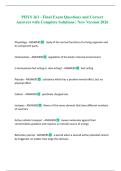
PHYS 261 - Final Exam Questions and Correct
Answers with Complete Solutions | New Version 2026
Physiology - ANSWERS study of the normal functions of a living organism and
its component parts.
Homeostasis - ANSWERS regulation of the body's internal environment
Is homeostasis fast acting or slow acting? - ANSWERS Fast acting
Placebo - ANSWERS substance which has a positive mental effect, but no
physical effect
Cations - ANSWERS positively charged ions
Isotopes - ANSWERS Atoms of the same element that have different numbers
of neutrons
Active cellular transport - ANSWERS moves molecules against their
concentration gradient and requires an outside source of energy
Refractory period - ANSWERS a period when a second action potential cannot
be triggered, no matter how large the stimulus.
, Isotonic muscle contraction vs Isometric muscle contraction - ANSWERS
Isotonic: creates force and moves a load.
Isometric: creates force without moving a load
Intercalated discs - ANSWERS gap junctions that connect myocardial cells and
allow depolarizations to spread rapidly from cell to cell
what does "MI" stand for - ANSWERS myocardial infarction
Define myocardial infarction - ANSWERS heart attack
isovolumetric ventricular systole - ANSWERS the ventricular blood volume
does not change, but pressure rises. When ventricular pressure exceeds arterial
pressure, the semilunar valves open, and blood is ejected into the arteries
Cardiac Output (CO) - ANSWERS the volume of blood pumped per ventricle
per unit time
Cardiac output formula - ANSWERS heart rate X stroke volume
Angiogenesis - ANSWERS the process by which new blood vessels grow and
develop
What does Mean Arterial Pressure (MAP) represent? - ANSWERS represents
the driving pressure for blood flow.
Answers with Complete Solutions | New Version 2026
Physiology - ANSWERS study of the normal functions of a living organism and
its component parts.
Homeostasis - ANSWERS regulation of the body's internal environment
Is homeostasis fast acting or slow acting? - ANSWERS Fast acting
Placebo - ANSWERS substance which has a positive mental effect, but no
physical effect
Cations - ANSWERS positively charged ions
Isotopes - ANSWERS Atoms of the same element that have different numbers
of neutrons
Active cellular transport - ANSWERS moves molecules against their
concentration gradient and requires an outside source of energy
Refractory period - ANSWERS a period when a second action potential cannot
be triggered, no matter how large the stimulus.
, Isotonic muscle contraction vs Isometric muscle contraction - ANSWERS
Isotonic: creates force and moves a load.
Isometric: creates force without moving a load
Intercalated discs - ANSWERS gap junctions that connect myocardial cells and
allow depolarizations to spread rapidly from cell to cell
what does "MI" stand for - ANSWERS myocardial infarction
Define myocardial infarction - ANSWERS heart attack
isovolumetric ventricular systole - ANSWERS the ventricular blood volume
does not change, but pressure rises. When ventricular pressure exceeds arterial
pressure, the semilunar valves open, and blood is ejected into the arteries
Cardiac Output (CO) - ANSWERS the volume of blood pumped per ventricle
per unit time
Cardiac output formula - ANSWERS heart rate X stroke volume
Angiogenesis - ANSWERS the process by which new blood vessels grow and
develop
What does Mean Arterial Pressure (MAP) represent? - ANSWERS represents
the driving pressure for blood flow.