
Evolutionary Development Biology – Lecture 4 – Bipedalism
From knuckle walking to bipedalism
The radius of knuckle walkers has a cavity at the end to fit the wrist. This cavity is
present in
Australophithecus afarensis watch out NOT in later Homo
Chimpanzee and gorilla the 2 species that most related to H. sapiens
Humans lacks this cavity – wrist is quite flexible
Hominins evolved in savannah landscape
Temperature dropped – precipitation (neerslag) decreased – Africa become drier –
rain forest shrinked – more savannahs and grasslands – allopatric speciation
contributed to the evolution of hominins
Advantages of bipedalism
Food more easily carried with free hands
Allow living from a home base – raise offspring
in a safe place
Bipedalism hominis had better view over their
surrounding
Avoid overheating by strong sunshine (energetic
advantage)
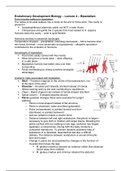
Anatomic traits associated with bipedalism
Skull -- Foramen magnum in the centre of the basicranium, not
at the back of the skull
Shoulder – shoulder joint laterally oriented instead of cranial.
Allows swining arms to the side contributing to equilibrium
Chest – Barrel shaped (vat) instead of funnel-shaped (trechter)
Spinal column – S-shaped absorbs shocks
Pelvis (greatest changes these were essential for upright
walking)
o Pelvis is bowl-shaped instead of flat structure
o Pelvis is shortened, wider and tilted (gekanteld)
o Pubis (schaambeen) is pointed forward and ilium
(darmbeen) is pointed backward
o Ischium (zitbeen) makes a shorter bend
o Distance between left and right acetabulum (heupkom) is larger—
necessary to give birth to children with larger brains. Broading the
pelvis conficts with our walking on two legs, evolution has forged
(gesloten) a compromise. During birth the baby conducts a
corkscrew manoeuvre. To prevent obstetric problems help of
assistance of is desirable. Neanderthal had also a difficult
delivery. The distance between acetabulum is sexual dimorphic
form the human.
o Change in pelvis are accompanied by changes in the function of
muscles that moves the legs
M. gluteus maximus became an extensor rather than abductor
(move away from midline)
M. gluteus medius and minimus retained the abductor
From knuckle walking to bipedalism
The radius of knuckle walkers has a cavity at the end to fit the wrist. This cavity is
present in
Australophithecus afarensis watch out NOT in later Homo
Chimpanzee and gorilla the 2 species that most related to H. sapiens
Humans lacks this cavity – wrist is quite flexible
Hominins evolved in savannah landscape
Temperature dropped – precipitation (neerslag) decreased – Africa become drier –
rain forest shrinked – more savannahs and grasslands – allopatric speciation
contributed to the evolution of hominins
Advantages of bipedalism
Food more easily carried with free hands
Allow living from a home base – raise offspring
in a safe place
Bipedalism hominis had better view over their
surrounding
Avoid overheating by strong sunshine (energetic
advantage)
Anatomic traits associated with bipedalism
Skull -- Foramen magnum in the centre of the basicranium, not
at the back of the skull
Shoulder – shoulder joint laterally oriented instead of cranial.
Allows swining arms to the side contributing to equilibrium
Chest – Barrel shaped (vat) instead of funnel-shaped (trechter)
Spinal column – S-shaped absorbs shocks
Pelvis (greatest changes these were essential for upright
walking)
o Pelvis is bowl-shaped instead of flat structure
o Pelvis is shortened, wider and tilted (gekanteld)
o Pubis (schaambeen) is pointed forward and ilium
(darmbeen) is pointed backward
o Ischium (zitbeen) makes a shorter bend
o Distance between left and right acetabulum (heupkom) is larger—
necessary to give birth to children with larger brains. Broading the
pelvis conficts with our walking on two legs, evolution has forged
(gesloten) a compromise. During birth the baby conducts a
corkscrew manoeuvre. To prevent obstetric problems help of
assistance of is desirable. Neanderthal had also a difficult
delivery. The distance between acetabulum is sexual dimorphic
form the human.
o Change in pelvis are accompanied by changes in the function of
muscles that moves the legs
M. gluteus maximus became an extensor rather than abductor
(move away from midline)
M. gluteus medius and minimus retained the abductor



