SUMMARY
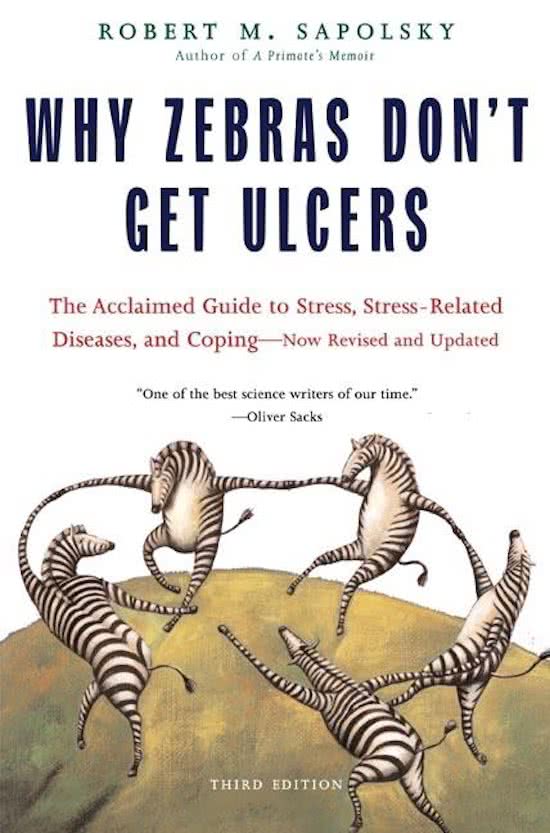
Book: Why Zebras Don’t Get Ulcers
Author: Robert M. Sapolsky
Edition: 3
Summarized by: L. C. Claassen
Dear student,
Please keep in mind that this is a SUMMARY. This work contains merely the MAIN topics
and ideas of the book. It is a simplified version of the real work, so it does not contain every
single concept. In order to fully grasp the material, I strongly advise you to READ THE
BOOK.
If you read the book, you will come across all sorts of explanations and examples which
clarify the topics in the most sophisticated way possible. You will be far better able to
remember all the information that was given to you if you understand it FULLY.
Then again, you are a student, and students have all sorts of other responsibilities. There are
other courses that you must study for and there are other assignments that you must make. Of
course, at times, it is equally important to take a break and not think about school for a while
in order to rest and regain your focus. Next to all this, you probably have a social life as well.
It is completely understandable if you choose to make a compromise for your time by only
studying a summary.
If that is the case, I hope that my summary will help you on your way to learn the material
and pass the exam. I have tried my best to gather all the main information and to write it
down in an understandable way. However, I would recommend you to at least compare
different summaries, and take a look at the lecture material, so that you DO NOT MISS OUT
on any important information. I am a learning student myself, so I make mistakes. This means
that my summary is NOT an end-all be-all solution for passing your exam. And NEITHER is
any other summary that you may use. Nevertheless, I hope that it is of use to you and I wish
you the best of luck in your academic career.
- Lauran
,CHAPTER 1: WHY DON’T ZEBRAS GET ULCERS?
- In the past, many people died at a young age due to different diseases like influenza or
tuberculosis. Today, most people live long enough to die of slow diseases that cause damage
over time such as heart disease or cancer. These slowly progressing diseases can be caused or
made worse by stress.
- Stress physiology: the study of how the human body responds to stressful events.
Some initial concepts
- There are three sources of stress:
1. Acute physical crises such as being chased by a predator. This is the most common
source of stress for animals such as zebras. These acute events require immediate
physiological adaptations. Our bodies’ stress-response is very good at providing these
adaptations.
2. Chronic physical challenges such as drought or famine. Our bodies’ stress-
response is reasonably well adapted to handle these challenges.
3. Psychological and social disruptions such as not being able to get a parking spot
or not getting along with a family member. We humans are smart enough and live long
and well enough that we can generate these kinds of stressful events in our heads.
Animals typically do not worry about such things. This form of stress can chronically
provoke our stress-response which can be bad for our health.
- Homeostasis: a state in which bodily processes are kept at an optimal level. For example,
your body has an ideal level of oxygen it needs, an ideal temperature, etc. When these ideal
levels are reached your body is in a homeostatic balance.
- Stressor: anything that disrupts your homeostatic balance. For most animals, a stressor
consists of something that happens in the physical world. But for us humans, a stressor can
also be the anticipation of something bad.
- Stress-response: the response of your body to reestablish a homeostatic balance after it has
encountered a stressor.
- Hans Selye: a scientist who initially came up with the notion that our stress-response can be
activated by the expectation/anticipation of stressors. Hans studied endocrine processes in
rats. Unfortunately, Hans was very crappy at taking care of his rats, accidentaly dropping
them on the floor, chasing them through the lab, and so on. Hans discovered that his rats
gained impaired immune functioning and developed ulcers. He found out that this was caused
by the stressful circumstances of the rats. Thus, by being a terrible rat-owner, he accidentally
stumbled upon the phenomena that (1) a wide array of stressors can activate the stress-
response, and (2) prolongued stress can cause sickness.
Homeostasis plus: the more stress-appropriate concept of allostasis
- Allostasis: a refined definition of the concept of homeostasis. The idea of allostasis holds
that optimal levels of bodily processes can be different for different circumstances (e.g. the
optimal level of blood pressure can be lower when you are sleeping than when you are
,active). The concept of allostasis also holds that suboptimal levels of bodily processes can be
changed in different ways, and that these changes are usually coordinated by the brain. Lastly,
the view of allostasis includes the notion that physical changes can happen in anticipation of
suboptimal levels of bodily processes (this idea is in line with the fact that our stress-system
can activate in the anticipation of a stressor).
What your body does to adapt to an acute stressor
- Our stress-response is mainly built to increase muscle activity, because that is what typical
natural stressors require from us. When you are being chased by a lion your muscles need to
work in order to run away. Your muscles require energy (mainly glucose) and oxygen. So
when the stress-response is activated, energy is released from your fat cells, you start
breathing more heavily in order to take in more oxygen, and your heart starts beating faster in
order to mobilize the resources towars the muscles more quickly.
- Another thing that happens during the stress-response is the ceasing of slow physical
processes such as digestion, growth, or reproduction. Acute stressful situations in nature are
often a matter of life or death, so your body does not want to waste any energy into processes
that do not directly help you survive. The same thing goes for the immune system; you do not
need to fend off diseases that might kill you in a year if you are being chased by a predator
that can kill you in an instant.
- The stress-response also shuts down pain. When you are being chased by that lion, it is not
adaptive to go into shock from pain. You need to keep running, so you cannot use any
distractions.
- One last thing that changes due to the stress-response are cognitive and sensory abilities.
Senses become sharper in order to react to the situation, and certain kinds of memory improve
in order to help you figure out how to get away from danger.
- Walter Cannon: a scientist who focused on the adaptivity of the stress-response. He came
up with the term ‘fight-or-flight’, which points to the fact that the stress-response makes us
more able to fight off or flee from danger.
- Selye’s three part view of the stress response (a view that later turned out to be wrong):
1. Initial (alarm) stage: you note a stressor.
2. Second (adaptation/resistance) stage: the stress-response is able to reestablish
allostatic balance. This happens during acute stress.
3. Third (exhausted) stage: stress-hormone reserves are depleted because the stress-
response has been activated for too long. This happens during chronic stress and can
cause disease.
- The reason why Selye’s three part view is wrong is because stress-hormone reserves do not
run out of hormones. Instead, what happens during chronic stress is that the body spends so
much energy on the stress response that it neglects other processes such as tissue repair or
immune processes. Therefore, the stress-response itself becomes harmful. Chronic exposure
to stressors, especially psychological stressors, can tear down our biological systems which
makes us more vulnerable to stress-related diseases. Other animals such as zebras typically do
not experience such chronic stressors, which is why they are not at risk for these kinds of
diseases; zebras don’t get ulcers.
, CHAPTER 2: GLANDS, GOOSEFLESH, AND HORMONES
Stress and the autonomic nervous system
- Autonomic nervous system: the part of the nervous system that sends out automatic, mostly
involuntary signals (e.g. when your brain tells your heart how fast it should pump, or when it
tells organs to produce hormones). The autonomic nervous system consists of two parts:
1. The sympathetic nervous system: the system that activates during the stress-
response; it has an energizing and stimulating function meant to carry out the ‘four
Fs’: fight, flight, fright, and... having sexual intercourse. Two hormones related to the
sympathetic nervous system are epinephrine (a.k.a. adrenaline) and norepinephrine
(a.k.a. noradrenaline). Epinephrine is secreted by the adrenal glands above your
kidneys and norepineprhine is secreted by sympathetic nerve endings throughout the
body. These two substances can activate organ activities that are needed to carry out
the four Fs. Here are some things that the sympathetic nervous system does:
1. It dilates pupils.
2. It inhibits salivation.
3. It accelerates heartbeat.
4. It inhibits digestion.
5. It stimulates secretion of adrenaline.
6. It stimulates orgasm.
2. The parasympathetic nervous system: this system is opposite to the sympathetic
nervous system. It mediates calm, vegetative processes such as digestion, energy
storage, and growth. The two work in opposition of each other. Here are some things
that the parasympathetic nervous system does:
1. It constricts pupils.
2. It stimulates salivation.
3. It slows down heartbeat.
4. It stimulates digestion.
5. It stimulates sexual arousal.
Your brain: the real master gland
- Neurotransmitter: a chemical secreted by a neuron which affects another neighboring
neuron.
- Hormone: a chemical secreted into the bloodstream by a neuron or another cell, which has
an effect elsewhere in the body. Some substances can act as both a neurotransmitter or as a
hormone.
- Pituitary gland: a gland at the bottom of the brain that uses hormones to regulate other
glands in the body. The pituitary used to be seen as the ‘master gland’ because it is the central
point that controls the other glands. However, scientists Roger Guillemin and Andrew
Schally discovered that the pituitary was controlled by the brain, in particular by the
hypothalamus: an area at the base of the brain that uses hormones to regulate the pituitary
gland. Thus, the brain turned out to be the real master gland.
Book: Why Zebras Don’t Get Ulcers
Author: Robert M. Sapolsky
Edition: 3
Summarized by: L. C. Claassen
Dear student,
Please keep in mind that this is a SUMMARY. This work contains merely the MAIN topics
and ideas of the book. It is a simplified version of the real work, so it does not contain every
single concept. In order to fully grasp the material, I strongly advise you to READ THE
BOOK.
If you read the book, you will come across all sorts of explanations and examples which
clarify the topics in the most sophisticated way possible. You will be far better able to
remember all the information that was given to you if you understand it FULLY.
Then again, you are a student, and students have all sorts of other responsibilities. There are
other courses that you must study for and there are other assignments that you must make. Of
course, at times, it is equally important to take a break and not think about school for a while
in order to rest and regain your focus. Next to all this, you probably have a social life as well.
It is completely understandable if you choose to make a compromise for your time by only
studying a summary.
If that is the case, I hope that my summary will help you on your way to learn the material
and pass the exam. I have tried my best to gather all the main information and to write it
down in an understandable way. However, I would recommend you to at least compare
different summaries, and take a look at the lecture material, so that you DO NOT MISS OUT
on any important information. I am a learning student myself, so I make mistakes. This means
that my summary is NOT an end-all be-all solution for passing your exam. And NEITHER is
any other summary that you may use. Nevertheless, I hope that it is of use to you and I wish
you the best of luck in your academic career.
- Lauran
,CHAPTER 1: WHY DON’T ZEBRAS GET ULCERS?
- In the past, many people died at a young age due to different diseases like influenza or
tuberculosis. Today, most people live long enough to die of slow diseases that cause damage
over time such as heart disease or cancer. These slowly progressing diseases can be caused or
made worse by stress.
- Stress physiology: the study of how the human body responds to stressful events.
Some initial concepts
- There are three sources of stress:
1. Acute physical crises such as being chased by a predator. This is the most common
source of stress for animals such as zebras. These acute events require immediate
physiological adaptations. Our bodies’ stress-response is very good at providing these
adaptations.
2. Chronic physical challenges such as drought or famine. Our bodies’ stress-
response is reasonably well adapted to handle these challenges.
3. Psychological and social disruptions such as not being able to get a parking spot
or not getting along with a family member. We humans are smart enough and live long
and well enough that we can generate these kinds of stressful events in our heads.
Animals typically do not worry about such things. This form of stress can chronically
provoke our stress-response which can be bad for our health.
- Homeostasis: a state in which bodily processes are kept at an optimal level. For example,
your body has an ideal level of oxygen it needs, an ideal temperature, etc. When these ideal
levels are reached your body is in a homeostatic balance.
- Stressor: anything that disrupts your homeostatic balance. For most animals, a stressor
consists of something that happens in the physical world. But for us humans, a stressor can
also be the anticipation of something bad.
- Stress-response: the response of your body to reestablish a homeostatic balance after it has
encountered a stressor.
- Hans Selye: a scientist who initially came up with the notion that our stress-response can be
activated by the expectation/anticipation of stressors. Hans studied endocrine processes in
rats. Unfortunately, Hans was very crappy at taking care of his rats, accidentaly dropping
them on the floor, chasing them through the lab, and so on. Hans discovered that his rats
gained impaired immune functioning and developed ulcers. He found out that this was caused
by the stressful circumstances of the rats. Thus, by being a terrible rat-owner, he accidentally
stumbled upon the phenomena that (1) a wide array of stressors can activate the stress-
response, and (2) prolongued stress can cause sickness.
Homeostasis plus: the more stress-appropriate concept of allostasis
- Allostasis: a refined definition of the concept of homeostasis. The idea of allostasis holds
that optimal levels of bodily processes can be different for different circumstances (e.g. the
optimal level of blood pressure can be lower when you are sleeping than when you are
,active). The concept of allostasis also holds that suboptimal levels of bodily processes can be
changed in different ways, and that these changes are usually coordinated by the brain. Lastly,
the view of allostasis includes the notion that physical changes can happen in anticipation of
suboptimal levels of bodily processes (this idea is in line with the fact that our stress-system
can activate in the anticipation of a stressor).
What your body does to adapt to an acute stressor
- Our stress-response is mainly built to increase muscle activity, because that is what typical
natural stressors require from us. When you are being chased by a lion your muscles need to
work in order to run away. Your muscles require energy (mainly glucose) and oxygen. So
when the stress-response is activated, energy is released from your fat cells, you start
breathing more heavily in order to take in more oxygen, and your heart starts beating faster in
order to mobilize the resources towars the muscles more quickly.
- Another thing that happens during the stress-response is the ceasing of slow physical
processes such as digestion, growth, or reproduction. Acute stressful situations in nature are
often a matter of life or death, so your body does not want to waste any energy into processes
that do not directly help you survive. The same thing goes for the immune system; you do not
need to fend off diseases that might kill you in a year if you are being chased by a predator
that can kill you in an instant.
- The stress-response also shuts down pain. When you are being chased by that lion, it is not
adaptive to go into shock from pain. You need to keep running, so you cannot use any
distractions.
- One last thing that changes due to the stress-response are cognitive and sensory abilities.
Senses become sharper in order to react to the situation, and certain kinds of memory improve
in order to help you figure out how to get away from danger.
- Walter Cannon: a scientist who focused on the adaptivity of the stress-response. He came
up with the term ‘fight-or-flight’, which points to the fact that the stress-response makes us
more able to fight off or flee from danger.
- Selye’s three part view of the stress response (a view that later turned out to be wrong):
1. Initial (alarm) stage: you note a stressor.
2. Second (adaptation/resistance) stage: the stress-response is able to reestablish
allostatic balance. This happens during acute stress.
3. Third (exhausted) stage: stress-hormone reserves are depleted because the stress-
response has been activated for too long. This happens during chronic stress and can
cause disease.
- The reason why Selye’s three part view is wrong is because stress-hormone reserves do not
run out of hormones. Instead, what happens during chronic stress is that the body spends so
much energy on the stress response that it neglects other processes such as tissue repair or
immune processes. Therefore, the stress-response itself becomes harmful. Chronic exposure
to stressors, especially psychological stressors, can tear down our biological systems which
makes us more vulnerable to stress-related diseases. Other animals such as zebras typically do
not experience such chronic stressors, which is why they are not at risk for these kinds of
diseases; zebras don’t get ulcers.
, CHAPTER 2: GLANDS, GOOSEFLESH, AND HORMONES
Stress and the autonomic nervous system
- Autonomic nervous system: the part of the nervous system that sends out automatic, mostly
involuntary signals (e.g. when your brain tells your heart how fast it should pump, or when it
tells organs to produce hormones). The autonomic nervous system consists of two parts:
1. The sympathetic nervous system: the system that activates during the stress-
response; it has an energizing and stimulating function meant to carry out the ‘four
Fs’: fight, flight, fright, and... having sexual intercourse. Two hormones related to the
sympathetic nervous system are epinephrine (a.k.a. adrenaline) and norepinephrine
(a.k.a. noradrenaline). Epinephrine is secreted by the adrenal glands above your
kidneys and norepineprhine is secreted by sympathetic nerve endings throughout the
body. These two substances can activate organ activities that are needed to carry out
the four Fs. Here are some things that the sympathetic nervous system does:
1. It dilates pupils.
2. It inhibits salivation.
3. It accelerates heartbeat.
4. It inhibits digestion.
5. It stimulates secretion of adrenaline.
6. It stimulates orgasm.
2. The parasympathetic nervous system: this system is opposite to the sympathetic
nervous system. It mediates calm, vegetative processes such as digestion, energy
storage, and growth. The two work in opposition of each other. Here are some things
that the parasympathetic nervous system does:
1. It constricts pupils.
2. It stimulates salivation.
3. It slows down heartbeat.
4. It stimulates digestion.
5. It stimulates sexual arousal.
Your brain: the real master gland
- Neurotransmitter: a chemical secreted by a neuron which affects another neighboring
neuron.
- Hormone: a chemical secreted into the bloodstream by a neuron or another cell, which has
an effect elsewhere in the body. Some substances can act as both a neurotransmitter or as a
hormone.
- Pituitary gland: a gland at the bottom of the brain that uses hormones to regulate other
glands in the body. The pituitary used to be seen as the ‘master gland’ because it is the central
point that controls the other glands. However, scientists Roger Guillemin and Andrew
Schally discovered that the pituitary was controlled by the brain, in particular by the
hypothalamus: an area at the base of the brain that uses hormones to regulate the pituitary
gland. Thus, the brain turned out to be the real master gland.