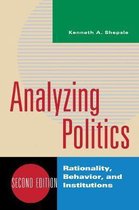
Analyzing Politics: Rationality,
Behavior, and Institutions 2nd Edition
ST
SOLUTIONS
UV
MANUAL
IA
_A
PP
Kenneth Shepsle
RO
Comprehensive Solutions Manual for
VE
Instructors and Students
D?
© Kenneth Shepsle
All rights reserved. Reproduction or distribution without permission is prohibited.
©MedConnoisseur
,Solutions Manual for Analyzing Politics Rationality, Behavior, and
Instititutions, 2e Kenneth, Shepsle (All Chapters)
Analyzing Politics: Answer Key
Iain Osgood
ST
July 7, 2010
Chapter 2: Problems and Discussion Questions
UV
4. Either player can identify a top choice (or choices in the case of indifference) for any subset of size 2. This
is always the case as long a person’s preferences satisfy comparability. There are 5 subsets with 3 or more
outcomes: wxy, wxz, wyz, xyz and wxyz. Mr. i’s and Ms. j’s most-preferred outcomes over these subsets
are shown in Table 1. Where either actor cannot state a most-preferred choice or choices, the table contains
IA
a ‘-’.
Mr. i Ms. j
Subset Top choice Cycle? Top choice Cycle?
wxy x No x,y No
_A
wxz - Yes x No
wyz w No y No
xyz - Yes x,y No
wxyz - Yes x,y No
PP
Table 1: Mr. i’s and Ms. j’s preferences for within subsets of the outcomes.
Preference orderings over a subset of outcomes which contain a strict preference cycle through all of the
elements in the subset have no articulable top choice. Preferences orderings over a subset of outcomes which
contain a strict preference cycle through less than all of the outcomes in the subset may or may not have
RO
an articulable top choice. By way of comparison, note that i has no top choice among the subset wxyz, but
an individual with the following preferences would strictly prefer w despite the presence of a cycle through
x, y and z: wPx, wPy, wPz, xPy, yPz, and zPx.
Thus, transitive preferences are a sufficient condition for identifying top choices with respect to any possible
set of outcomes. Technically, acyclic preferences over all triples of alternatives in a subset are necessary and
VE
sufficient for each subset to possess a maximal element. Acyclicity is defined, for any x, y, z, as: if xPy, yPz
then not zPx. Transitivity implies acyclicity and thus is sufficient for the existence of a maximal element.
Inasmuch as maximizing behavior often relies on specifying clear ordinal rankings among outcomes, transitive
preferences are effectively a prerequisite for a rational choice approach to individual decision-making.
D?
5. A reasonable assumption is that Senator Clinton’s preferences at that point were as follows: 𝑃 > 𝑆 > 𝐶.
Because she chose the office of Secretary of State, it would not be reasonable to assume that 𝑃 > 𝐶 > 𝑆.
The assumption that 𝑃 > 𝑆 is stronger, but corresponds with reports in the media at the time.
1
Downloaded by: tutorsection | Want to earn $1.236
Distribution of this document is illegal extra per year?
, The fact that Senator Clinton chose the position within the administration implies the following: 𝑆 >
(1 − 𝑝)𝐶 + 𝑝(𝑃 ). The chance to serve as Secretary of State was preferred to a risky ‘lottery’ over remaining
in the Senate and eventually becoming President. We can rearrange the parts of the inequality to derive
the following statement: 𝑃𝑆−𝐶
−𝐶 > 𝑝. Thus, the lowest 𝑝 which would induce Hillary Clinton to stay in the
Senate is 𝑃𝑆−𝐶
−𝐶 = 𝑝, and any 𝑝 greater than 𝑃𝑆−𝐶
−𝐶 would induce a strict preference for remaining in the
Senate. This relation also suggests three interesting comparative statics when all other variables are held
ST
constant: 1. there is a threshold as 𝑆 increases at which one cannot resist the offer of the Secretaryship; 2.
there is a threshold as 𝑃 increases at which one will reject the Secretaryship and hold out for a chance at
the Presidency; and, 3. as 𝐶 increases the threshold 𝑝 at which one will accept the Secretaryship decreases.
This latter effect occurs because as serving in Congress becomes more desirable, the lottery over 𝐶 and 𝑃
UV
becomes more appealing relative to the 𝑆.
6. Recall that the theory of expected utility states that given two different lotteries, L and L′ , over the same
outcomes, then LPL′ if and only if 𝑥𝜖𝑋 𝑝(𝑥)𝑢(𝑥) > 𝑥𝜖𝑋 𝑝′ (𝑥)𝑢(𝑥). Using this definition we can get the
∑ ∑
following two relations about L1 and L2 , and L3 and L4 :
IA
L1 PL2 implies 𝑢(𝑦) > .10𝑢(𝑥) + .89𝑢(𝑦) + .01𝑢(𝑧)
and
L4 PL3 implies .10𝑢(𝑥) + .90𝑢(𝑧) > .11𝑢(𝑦) + .89𝑢(𝑧)
_A
The trick here is to manipulate these expressions to show that they imply a contradiction. Consider the
following two steps: add .89𝑢(𝑧) to both sides of the first expression, and then subtract .89𝑢(𝑦) from both
sides of the first expression. This yields:
.11𝑢(𝑦) + .89𝑢(𝑧) > .10𝑢(𝑥) + .90𝑢(𝑧) which implies L3 PL4 ,
PP
which contradicts our second expression.
Two steps in this process require further justification. First, is it okay to add and subtract constants to an
expected utility expression? This is fine: expected utilities act like numbers and adding the same number
RO
to each side of an expression will not change the overall preference relation. If I prefer 2 apples to 1 orange,
then I should also prefer 2 apples and 10 units of utility to 1 orange and 10 units of utility. Second, can we
take these ‘manipulated’ expressions and treat them as identical to a genuine lottery? If we are smart about
our manipulations (i.e. add and subtract things so that we still have a proper probability distribution where
all of the probabilities are between 0 and 1, and also sum to 1) then we can treat the new objects as ordinary
VE
lotteries. This is what allows us to compare our manipulated version of expression 1 with expression 2.
D?
2
Downloaded by: tutorsection | Want to earn $1.236
Distribution of this document is illegal extra per year?
, Chapter 3: Problems and Discussion Questions
1. Using plurality rule and voting over all four alternatives, plan A wins with two votes. In a round-robin
tournament, B is a Condorcet winner : it beats all of the other plans in a head-to-head competition. If plan
B is removed from the competition, there is no Condorcet winner. Plan A defeats plan C in a head-to-head
vote; plan C defeats plan D in a head-to-head vote; and, plan D defeats plan A in a head-to-head vote.
ST
Thus, there is a group preference cycle and the group has intransitive social preferences among the three
outcomes, precluding identification of a top choice.
2. The following table provides the outcomes of every head-to-head vote over 𝑞, 𝑟, 𝑠, 𝑡 for the original and
the revised preferences:
UV
Matchup: qr qs qt sr st rt
Original r q q r t r
Revised r q q s t r
IA
Under the original preferences, there are no group preference cycles. Under the revised preferences, there
are preference cycles among (𝑞, 𝑠, 𝑟), (𝑟, 𝑡, 𝑠) and (𝑞, 𝑟, 𝑠, 𝑡). Under both sets of preferences, each individual’s
preferences are both complete and transitive, satisfying our very basic rationality requirement. However,
for the revised preferences, these individually rational preferences give rise to collectively irrational social
_A
preferences which feature several preference cycles. This illustrates the fact that rational preferences at the
individual level are no guarantee of rational preferences at the collective level.
3. i cannot identify a sequential agenda to secure outcome 𝑞 because outcome 𝑟 is a Condorcet winner (it
beats any other outcome so it survives every round of a sequential agenda and thus always beats 𝑞 at some
PP
point in the voting). After k’s preferences change, 𝑟 is no longer a Condorcet winner and the following
agendas will lead to 𝑞 winning: 𝑟𝑠∣𝑡∣𝑞, 𝑟𝑠∣𝑞∣𝑡 and 𝑟𝑡∣𝑠∣𝑞. This notation, for example with 𝑟𝑠∣𝑡∣𝑞, means that
in round 1, 𝑠 and 𝑟 face off; the winner of that round faces 𝑡 in round 2; and, the winner of round 2 faces 𝑞
in round 3.
RO
Before k changes his mind, j will secure his most-preferred outcome with any agenda, because his top choice,
𝑟, is a Condorcet winner. However, similar to player i, k cannot secure his top choice, 𝑡, because 𝑟 beats all
challengers. After k changes his mind, j can secure his most-preferred outcome with several agendas: 𝑠𝑞∣𝑟∣𝑡,
𝑠𝑞∣𝑡∣𝑟, 𝑠𝑡∣𝑞∣𝑟, 𝑠𝑡∣𝑟∣𝑞 and 𝑞𝑡∣𝑠∣𝑟. Likewise, k can secure his most-preferred outcome with 𝑟𝑞∣𝑠∣𝑡. In answering
this question, you may find it helpful to enumerate all 12 possible agendas and to determine the victor for
VE
each one.
It is not possible to fashion a sequential agenda which defeats a Condorcet winner, because by definition
such an outcome will survive every head-to-head competition it faces in any agenda. Absent a Condorcet
winner, all kinds of manipulation are possible although it is of course not possible to create an agenda which
D?
leads to the victory of an outcome which loses in a head-to-head competition with all other outcomes.
4. If player i votes honestly under agenda 𝑠𝑡∣𝑟∣𝑞 then 𝑟 is the victor. However, if he misrepresents his
preferences by voting strategically for option 𝑡 in Round 2, then he secures his most-preferred outcome, 𝑞
3
Downloaded by: tutorsection | Want to earn $1.236
Distribution of this document is illegal extra per year?
Behavior, and Institutions 2nd Edition
ST
SOLUTIONS
UV
MANUAL
IA
_A
PP
Kenneth Shepsle
RO
Comprehensive Solutions Manual for
VE
Instructors and Students
D?
© Kenneth Shepsle
All rights reserved. Reproduction or distribution without permission is prohibited.
©MedConnoisseur
,Solutions Manual for Analyzing Politics Rationality, Behavior, and
Instititutions, 2e Kenneth, Shepsle (All Chapters)
Analyzing Politics: Answer Key
Iain Osgood
ST
July 7, 2010
Chapter 2: Problems and Discussion Questions
UV
4. Either player can identify a top choice (or choices in the case of indifference) for any subset of size 2. This
is always the case as long a person’s preferences satisfy comparability. There are 5 subsets with 3 or more
outcomes: wxy, wxz, wyz, xyz and wxyz. Mr. i’s and Ms. j’s most-preferred outcomes over these subsets
are shown in Table 1. Where either actor cannot state a most-preferred choice or choices, the table contains
IA
a ‘-’.
Mr. i Ms. j
Subset Top choice Cycle? Top choice Cycle?
wxy x No x,y No
_A
wxz - Yes x No
wyz w No y No
xyz - Yes x,y No
wxyz - Yes x,y No
PP
Table 1: Mr. i’s and Ms. j’s preferences for within subsets of the outcomes.
Preference orderings over a subset of outcomes which contain a strict preference cycle through all of the
elements in the subset have no articulable top choice. Preferences orderings over a subset of outcomes which
contain a strict preference cycle through less than all of the outcomes in the subset may or may not have
RO
an articulable top choice. By way of comparison, note that i has no top choice among the subset wxyz, but
an individual with the following preferences would strictly prefer w despite the presence of a cycle through
x, y and z: wPx, wPy, wPz, xPy, yPz, and zPx.
Thus, transitive preferences are a sufficient condition for identifying top choices with respect to any possible
set of outcomes. Technically, acyclic preferences over all triples of alternatives in a subset are necessary and
VE
sufficient for each subset to possess a maximal element. Acyclicity is defined, for any x, y, z, as: if xPy, yPz
then not zPx. Transitivity implies acyclicity and thus is sufficient for the existence of a maximal element.
Inasmuch as maximizing behavior often relies on specifying clear ordinal rankings among outcomes, transitive
preferences are effectively a prerequisite for a rational choice approach to individual decision-making.
D?
5. A reasonable assumption is that Senator Clinton’s preferences at that point were as follows: 𝑃 > 𝑆 > 𝐶.
Because she chose the office of Secretary of State, it would not be reasonable to assume that 𝑃 > 𝐶 > 𝑆.
The assumption that 𝑃 > 𝑆 is stronger, but corresponds with reports in the media at the time.
1
Downloaded by: tutorsection | Want to earn $1.236
Distribution of this document is illegal extra per year?
, The fact that Senator Clinton chose the position within the administration implies the following: 𝑆 >
(1 − 𝑝)𝐶 + 𝑝(𝑃 ). The chance to serve as Secretary of State was preferred to a risky ‘lottery’ over remaining
in the Senate and eventually becoming President. We can rearrange the parts of the inequality to derive
the following statement: 𝑃𝑆−𝐶
−𝐶 > 𝑝. Thus, the lowest 𝑝 which would induce Hillary Clinton to stay in the
Senate is 𝑃𝑆−𝐶
−𝐶 = 𝑝, and any 𝑝 greater than 𝑃𝑆−𝐶
−𝐶 would induce a strict preference for remaining in the
Senate. This relation also suggests three interesting comparative statics when all other variables are held
ST
constant: 1. there is a threshold as 𝑆 increases at which one cannot resist the offer of the Secretaryship; 2.
there is a threshold as 𝑃 increases at which one will reject the Secretaryship and hold out for a chance at
the Presidency; and, 3. as 𝐶 increases the threshold 𝑝 at which one will accept the Secretaryship decreases.
This latter effect occurs because as serving in Congress becomes more desirable, the lottery over 𝐶 and 𝑃
UV
becomes more appealing relative to the 𝑆.
6. Recall that the theory of expected utility states that given two different lotteries, L and L′ , over the same
outcomes, then LPL′ if and only if 𝑥𝜖𝑋 𝑝(𝑥)𝑢(𝑥) > 𝑥𝜖𝑋 𝑝′ (𝑥)𝑢(𝑥). Using this definition we can get the
∑ ∑
following two relations about L1 and L2 , and L3 and L4 :
IA
L1 PL2 implies 𝑢(𝑦) > .10𝑢(𝑥) + .89𝑢(𝑦) + .01𝑢(𝑧)
and
L4 PL3 implies .10𝑢(𝑥) + .90𝑢(𝑧) > .11𝑢(𝑦) + .89𝑢(𝑧)
_A
The trick here is to manipulate these expressions to show that they imply a contradiction. Consider the
following two steps: add .89𝑢(𝑧) to both sides of the first expression, and then subtract .89𝑢(𝑦) from both
sides of the first expression. This yields:
.11𝑢(𝑦) + .89𝑢(𝑧) > .10𝑢(𝑥) + .90𝑢(𝑧) which implies L3 PL4 ,
PP
which contradicts our second expression.
Two steps in this process require further justification. First, is it okay to add and subtract constants to an
expected utility expression? This is fine: expected utilities act like numbers and adding the same number
RO
to each side of an expression will not change the overall preference relation. If I prefer 2 apples to 1 orange,
then I should also prefer 2 apples and 10 units of utility to 1 orange and 10 units of utility. Second, can we
take these ‘manipulated’ expressions and treat them as identical to a genuine lottery? If we are smart about
our manipulations (i.e. add and subtract things so that we still have a proper probability distribution where
all of the probabilities are between 0 and 1, and also sum to 1) then we can treat the new objects as ordinary
VE
lotteries. This is what allows us to compare our manipulated version of expression 1 with expression 2.
D?
2
Downloaded by: tutorsection | Want to earn $1.236
Distribution of this document is illegal extra per year?
, Chapter 3: Problems and Discussion Questions
1. Using plurality rule and voting over all four alternatives, plan A wins with two votes. In a round-robin
tournament, B is a Condorcet winner : it beats all of the other plans in a head-to-head competition. If plan
B is removed from the competition, there is no Condorcet winner. Plan A defeats plan C in a head-to-head
vote; plan C defeats plan D in a head-to-head vote; and, plan D defeats plan A in a head-to-head vote.
ST
Thus, there is a group preference cycle and the group has intransitive social preferences among the three
outcomes, precluding identification of a top choice.
2. The following table provides the outcomes of every head-to-head vote over 𝑞, 𝑟, 𝑠, 𝑡 for the original and
the revised preferences:
UV
Matchup: qr qs qt sr st rt
Original r q q r t r
Revised r q q s t r
IA
Under the original preferences, there are no group preference cycles. Under the revised preferences, there
are preference cycles among (𝑞, 𝑠, 𝑟), (𝑟, 𝑡, 𝑠) and (𝑞, 𝑟, 𝑠, 𝑡). Under both sets of preferences, each individual’s
preferences are both complete and transitive, satisfying our very basic rationality requirement. However,
for the revised preferences, these individually rational preferences give rise to collectively irrational social
_A
preferences which feature several preference cycles. This illustrates the fact that rational preferences at the
individual level are no guarantee of rational preferences at the collective level.
3. i cannot identify a sequential agenda to secure outcome 𝑞 because outcome 𝑟 is a Condorcet winner (it
beats any other outcome so it survives every round of a sequential agenda and thus always beats 𝑞 at some
PP
point in the voting). After k’s preferences change, 𝑟 is no longer a Condorcet winner and the following
agendas will lead to 𝑞 winning: 𝑟𝑠∣𝑡∣𝑞, 𝑟𝑠∣𝑞∣𝑡 and 𝑟𝑡∣𝑠∣𝑞. This notation, for example with 𝑟𝑠∣𝑡∣𝑞, means that
in round 1, 𝑠 and 𝑟 face off; the winner of that round faces 𝑡 in round 2; and, the winner of round 2 faces 𝑞
in round 3.
RO
Before k changes his mind, j will secure his most-preferred outcome with any agenda, because his top choice,
𝑟, is a Condorcet winner. However, similar to player i, k cannot secure his top choice, 𝑡, because 𝑟 beats all
challengers. After k changes his mind, j can secure his most-preferred outcome with several agendas: 𝑠𝑞∣𝑟∣𝑡,
𝑠𝑞∣𝑡∣𝑟, 𝑠𝑡∣𝑞∣𝑟, 𝑠𝑡∣𝑟∣𝑞 and 𝑞𝑡∣𝑠∣𝑟. Likewise, k can secure his most-preferred outcome with 𝑟𝑞∣𝑠∣𝑡. In answering
this question, you may find it helpful to enumerate all 12 possible agendas and to determine the victor for
VE
each one.
It is not possible to fashion a sequential agenda which defeats a Condorcet winner, because by definition
such an outcome will survive every head-to-head competition it faces in any agenda. Absent a Condorcet
winner, all kinds of manipulation are possible although it is of course not possible to create an agenda which
D?
leads to the victory of an outcome which loses in a head-to-head competition with all other outcomes.
4. If player i votes honestly under agenda 𝑠𝑡∣𝑟∣𝑞 then 𝑟 is the victor. However, if he misrepresents his
preferences by voting strategically for option 𝑡 in Round 2, then he secures his most-preferred outcome, 𝑞
3
Downloaded by: tutorsection | Want to earn $1.236
Distribution of this document is illegal extra per year?