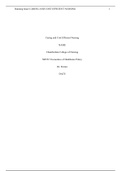
NR552 Week 6 Discussion, Caring and Cost Efficient Nursing
Caring and Cost Efficient Nursing NAME Chamberlain College of Nursing NR552: Economics of Healthcare Policy Dr. Poirier DATE After reading the article: Cara, C. M., Nyberg, J. J., & Brousseau, S. (2011). Fostering the coexistence of caring philosophy and economics in today's healthcare system. Nursing Administration Quarterly, 35(1), 6-14. Propose a caring behavior or policy you would like to initiate in your workplace. Describe how this caring behavior would impact nursing satisfaction, patient outcomes, and healthcare costs. Caring is a core feature in nursing. Several studies have tried to explore the concept of caring behavior among nurses in the Emergency Department. Research conducted by Wiman & Wikblad (2004) revealed that both caring and uncaring aspects existed in Emergency Care. (Wiman & Wikblad, 2004). Aspects of caring behavior include moral responsibility, genuine concern for the patient, openness to others, dedication and being involved with courage (Wiman & Wikblad, 2004). The aspects of uncaring behavior include disinterest, insensitivity, coldness, and inhumanity (Wiman & Wikblad, 2004). The best caring behavior I would like to initiate in the Emergency Department is a relational dialogue (Cara, et al., 2011). Relational dialogue entails both formal and informal conversations (Cara, et al., 2011). It encourages open conversation, careful listening, trust, and focus on solving problems (Cara, et al., 2011). This is consistent with Watson’s Theory of Human Care which recognizes effective care based on transpersonal relationships. This implies a care which transcends a patient’s matter, space, and time and the healthcare professional such that a single element is formed in harmony besides the punctual period of interaction, so as to promote healing (Wong, et al., 2013). Relational dialogue promotes transpersonal relationships Relational dialogue can impact on nursing satisfaction by providing a sense of understanding. Nurses in the Emergency Department have different needs because they deal with both life-saving and psychological issues (Wiman & Wikblad, 2004). Open communication between the nurses and the administration can help the administrators develop a deep and better understanding of the needs of these nurses in view of their practices in caring (Cara, et al., 2011). This can help address their problems thus, providing the highest level of carrier satisfaction. Relational dialogue can also impact on nursing satisfaction by creating a sense of trust between nurses and the administration. Cara, et al. (2011) explain that nurses who are involved in direct care of patients appreciate administrators who take personal involvement with issues and problems brought to them hence they develop trust that the administration is reliable and accountable (Cara, et al., 2011). The caring behavior would provide positive patient outcomes. Relational dialogue encourages understanding and trust which produces a highly satisfied nursing staff. This is consistent with Watson’s theory of Human Care because it facilitates the harmonious formation of a single element that promotes healing (Cara, et al., 2011). When nurses are highly satisfied they become highly motivated and develop aspects of caring behavior which promotes faster and effective healing of emergency victims. It also minimizes conflicts between management and nurses thus, allowing for full focus on patient care (Cara, et al., 2011). This can provide positive patient outcomes. Relational dialogue can also impact on health care costs by helping the management save on costs. Open communication can enable nurses to come up with perfect ideas for cutting costs (Cara, et al., 2011). For instances, they can explore and come up with innovative strategies for providing quality care with limited resources. By perfectly understanding the needs of the organization, nurses can work in a more proactive and positive way, optimizing economics while still focusing on the goals of patient care (Cara, et al., 2011). To conclude, managers may opt for a business-oriented approach to manage health services due to economic constraints. This may result in uncaring nursing behavior. Relational dialogue can help balance between fiscal responsibility and caring behavior. It encourages understanding and trust thus, promoting nursing satisfaction which in turn enhances positive patient outcome. It also allows nurses to understand the organization better hence optimizing economics while still focusing on caring behavior. References Cara, C. M., Nyberg, J. J., & Brousseau, S. (2011). Fostering the coexistence of caring philosophy and economics in today's health care system. Nursing administration quarterly, 35(1), 6-14. Wiman, E., & Wikblad, K. (2004). Caring and uncaring encounters in nursing in an emergency department. Journal of clinical nursing, 13(4), 422-429. Wong, C. A., Cummings, G. G., & Ducharme, L. (2013). The relationship between nursing leadership and patient outcomes: a systematic review update. Journal of nursing management, 21(5), 709-724. PROFESSOR RESPONSE TO PEER POST: Thank you, Amanda. Many facilities attempt to incorporate more professional development, but nurses often do not take advantage of those opportunities, for a variety of reasons. Most nurses say they are "too busy." How might you overcome some of those barriers? RESPONSE TO PROFESSOR: Dr. Poirier, Continued professional development plays an important role in enhancing service provision and maintaining safety for patients and nurses. The American Nurses Association has defined nursing professional development as the lifelong process of active participation by nurses in learning activities that assist in developing and maintaining their continuing competence, enhance their professional practice, and support achievements of their career goals (ANA, 2011). Professional development needs are challenged by multi-factorial reasons that place barriers from them being fulfilled. These barriers include but are not limited to accessibility, inability to get time off from work to attend CE, staff motivation, lack of encouragement from managers, staff shortages, work pressure, unsafe environment, participation of nurses on their own time, family commitments and home responsibilities, financial issues, (Aboshaiqah, Qasim, Abualwafa, Al-Bashaireh, 2012). Professional development takes place throughout a nurse's entire career, thus professional development programs need to be planned to meet the needs and promote professional growth of nurses at various levels of expertise. There are formal and informal disciplines to meet continuing professional development needs. Formal means include continuing education, staff development, academic education, and research activities (Brunt, 2001). However, nurses can continue their professional growth through informal means such as consultation, professional reading, experiential learning, self-directed activities, and online or webcast classes (Brunt, 2001). Education of the nursing staff should include programs that continually upgrade skills so that quality patient care can be maintained. Nursing leadership can ask staff members what they need or want for continued professional development activities. The staff must see a perceived need to change or a perceived benefit for better patient care. Leadership should also create a supportive atmosphere in the clinical environment that promotes continued professional development activities. References Aboshaiqah, A. E., Qasim, A., Abualwafa, N., Al-Bashaireh, A.M. (2012). Barriers for continuing professional development among nurses in a Saudi Arabia. Middle East Journal of Nursing, 6(3), 22-27. American Nurses Association. (2011). American Nurses Association continuing education. Retrieved on August 15, 2018, from Brunt, B. (2001). The importance of lifelong learning in managing risks. Retrieved on August 15, 2018, from WEEK 6 SUMMARY: Caring as an essential element of nursing is widely accepted among nurses. Nurses’ caring approach is believed to enhance the patient’s health and well-being and to facilitate health promotion. Jean Watson’s philosophy and theory of caring provides a way to blend the highly technical, cost conscious healthcare environment of today with the more human practices of caring. Nurses strive to have caring relationships with patients, to discover their stories, and to know them so as to assist them better back to health. Nursing research has provided evidence of the positive impact caring has on the caregiver. A decrease in stress levels has been demonstrated as well as an increase in reported job satisfaction rates (Poochikian-Sarkissian, Sidani, Ferguson-Pare & Doran, 2010). Additionally, a sense of empowerment or capability to advocate and effect change as a result of providing caring nursing practice has been discovered (Poochikian-Sarkissian et al., 2010). Reference Poochikian-Sarkissian, S., Sidani, S., Ferguson-Pare, M., & Doran, D. (2010). Examining the relationship between patient-centred care and outcomes. Canadian Journal of Neuroscience Nursing, 32(4), 14-21.

Geschreven voor
- Instelling
- Chamberlain College Nursing
- Vak
- NR 552 (NR552)
Documentinformatie
- Geüpload op
- 27 januari 2021
- Aantal pagina's
- 8
- Geschreven in
- 2020/2021
- Type
- Case uitwerking
- Docent(en)
- Professor
- Cijfer
- A+
Onderwerpen
-
nr552 week 6 discussion
-
caring and cost efficient nursing
-
caring and cost efficient nursing name chamberlain college of nursing nr552 economics of healthcare policy dr poirier date afte

Ook beschikbaar in voordeelbundel