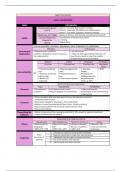
Criminal Law – Full Module Lecture Notes
1. Introduction to Criminal Law
- Criminal law defines behaviour that is prohibited by the state and punishable by sanctions
such as imprisonment or fines.
- It aims to protect society, maintain order, and deter wrongdoing.
- The **prosecution** bears the **burden of proof**, proving guilt **beyond reasonable
doubt**.
- The **defendant** is presumed innocent until proven guilty.
- Most offences contain two key elements:
- **Actus Reus (AR)** – the physical act or omission.
- **Mens Rea (MR)** – the mental state (intention, recklessness, etc.).
2. Actus Reus
- **Definition:** The external or physical element of an offence.
- The act must be **voluntary** (*Hill v Baxter*). Involuntary actions (e.g. during a seizure)
do not count.
**Omissions:** Generally, there is no liability for omissions unless a legal duty to act exists:
1. **Contractual duty** – *R v Pittwood* (railway gatekeeper failed to shut gate).
2. **Relationship duty** – *R v Gibbins & Proctor* (parent failed to feed child).
3. **Voluntary assumption of care** – *R v Stone & Dobinson*.
4. **Creating a dangerous situation** – *R v Miller* (failed to stop fire he caused).
**Causation:**
- **Factual causation:** “But for” test (*R v White*).
- **Legal causation:** Defendant’s act must be a substantial and operating cause (*R v
Smith*).
- **Intervening acts:** May break the chain if unforeseeable (*R v Jordan*; *R v Roberts*).
3. Mens Rea
- **Definition:** The mental element of an offence.
- **Intention:**
- **Direct intention:** Defendant’s purpose was to bring about the consequence (*R v
Mohan*).
- **Oblique intention:** Result was virtually certain and defendant appreciated that (*R v
Woollin*).
1. Introduction to Criminal Law
- Criminal law defines behaviour that is prohibited by the state and punishable by sanctions
such as imprisonment or fines.
- It aims to protect society, maintain order, and deter wrongdoing.
- The **prosecution** bears the **burden of proof**, proving guilt **beyond reasonable
doubt**.
- The **defendant** is presumed innocent until proven guilty.
- Most offences contain two key elements:
- **Actus Reus (AR)** – the physical act or omission.
- **Mens Rea (MR)** – the mental state (intention, recklessness, etc.).
2. Actus Reus
- **Definition:** The external or physical element of an offence.
- The act must be **voluntary** (*Hill v Baxter*). Involuntary actions (e.g. during a seizure)
do not count.
**Omissions:** Generally, there is no liability for omissions unless a legal duty to act exists:
1. **Contractual duty** – *R v Pittwood* (railway gatekeeper failed to shut gate).
2. **Relationship duty** – *R v Gibbins & Proctor* (parent failed to feed child).
3. **Voluntary assumption of care** – *R v Stone & Dobinson*.
4. **Creating a dangerous situation** – *R v Miller* (failed to stop fire he caused).
**Causation:**
- **Factual causation:** “But for” test (*R v White*).
- **Legal causation:** Defendant’s act must be a substantial and operating cause (*R v
Smith*).
- **Intervening acts:** May break the chain if unforeseeable (*R v Jordan*; *R v Roberts*).
3. Mens Rea
- **Definition:** The mental element of an offence.
- **Intention:**
- **Direct intention:** Defendant’s purpose was to bring about the consequence (*R v
Mohan*).
- **Oblique intention:** Result was virtually certain and defendant appreciated that (*R v
Woollin*).