

Learning outcomes THEME 3
Week 9
- the arrangement/main structures of the brainstem and the functions of various cranial nerves, more specifically:
• the pupillary reflex, what happens when it is impaired and the anatomical structure in which the problem then
resides
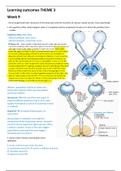
Pupillary reflex: ANS reflex
- afferent pathway: optic nerve
- efferent pathway: oculomotor nerve
dilation: sympathetic activity of spinal cord
Constriction (relaxed state): parasympathetic
activity of midbrain
Anisocoria: different size of the two pupils →
impaired efferent pathway (if optic nerve: both
equally illuminated) so can be in oculomotor nerve
or midbrain
Impaired? → constantly dilated pupils, no
constriction
During sleep or metabolic coma (without
compression of the oculomotor nerve), the pupils
constrict, but do respond to light exposure. When
a patient is awake, closure of the eyes triggers
pupil dilation; opening of the eyes triggers
renewed pupil constriction.
• ocular motor function and double vision
(diplopia)
3 nerves control ocular motor function:
1) oculomotor nerve (III) → nuclei in midbrain and pons.
2) trochlear nerve (IV)
3) abducens nerve (VI)
,When a person opens his eyes after sleeping, that is induced primarily by nerve III and the sympathetic system.
When one grows sleepy and cannot keep one’s eyes open, that system is no longer functioning optimally. Active eye
closure is induced by the facial nerve (VII), which controls the orbicularis oculi muscle.
(horizontal) diplopia: dysfunction of the abducens nerve. = uncrossed double vision: right eye is responsible for right
hand vision
(to close objects) diplopia: dysfunction oculomotor nerve. = crossed double vision: when hand is in front of left or
right eye, the double vision disappears.
Medial longitudinal fasciculus: for the coordination of eye movement
→ disorder? → nystagmus
→ injury → internuclear ophthalmoplegia = impaired ability to look to one side (adduction is not possible)
paramedian pontine reticular formation: for horizontal control of the oculomotor nerve nuclei. Is in frontal visual
centre
→ damage to PPRF or abducens nerve: horizontal gaze palsy
Superior colliculi: within tectum: for vertical movement
→ damage? → downward gaze
• the main causes of facial nerve impairment and the distinction between peripheral and central facial paresis
Facial nerve (VII): for facial expression
→ 2 regions: one for upper face and one for lower face
- lower facial neurons are controlled by the pyramidal tract → only contralateral
- upper facial neurons are controlled by ipsi- AND contralateral pyramidal tracts
→ so corner of mouth might drop, but eye can still close
,* notice: if the eye cannot be closed voluntarily, then it is not a central, but a peripheral neuron problem
→ in that case: eyeball will roll upwards: Bells phenomenon
Main causes of facial impairment
- the definition of coma, the main causes of coma
and the examination of comatose patients:
Coma: a state of unarousable psychological
responsiveness, in which the subjects lie with their
eyes closed (unconsciousness).
Main causes: FAILURE OF ARAS
- bleeding → shift tissue → fail arousal system
- tumour
- infectious
- metabolic
- direct brainstem lesion
- epilepsy
depth of coma correlates to progressive craniocaudal
brainstem function loss → the more caudal the the affected
lesions to the spinal cord, the grimmer the situation
Examination: →
- EMV score: at least 1-5-2 or lower
Eye position: eyes are closed.
→ Cornea reflex: should be tested → indicator of pons function
→ Oculocephalic response: doll eye manoevre
→ oculovestibular response: ice water test (little movement = coma, no movement = brain death)
Breathing: Cheyne-Stokes (bouts of heavy breathing), hyperpnoea or apnoea
Pulse and BP: low pulse and high tension
, • vegetative state/ non-responsive wakefulness syndrome (NRWS), minimally conscious state and locked-in
syndrome
Locked in syndrome: awake. Paralysis below pontine level. Only vertical eye movement
→ due to ventral pons infarction
→ patient can hear, see, feel, but no motor movement at all.
→ so may appear comatose, but is conscious!
Week 9
- the arrangement/main structures of the brainstem and the functions of various cranial nerves, more specifically:
• the pupillary reflex, what happens when it is impaired and the anatomical structure in which the problem then
resides
Pupillary reflex: ANS reflex
- afferent pathway: optic nerve
- efferent pathway: oculomotor nerve
dilation: sympathetic activity of spinal cord
Constriction (relaxed state): parasympathetic
activity of midbrain
Anisocoria: different size of the two pupils →
impaired efferent pathway (if optic nerve: both
equally illuminated) so can be in oculomotor nerve
or midbrain
Impaired? → constantly dilated pupils, no
constriction
During sleep or metabolic coma (without
compression of the oculomotor nerve), the pupils
constrict, but do respond to light exposure. When
a patient is awake, closure of the eyes triggers
pupil dilation; opening of the eyes triggers
renewed pupil constriction.
• ocular motor function and double vision
(diplopia)
3 nerves control ocular motor function:
1) oculomotor nerve (III) → nuclei in midbrain and pons.
2) trochlear nerve (IV)
3) abducens nerve (VI)
,When a person opens his eyes after sleeping, that is induced primarily by nerve III and the sympathetic system.
When one grows sleepy and cannot keep one’s eyes open, that system is no longer functioning optimally. Active eye
closure is induced by the facial nerve (VII), which controls the orbicularis oculi muscle.
(horizontal) diplopia: dysfunction of the abducens nerve. = uncrossed double vision: right eye is responsible for right
hand vision
(to close objects) diplopia: dysfunction oculomotor nerve. = crossed double vision: when hand is in front of left or
right eye, the double vision disappears.
Medial longitudinal fasciculus: for the coordination of eye movement
→ disorder? → nystagmus
→ injury → internuclear ophthalmoplegia = impaired ability to look to one side (adduction is not possible)
paramedian pontine reticular formation: for horizontal control of the oculomotor nerve nuclei. Is in frontal visual
centre
→ damage to PPRF or abducens nerve: horizontal gaze palsy
Superior colliculi: within tectum: for vertical movement
→ damage? → downward gaze
• the main causes of facial nerve impairment and the distinction between peripheral and central facial paresis
Facial nerve (VII): for facial expression
→ 2 regions: one for upper face and one for lower face
- lower facial neurons are controlled by the pyramidal tract → only contralateral
- upper facial neurons are controlled by ipsi- AND contralateral pyramidal tracts
→ so corner of mouth might drop, but eye can still close
,* notice: if the eye cannot be closed voluntarily, then it is not a central, but a peripheral neuron problem
→ in that case: eyeball will roll upwards: Bells phenomenon
Main causes of facial impairment
- the definition of coma, the main causes of coma
and the examination of comatose patients:
Coma: a state of unarousable psychological
responsiveness, in which the subjects lie with their
eyes closed (unconsciousness).
Main causes: FAILURE OF ARAS
- bleeding → shift tissue → fail arousal system
- tumour
- infectious
- metabolic
- direct brainstem lesion
- epilepsy
depth of coma correlates to progressive craniocaudal
brainstem function loss → the more caudal the the affected
lesions to the spinal cord, the grimmer the situation
Examination: →
- EMV score: at least 1-5-2 or lower
Eye position: eyes are closed.
→ Cornea reflex: should be tested → indicator of pons function
→ Oculocephalic response: doll eye manoevre
→ oculovestibular response: ice water test (little movement = coma, no movement = brain death)
Breathing: Cheyne-Stokes (bouts of heavy breathing), hyperpnoea or apnoea
Pulse and BP: low pulse and high tension
, • vegetative state/ non-responsive wakefulness syndrome (NRWS), minimally conscious state and locked-in
syndrome
Locked in syndrome: awake. Paralysis below pontine level. Only vertical eye movement
→ due to ventral pons infarction
→ patient can hear, see, feel, but no motor movement at all.
→ so may appear comatose, but is conscious!



