Checklist week 12 – Difficulty swallowing
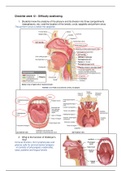
1. Students know the anatomy of the pharynx and its division into three compartments
(nasopharynx, etc.) and the location of the tonsils, uvula, epiglottis and piriform sinus.
The pyriform sinus is below the epiglottis
2. What is the function of Waldeyer’s
ring?
Immune function, form lymphocytes and
plasma cells for environmental antigens
→ consists of pharyngeal (=adenoids),
tubal, palatine and lingual tonsils
, 3. Describe the clinical picture of adenoiditis and indication(s) for adenoidectomy.
Inflamed, swollen tonsils with white plagues. If they cause recurrent infections, they can be
taken out. Or if they obstruct the airway or cause sleep apnoea. Snoring occurs, children
breath via mouth, often in young age, because the tonsil is very big compared to the small
lumen.
4. Describe the clinical picture of tonsillitis, its complications and indication(s) for
tonsillectomy.
Sore throat, swollen lymph nodes, painful and difficulty swallowing, red/enlarged tonsils.
Less in younger children (almost not). If it occurs, also often adenoiditis.
Tonsillectomy: recurrent infection, chronic tonsillitis.
5. Describe the various levels of the neck and the lymph nodes draining into them.
Describe the anatomical area that must be examined in the event of a swelling at
level V.
!-
I= submental and submandibular
II= upper jugular
III= middle jugular
IV= lower jugular
V= posterior triangle
VI= anterior compartment
1. Describe the three phases of the act of swallowing.
1. Oral phase: chew and mix with saliva. Soft palate faces anteriorly. Preparation
pharyngeal phase.
2. Pharyngeal phase: bolus via back of tongue into oropharynx, reflex is initiated. 0,8 sec.
3. Oesophageal phase: closure larynx and movement to oesophagus. 3 types of peristalsis:
- primary peristalsis → reflex in brainstem
- secondary peristalsis → local stimuli due to food bolus
- tertiary peristalsis → pathological
* swallowing can proceed without epiglottis, but nerves need to be intact.
2. Define aspiration.
Breathing in a foreign object (sucking food into the airway)
3. Which symptoms can occur when a foreign body is swallowed? How is this different
from aspiration?
Not getting enough air, damage to the epithelium.
4. Where do foreign bodies commonly get stuck?
Rarely at the level of the vocal cords: corpus alienum. Most times in the trachea or
oesophagus
, 1. Draw an anterior view of the hyoid bone,
thyroid cartilage, cricoid cartilage and the
trachea, including the pathway of the tenth
cranial nerve, and label the various
structures.
2. The muscles acting on the larynx are
divided into two main groups. In general
terms, describe the differences between
these two groups and their innervation.
Extrinsic muscles: move whole larynx
→ innervated by internal laryngeal nerve (CN X)
Intrinsic muscles: move laryngeal parts, making
alterations in length and tension of vocal cords.
→ innervated by recurrent laryngeal nerve (CN X)
3. List several fundamentally different
disorders leading to hoarseness.
Laryngeal carcinoma, vocal cord nodules
(impaired vocal cords), chronic laryngitis,
hypopharyngeal carcinoma, smokers, heavy
screaming, GERD, thyroid problems…
4. Loss of function of one of the recurrent
laryngeal nerves leads to a stationary
hemi larynx, which can stagnate at various
positions. Describe in which cases a voice
disorder will occur and what the resulting
voice will sound like. Also describe in
which cases a voice disorder will not
occur.
When vocal cords are not impaired, the voice will
not be changed. Hemi larynx occurs most often
on the left side, because this nerve is more prone
to paralysis. Hoarseness: irregular vocal cord and
breathiness (heesheid): no movement of vocal cord
5. Describe and explain the differences between
subglottic laryngitis, laryngotracheobronchitis
and epiglottitis and describe the treatment for
each disorder.
Laryngotracheobronchitis: usually caused by a virus.
The infection leads to swelling inside the trachea, which
interferes with breathing and produces the classic
symptoms of "barking" cough, stridor, and hoarse voice.
→ treatment = steroids, and if severe epinephrine
1. What are the most important etiological factors for
head-neck carcinomas?
Mainly tabaco and alcohol. But also a bit: sun exposure,
male gender, EBV and HPV.
2. Which diagnostic investigations have to performed
when a head-neck carcinoma is suspected?
Endoscopy, biopsy or head-neck CT.
3. What treatment options are available for head-neck carcinomas?
Early stage and small? Sometimes radiotherapy alone possible or + systemic (if patient is
younger than 70 years, because side effects of radio will beworse due to chemo). Large tumor?
Surgery + radiotherapy. Sometimes also CO2 laser therapy. Most common side effect of
radiotherapy is xerostomia (= dry mouth).
4. In what aspect is there a difference between patients with a nasal-pharynx
1. Students know the anatomy of the pharynx and its division into three compartments
(nasopharynx, etc.) and the location of the tonsils, uvula, epiglottis and piriform sinus.
The pyriform sinus is below the epiglottis
2. What is the function of Waldeyer’s
ring?
Immune function, form lymphocytes and
plasma cells for environmental antigens
→ consists of pharyngeal (=adenoids),
tubal, palatine and lingual tonsils
, 3. Describe the clinical picture of adenoiditis and indication(s) for adenoidectomy.
Inflamed, swollen tonsils with white plagues. If they cause recurrent infections, they can be
taken out. Or if they obstruct the airway or cause sleep apnoea. Snoring occurs, children
breath via mouth, often in young age, because the tonsil is very big compared to the small
lumen.
4. Describe the clinical picture of tonsillitis, its complications and indication(s) for
tonsillectomy.
Sore throat, swollen lymph nodes, painful and difficulty swallowing, red/enlarged tonsils.
Less in younger children (almost not). If it occurs, also often adenoiditis.
Tonsillectomy: recurrent infection, chronic tonsillitis.
5. Describe the various levels of the neck and the lymph nodes draining into them.
Describe the anatomical area that must be examined in the event of a swelling at
level V.
!-
I= submental and submandibular
II= upper jugular
III= middle jugular
IV= lower jugular
V= posterior triangle
VI= anterior compartment
1. Describe the three phases of the act of swallowing.
1. Oral phase: chew and mix with saliva. Soft palate faces anteriorly. Preparation
pharyngeal phase.
2. Pharyngeal phase: bolus via back of tongue into oropharynx, reflex is initiated. 0,8 sec.
3. Oesophageal phase: closure larynx and movement to oesophagus. 3 types of peristalsis:
- primary peristalsis → reflex in brainstem
- secondary peristalsis → local stimuli due to food bolus
- tertiary peristalsis → pathological
* swallowing can proceed without epiglottis, but nerves need to be intact.
2. Define aspiration.
Breathing in a foreign object (sucking food into the airway)
3. Which symptoms can occur when a foreign body is swallowed? How is this different
from aspiration?
Not getting enough air, damage to the epithelium.
4. Where do foreign bodies commonly get stuck?
Rarely at the level of the vocal cords: corpus alienum. Most times in the trachea or
oesophagus
, 1. Draw an anterior view of the hyoid bone,
thyroid cartilage, cricoid cartilage and the
trachea, including the pathway of the tenth
cranial nerve, and label the various
structures.
2. The muscles acting on the larynx are
divided into two main groups. In general
terms, describe the differences between
these two groups and their innervation.
Extrinsic muscles: move whole larynx
→ innervated by internal laryngeal nerve (CN X)
Intrinsic muscles: move laryngeal parts, making
alterations in length and tension of vocal cords.
→ innervated by recurrent laryngeal nerve (CN X)
3. List several fundamentally different
disorders leading to hoarseness.
Laryngeal carcinoma, vocal cord nodules
(impaired vocal cords), chronic laryngitis,
hypopharyngeal carcinoma, smokers, heavy
screaming, GERD, thyroid problems…
4. Loss of function of one of the recurrent
laryngeal nerves leads to a stationary
hemi larynx, which can stagnate at various
positions. Describe in which cases a voice
disorder will occur and what the resulting
voice will sound like. Also describe in
which cases a voice disorder will not
occur.
When vocal cords are not impaired, the voice will
not be changed. Hemi larynx occurs most often
on the left side, because this nerve is more prone
to paralysis. Hoarseness: irregular vocal cord and
breathiness (heesheid): no movement of vocal cord
5. Describe and explain the differences between
subglottic laryngitis, laryngotracheobronchitis
and epiglottitis and describe the treatment for
each disorder.
Laryngotracheobronchitis: usually caused by a virus.
The infection leads to swelling inside the trachea, which
interferes with breathing and produces the classic
symptoms of "barking" cough, stridor, and hoarse voice.
→ treatment = steroids, and if severe epinephrine
1. What are the most important etiological factors for
head-neck carcinomas?
Mainly tabaco and alcohol. But also a bit: sun exposure,
male gender, EBV and HPV.
2. Which diagnostic investigations have to performed
when a head-neck carcinoma is suspected?
Endoscopy, biopsy or head-neck CT.
3. What treatment options are available for head-neck carcinomas?
Early stage and small? Sometimes radiotherapy alone possible or + systemic (if patient is
younger than 70 years, because side effects of radio will beworse due to chemo). Large tumor?
Surgery + radiotherapy. Sometimes also CO2 laser therapy. Most common side effect of
radiotherapy is xerostomia (= dry mouth).
4. In what aspect is there a difference between patients with a nasal-pharynx