Mechanics of Breathing II
What drives inspiration and expiration?
What determines alveolar pressure?
Airway resistance to flow
What determines airway resistance?
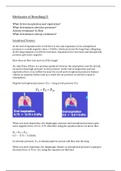
Intrapleural Pressure
At the end of expiration the recoil force is low and expansion is low, intrapleural
pressure is a small negative value (-0.5kPa), which prevents the lung from collapsing.
As the lung expands, recoil force increases, expansion force increases and intrapleural
pressure gets more negative.
How does air flow into and out of the lungs?
Air only flows if there is a pressure gradient between the atmosphere and the alveoli,
air moves from high pressure to low pressure. At the end of inspiration and end
expiration there is no airflow because the recoil and intrapleural pressures balance
(shown in equation below) and as a result, the air pressure in alveoli is equal to
atmospheric.
Negative Intrapleural pressure (PIP) = Lung recoil pressure (PR)
PR + PIP = Palv
When you start inspiration, the diaphragm contracts and intrapleural pressure gets
more negative from -0.5 to -0.75, therefore using the equation above we know that
PR + PIP = Palv,
0.5 + - 0.75 = -0.25kPa
So alveolar pressure, Palv, is subatmospheric and air will flow into the lung
When you start expiration, the diaphragm relaxes, so intrapleural pressure is going to
decrease from -0.75 to -0.5, using the equation we find that
, PR + PIP = Palv,
0.75 + - 0.5 = +0.25kPa
So alveolar pressure, Palv, is now superatmospheric, so air will flow out of the lung
Volume/ Pressure changes – As you make intrapleural pressure more negative on
breathing in, the alveolar air pressure starts to fall and air starts to move in.
Conversely as you make the intrapleural pressure less negative on breathing out, the
alveolar pressure starts to rise and air starts to move out.
Volume/ Pressure Loops
What drives inspiration and expiration?
What determines alveolar pressure?
Airway resistance to flow
What determines airway resistance?
Intrapleural Pressure
At the end of expiration the recoil force is low and expansion is low, intrapleural
pressure is a small negative value (-0.5kPa), which prevents the lung from collapsing.
As the lung expands, recoil force increases, expansion force increases and intrapleural
pressure gets more negative.
How does air flow into and out of the lungs?
Air only flows if there is a pressure gradient between the atmosphere and the alveoli,
air moves from high pressure to low pressure. At the end of inspiration and end
expiration there is no airflow because the recoil and intrapleural pressures balance
(shown in equation below) and as a result, the air pressure in alveoli is equal to
atmospheric.
Negative Intrapleural pressure (PIP) = Lung recoil pressure (PR)
PR + PIP = Palv
When you start inspiration, the diaphragm contracts and intrapleural pressure gets
more negative from -0.5 to -0.75, therefore using the equation above we know that
PR + PIP = Palv,
0.5 + - 0.75 = -0.25kPa
So alveolar pressure, Palv, is subatmospheric and air will flow into the lung
When you start expiration, the diaphragm relaxes, so intrapleural pressure is going to
decrease from -0.75 to -0.5, using the equation we find that
, PR + PIP = Palv,
0.75 + - 0.5 = +0.25kPa
So alveolar pressure, Palv, is now superatmospheric, so air will flow out of the lung
Volume/ Pressure changes – As you make intrapleural pressure more negative on
breathing in, the alveolar air pressure starts to fall and air starts to move in.
Conversely as you make the intrapleural pressure less negative on breathing out, the
alveolar pressure starts to rise and air starts to move out.
Volume/ Pressure Loops