
Chapter 1- Country and
population
Geographical location
Located on Iberian Peninsula
Capital: Madrid
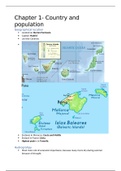
Las Islas Canarias:
Las Islas Baleares:
Enclaves in Morocco: Ceuta and Melilla
Enclave in France: Llívia.
Highest peak is in Tenerife.
Hydrograhpy
Most rivers not of economic importance, because many rivers dry during summer
because of drought.
, Most important rivers (río): El Duero, el Tajo, La Guadiana, el Guadalquivir, el Ebro,
la Segura and el Júcar.
Galicia characterized by rías altas(higher fjords) and rías bajas (smaller fjords). The
small rivers going into the country.
Mountain ranges
Most of Spain consist of elevation.
Highest mountains
1. Los Pirineos
2. La cordillera Cantábrica
3. El Sistema Iberico
4. El Sistema Central
Madrid surrounded by mountains
5. Sistemas Beticos includes Sierra Nevada.
Consequences of mountainous Spain:
Areas were isolated because of the mountains and hard to reach, because roads
went around mountains.
, Changed when Spain joined EU and got more money to improve infrastructure, which
was needed to improve trading relations.
Climate
Climate zones:
1. Atlantic Sea Climate: Soft summers, soft winters. Quite some rain, like in NL.
North-western coast of Spain.
2. Mediterranean country climate: hot summers, cold winters.
Centre of Spain
3. Mediterranean Sea climate: hot summers and soft winters. The more inwards you
go, the colder the winters get.
Along Mediterranean Coast.
4. Subtropical climate: summer and winter same
Canary Islands
5. Dry
Southeast
6. Mountainous areas are of course colder.
, Population
47 million inhabitants
Birth rate high during Franco regime. Wanted Spain to be unified, so Christianity was
state religion. Characteristic of catholic: have a lot of children, so you get as many
Catholics as possible.
Birth rate is low at moment.
Population very unequally divided: more people near coasts, Madrid, Basque
country and Catalunia (industry). Mountainous areas are not highly populated.
- Job opportunities
- Natural circumstances
Migration is high to Murcia, Madrid, Balearic Islands and whole East, but West is
losing population.
Languages
Many regions which have been isolated for long time, so developed own language.
Franco wanted unity (people only allowed to speak Castellano) but before that
there was long period of fragmentation.
Castellano= Spanish. Spoken by 473 million people in 23 countries.
4 official languages:
- El castellano (Castilian)
- El catalán (Catalan
- El gallego (Galicia)
- El vasco o euskera (Basque)
Dialects:
- Andalusian
- Aragonese
Religion
Decrease in believers
Roman Catholic most important (because of Franco).
The religious customs and fiestas are also celebrated by non-believers.
Religious feasts:
- Fiestas: Religious festivities like Semana Santa (Holy week)
- Feria: Feast (market)
- Romería: Pilgrimages (travel) people do to a chapel for example. Camino de
Santiage.
Camino de Santiago
population
Geographical location
Located on Iberian Peninsula
Capital: Madrid
Las Islas Canarias:
Las Islas Baleares:
Enclaves in Morocco: Ceuta and Melilla
Enclave in France: Llívia.
Highest peak is in Tenerife.
Hydrograhpy
Most rivers not of economic importance, because many rivers dry during summer
because of drought.
, Most important rivers (río): El Duero, el Tajo, La Guadiana, el Guadalquivir, el Ebro,
la Segura and el Júcar.
Galicia characterized by rías altas(higher fjords) and rías bajas (smaller fjords). The
small rivers going into the country.
Mountain ranges
Most of Spain consist of elevation.
Highest mountains
1. Los Pirineos
2. La cordillera Cantábrica
3. El Sistema Iberico
4. El Sistema Central
Madrid surrounded by mountains
5. Sistemas Beticos includes Sierra Nevada.
Consequences of mountainous Spain:
Areas were isolated because of the mountains and hard to reach, because roads
went around mountains.
, Changed when Spain joined EU and got more money to improve infrastructure, which
was needed to improve trading relations.
Climate
Climate zones:
1. Atlantic Sea Climate: Soft summers, soft winters. Quite some rain, like in NL.
North-western coast of Spain.
2. Mediterranean country climate: hot summers, cold winters.
Centre of Spain
3. Mediterranean Sea climate: hot summers and soft winters. The more inwards you
go, the colder the winters get.
Along Mediterranean Coast.
4. Subtropical climate: summer and winter same
Canary Islands
5. Dry
Southeast
6. Mountainous areas are of course colder.
, Population
47 million inhabitants
Birth rate high during Franco regime. Wanted Spain to be unified, so Christianity was
state religion. Characteristic of catholic: have a lot of children, so you get as many
Catholics as possible.
Birth rate is low at moment.
Population very unequally divided: more people near coasts, Madrid, Basque
country and Catalunia (industry). Mountainous areas are not highly populated.
- Job opportunities
- Natural circumstances
Migration is high to Murcia, Madrid, Balearic Islands and whole East, but West is
losing population.
Languages
Many regions which have been isolated for long time, so developed own language.
Franco wanted unity (people only allowed to speak Castellano) but before that
there was long period of fragmentation.
Castellano= Spanish. Spoken by 473 million people in 23 countries.
4 official languages:
- El castellano (Castilian)
- El catalán (Catalan
- El gallego (Galicia)
- El vasco o euskera (Basque)
Dialects:
- Andalusian
- Aragonese
Religion
Decrease in believers
Roman Catholic most important (because of Franco).
The religious customs and fiestas are also celebrated by non-believers.
Religious feasts:
- Fiestas: Religious festivities like Semana Santa (Holy week)
- Feria: Feast (market)
- Romería: Pilgrimages (travel) people do to a chapel for example. Camino de
Santiage.
Camino de Santiago



