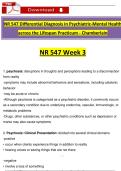
NR 547 Differential Diagnosis in Psychiatric-Mental Health
across the Lifespan Practicum - Chamberlain
NR 547 Week 3
1. psychosis: disruptions in thoughts and perceptions leading to a disconnection
from reality
-symptoms may include abnormal behaviors and sensations, including catatonic
behavior
-may be acute or chronic
-Although psychosis is categorized as a psychiatric disorder, it commonly occurs
as a secondary condition due to underlying endocrine, vascular, immunologic, or
metabolic problems
-Drugs, other substances, or other psychiatric conditions such as depression or
mania may also cause symptoms
2. Psychosis: Clinical Presentation: divided into several clinical domains
-positive
• occur when clients experience things in addition to reality
• hearing voices or seeing things that are not there
-negative
• involve a loss of something
,-affective
• the client's feelings and emotions
-motor
• may include abnormalities in gait, balance, and coordination, irregular muscle
contractions, or tremors
3. Psychosis: Positive Symptoms: Hallucinations
Delusions
Thought disorder
Hostility
Excitability
4. Psychosis: Motor Symptoms: Motor delay
Dyscoordination
EPS
-Parkinsonism
-Dyskinesia
,5. Psychosis: Affective Symptoms: Depression
Anxiety
Suicidality
6. Psychosis: Cognition symptoms: Attention
Working memory
Verbal memory
Visual memory
Executive functioning
Processing speed
Social conditioning
7. Psychosis: Negative Symptoms: Affective flattening
Alogia
Anhedonia
Amotivation
Asociality
8. Hallucinations:: perceptual experiences in the absence of external stimuli
-Auditory
• may include command hallucinations
-Visual
-Tactile: feeling sensations in the body in the absence of stimuli
-Olfactory: smelling things that are not there
-Gustatory: tasting things that are not there
9. Delusions:: fixed false, irrational beliefs
-persecution: delusions r/t being threatened, victimized, or spied on
, -grandeur: delusions r/t beliefs of special abilities or powers
-control: delusions that actions & thoughts are controlled by others
10. Symptoms of Psychosis: Thought Disorder: impairment in the process of
thinking and difficulty organizing thoughts in a logical pattern.
-incoherent speech
-loose associations
-meaningless words
-perseveration
11. Symptoms of Psychosis: Disorganized Behavior: disordered or impaired
behavior or communication
-childlike silliness
-unpredictable agitation
-inappropriate clothing for the weather
-poor hygiene
12. schizophrenia is a diagnosis commonly associated with : psy-
chosis
13. psychosis neurobiological factors: genetics: -Many genes play a role in the
likelihood that an individual will develop schizophrenia as do epigenetic factors
• Heritability for schizophrenia may be as high as 79%
• links gene-environment interaction to the diagnosis of schizophrenia
14. psychosis neurobiological factors: Environmental Triggers: Regular
Cannabis Use
Exposure to Early Life Trauma
across the Lifespan Practicum - Chamberlain
NR 547 Week 3
1. psychosis: disruptions in thoughts and perceptions leading to a disconnection
from reality
-symptoms may include abnormal behaviors and sensations, including catatonic
behavior
-may be acute or chronic
-Although psychosis is categorized as a psychiatric disorder, it commonly occurs
as a secondary condition due to underlying endocrine, vascular, immunologic, or
metabolic problems
-Drugs, other substances, or other psychiatric conditions such as depression or
mania may also cause symptoms
2. Psychosis: Clinical Presentation: divided into several clinical domains
-positive
• occur when clients experience things in addition to reality
• hearing voices or seeing things that are not there
-negative
• involve a loss of something
,-affective
• the client's feelings and emotions
-motor
• may include abnormalities in gait, balance, and coordination, irregular muscle
contractions, or tremors
3. Psychosis: Positive Symptoms: Hallucinations
Delusions
Thought disorder
Hostility
Excitability
4. Psychosis: Motor Symptoms: Motor delay
Dyscoordination
EPS
-Parkinsonism
-Dyskinesia
,5. Psychosis: Affective Symptoms: Depression
Anxiety
Suicidality
6. Psychosis: Cognition symptoms: Attention
Working memory
Verbal memory
Visual memory
Executive functioning
Processing speed
Social conditioning
7. Psychosis: Negative Symptoms: Affective flattening
Alogia
Anhedonia
Amotivation
Asociality
8. Hallucinations:: perceptual experiences in the absence of external stimuli
-Auditory
• may include command hallucinations
-Visual
-Tactile: feeling sensations in the body in the absence of stimuli
-Olfactory: smelling things that are not there
-Gustatory: tasting things that are not there
9. Delusions:: fixed false, irrational beliefs
-persecution: delusions r/t being threatened, victimized, or spied on
, -grandeur: delusions r/t beliefs of special abilities or powers
-control: delusions that actions & thoughts are controlled by others
10. Symptoms of Psychosis: Thought Disorder: impairment in the process of
thinking and difficulty organizing thoughts in a logical pattern.
-incoherent speech
-loose associations
-meaningless words
-perseveration
11. Symptoms of Psychosis: Disorganized Behavior: disordered or impaired
behavior or communication
-childlike silliness
-unpredictable agitation
-inappropriate clothing for the weather
-poor hygiene
12. schizophrenia is a diagnosis commonly associated with : psy-
chosis
13. psychosis neurobiological factors: genetics: -Many genes play a role in the
likelihood that an individual will develop schizophrenia as do epigenetic factors
• Heritability for schizophrenia may be as high as 79%
• links gene-environment interaction to the diagnosis of schizophrenia
14. psychosis neurobiological factors: Environmental Triggers: Regular
Cannabis Use
Exposure to Early Life Trauma