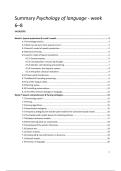
Summary Psychology of language - week
6–8
24/10/2025
Week 6: Speech production & Levelt’s model........................................................................................3
6.1 Terminology week 6................................................................................................................... 3
6.2 What can we learn from speech errors?.................................................................................... 4
6.3 Garrett’s model of speech production....................................................................................... 5
6.4 Retrieval of words...................................................................................................................... 6
6.5 Levelt’s model of speech production......................................................................................... 6
6.5.1 General aspects................................................................................................................ 6
6.5.2 Conceptualizer: structuring thought.................................................................................7
6.5.3 Monitor: self-checking and stuttering.............................................................................. 7
6.5.4 Formulator: the linguistic system..................................................................................... 8
6.5.5 Articulator: physical realization........................................................................................ 9
6.6 Picture-word interference..........................................................................................................9
6.7 Feedback & Cascading processing..............................................................................................9
6.8 Tip-of-the-Tongue states.......................................................................................................... 11
6.9 Planning syntax........................................................................................................................ 11
6.10 Controlling conversations.......................................................................................................12
6.11 The effect of brain damage on language................................................................................12
Week 7: Speech comprehension & Parsing strategies.......................................................................... 13
7.1 Terminology week 7................................................................................................................. 13
7.2 Parsing......................................................................................................................................15
7.3 Parsing algorithms....................................................................................................................15
7.4 Grammatical ambiguity............................................................................................................15
7.5 Temporary ambiguity, the Garden-path model & the Constraint-based model.......................16
7.6 The Garden-path model: biases for attaching phrases............................................................ 16
7.7 Multiple constraints models.................................................................................................... 17
7.8 Remembering what we understand.........................................................................................18
7.9 Going beyond the words: inferences....................................................................................... 18
7.10 Speech acts............................................................................................................................ 18
7.11 Grice’s maxims....................................................................................................................... 19
7.12 Linking old & new information in discourse...........................................................................19
7.13 Mental models....................................................................................................................... 20
7.14 Humour in language...............................................................................................................20
1
, 7.15 Levelt’s model and speech comprehension........................................................................... 21
7.16 Phonological development and challenges............................................................................22
Week 8: Abnormal development: Williams Syndrome, SLI, Dyslexia & Linguistic savants.....................23
8.1 Terminology week 8................................................................................................................. 23
8.2 Thought & Inner speech...........................................................................................................24
8.3 Is language development dependent on cognitive development?.......................................... 24
8.4 The cognition hypothesis......................................................................................................... 25
8.5 Is language development dependent on social development?............................................... 26
8.6 Modularity of language............................................................................................................26
8.7 The Sapir-Whorf hypothesis.....................................................................................................26
8.7.1 Color-naming.................................................................................................................. 27
8.7.2 Influence of language on memory and reasoning.......................................................... 27
8.8 Practical consequences of the way we use language...............................................................28
8.9 Are we forced to think in categories?...................................................................................... 28
8.10 The modularity of the mind: comparing Down Syndrome and Williams Syndrome..............29
8.10.1 Down Syndrome........................................................................................................... 29
8.10.2 Williams Syndrome.......................................................................................................29
8.11 The modularity of the mind: comparing SLI (DLD) and developmental dyslexia................... 30
8.11.1 Specific Language Impairment..................................................................................... 30
8.11.2 Dyslexia.........................................................................................................................31
8.12 Linguistic savants................................................................................................................... 33
2
, Week 6: Speech production & Levelt’s model
6.1 Terminology week 6
1. Speech error: An error in the spoken output
2. Exchange: A speech error in which two words (or phonemes) are used in place of each other
3. Planning: The process of planning the spoken output.
4. Intrusion: A speech error caused by the intrusion of a word, sound or thought
5. Freudian slip: A speech error that supposedly reflects suppressed intentions, feelings or
thoughts.
6. Frame-slot model: The idea that sentence production starts by constructing a frame in which the
relevant lexemes are inserted.
7. Lemma: A level of representation of a word between its semantic and phonological
representations; it is syntactically specified, but does not yet contain sound-level information; it
is the intermediate stage of two-stage models of lexicalisation
8. Lexeme: The phonological word-form, in a format where sounds are represented
9. Articulatory features (place, manner, voice): Criteria used to characterize sounds based on the
place and manner of articulation in the vocal tract and presence or absence of vibration of the
vocal cords
10.Picture-word interference task: The influence caused by a picture when a subject is asked to
determine if a sound presented auditorily is an existing word.
11.Stuttering: A disease affecting fluent speech, characterized by retracings, prolongations and
blocks.
12.Blocks, prolongation, retracing: Different instances of speech errors commonly associated with
stuttering
13.Dual task: A task in which subject need to carry out a primary task (for instance naming an
object) while also carrying out a secondary task.
14.Levelt’s model: A model of the processes that take place in preparation to language production
15.D-structure: The structure that is used when incorporating words directly from the lexicon.
16.S-structure: The structure that results from the application of movement operations.
17.Cascading processing: A type of processing where information can flow from one level of
processing to the next before the first has finished processing; contrast with discrete stage
model.
○ example: interaction between understanding of sounds and understanding of words →
when understanding sounds, certain word concepts get activated already
18.Feedback: The idea that steps and processes to be executed later can have an influence on
earlier processes.
19.Lexical bias (familiarity effect): The phenomenon by which speech errors tend to result in the
production of a wrong existing word rather than of a non-existing word.
3
, 20.Similarity bias: The phenomenon by which the word produced as a result of a speech error
typically show phonological or semantic similarity with the intended word.
21.Mediated priming: “(Facilitatory) priming through a semantic intermediary (e.g. “lion” to “tiger”
to “stripes”) → cascading processing
22.Tip-of-the-tongue phenomena: When you know that you know a word, but you cannot
immediately retrieve it (although you might know its first sound, or how many syllables it has).
→ lemma is retrieved, but not the lexeme
23.Incremental processing: The attempt to analyze the linguistic stimulus bit by bit, not in its
entirety
24.Syntactic priming (persistence): Priming, usually facilitatory, obtained by the prior presentation
of a specific syntactic structure.
25.Attraction error: A speech error in which the incorrect inflection is used because of intervening
material (e.g., The key to the cabinets are on the table)
26.Back-channel communication: A confirmation of listening, attested for instance by the use of
expressions like “uhuh” or “yeah”
6.2 What can we learn from speech errors?
Speech errors tell us a lot about speech production – especially slips of the tongue.
Example: A maniac for weekends instead of A weekend for maniacs.
→ the words have been exchanged, but not the inflection, and the pronunciation of -s in maniacs differs
from that of -s in weekends
→ speech-production model: speech involves 2 processes:
1. Retrieving words;
2. Constructing a frame into which the words can be inserted.
Observations:
● The words and their plural endings can become easily divorced.
● The plural ending cannot be spelled out in phonetic detail before the specific word is inserted,
because otherwise the plural ending would not accommodate its sound to the sound of the
word that ends up in the slot. → abstract form « plural »
Classification of speech errors:
● Units: individual sounds (phonemes and features of phonemes), syllables, morphemes, words &
phrases
● Mechanisms: deletion, addition, substitution & exchange (spoonerisms, in the case of sounds),
● Direction: anticipation (moving sounds closer to the beginning of the utterance → I [v]eel very
full) & perseveration (lingering of sounds → I’m suspicious of people who wear base[p]all hats
on TV - “[p]eople”)
This is just a classification framework, in order to provide an explanation, we have to look at the
activation of the involved words.
4
6–8
24/10/2025
Week 6: Speech production & Levelt’s model........................................................................................3
6.1 Terminology week 6................................................................................................................... 3
6.2 What can we learn from speech errors?.................................................................................... 4
6.3 Garrett’s model of speech production....................................................................................... 5
6.4 Retrieval of words...................................................................................................................... 6
6.5 Levelt’s model of speech production......................................................................................... 6
6.5.1 General aspects................................................................................................................ 6
6.5.2 Conceptualizer: structuring thought.................................................................................7
6.5.3 Monitor: self-checking and stuttering.............................................................................. 7
6.5.4 Formulator: the linguistic system..................................................................................... 8
6.5.5 Articulator: physical realization........................................................................................ 9
6.6 Picture-word interference..........................................................................................................9
6.7 Feedback & Cascading processing..............................................................................................9
6.8 Tip-of-the-Tongue states.......................................................................................................... 11
6.9 Planning syntax........................................................................................................................ 11
6.10 Controlling conversations.......................................................................................................12
6.11 The effect of brain damage on language................................................................................12
Week 7: Speech comprehension & Parsing strategies.......................................................................... 13
7.1 Terminology week 7................................................................................................................. 13
7.2 Parsing......................................................................................................................................15
7.3 Parsing algorithms....................................................................................................................15
7.4 Grammatical ambiguity............................................................................................................15
7.5 Temporary ambiguity, the Garden-path model & the Constraint-based model.......................16
7.6 The Garden-path model: biases for attaching phrases............................................................ 16
7.7 Multiple constraints models.................................................................................................... 17
7.8 Remembering what we understand.........................................................................................18
7.9 Going beyond the words: inferences....................................................................................... 18
7.10 Speech acts............................................................................................................................ 18
7.11 Grice’s maxims....................................................................................................................... 19
7.12 Linking old & new information in discourse...........................................................................19
7.13 Mental models....................................................................................................................... 20
7.14 Humour in language...............................................................................................................20
1
, 7.15 Levelt’s model and speech comprehension........................................................................... 21
7.16 Phonological development and challenges............................................................................22
Week 8: Abnormal development: Williams Syndrome, SLI, Dyslexia & Linguistic savants.....................23
8.1 Terminology week 8................................................................................................................. 23
8.2 Thought & Inner speech...........................................................................................................24
8.3 Is language development dependent on cognitive development?.......................................... 24
8.4 The cognition hypothesis......................................................................................................... 25
8.5 Is language development dependent on social development?............................................... 26
8.6 Modularity of language............................................................................................................26
8.7 The Sapir-Whorf hypothesis.....................................................................................................26
8.7.1 Color-naming.................................................................................................................. 27
8.7.2 Influence of language on memory and reasoning.......................................................... 27
8.8 Practical consequences of the way we use language...............................................................28
8.9 Are we forced to think in categories?...................................................................................... 28
8.10 The modularity of the mind: comparing Down Syndrome and Williams Syndrome..............29
8.10.1 Down Syndrome........................................................................................................... 29
8.10.2 Williams Syndrome.......................................................................................................29
8.11 The modularity of the mind: comparing SLI (DLD) and developmental dyslexia................... 30
8.11.1 Specific Language Impairment..................................................................................... 30
8.11.2 Dyslexia.........................................................................................................................31
8.12 Linguistic savants................................................................................................................... 33
2
, Week 6: Speech production & Levelt’s model
6.1 Terminology week 6
1. Speech error: An error in the spoken output
2. Exchange: A speech error in which two words (or phonemes) are used in place of each other
3. Planning: The process of planning the spoken output.
4. Intrusion: A speech error caused by the intrusion of a word, sound or thought
5. Freudian slip: A speech error that supposedly reflects suppressed intentions, feelings or
thoughts.
6. Frame-slot model: The idea that sentence production starts by constructing a frame in which the
relevant lexemes are inserted.
7. Lemma: A level of representation of a word between its semantic and phonological
representations; it is syntactically specified, but does not yet contain sound-level information; it
is the intermediate stage of two-stage models of lexicalisation
8. Lexeme: The phonological word-form, in a format where sounds are represented
9. Articulatory features (place, manner, voice): Criteria used to characterize sounds based on the
place and manner of articulation in the vocal tract and presence or absence of vibration of the
vocal cords
10.Picture-word interference task: The influence caused by a picture when a subject is asked to
determine if a sound presented auditorily is an existing word.
11.Stuttering: A disease affecting fluent speech, characterized by retracings, prolongations and
blocks.
12.Blocks, prolongation, retracing: Different instances of speech errors commonly associated with
stuttering
13.Dual task: A task in which subject need to carry out a primary task (for instance naming an
object) while also carrying out a secondary task.
14.Levelt’s model: A model of the processes that take place in preparation to language production
15.D-structure: The structure that is used when incorporating words directly from the lexicon.
16.S-structure: The structure that results from the application of movement operations.
17.Cascading processing: A type of processing where information can flow from one level of
processing to the next before the first has finished processing; contrast with discrete stage
model.
○ example: interaction between understanding of sounds and understanding of words →
when understanding sounds, certain word concepts get activated already
18.Feedback: The idea that steps and processes to be executed later can have an influence on
earlier processes.
19.Lexical bias (familiarity effect): The phenomenon by which speech errors tend to result in the
production of a wrong existing word rather than of a non-existing word.
3
, 20.Similarity bias: The phenomenon by which the word produced as a result of a speech error
typically show phonological or semantic similarity with the intended word.
21.Mediated priming: “(Facilitatory) priming through a semantic intermediary (e.g. “lion” to “tiger”
to “stripes”) → cascading processing
22.Tip-of-the-tongue phenomena: When you know that you know a word, but you cannot
immediately retrieve it (although you might know its first sound, or how many syllables it has).
→ lemma is retrieved, but not the lexeme
23.Incremental processing: The attempt to analyze the linguistic stimulus bit by bit, not in its
entirety
24.Syntactic priming (persistence): Priming, usually facilitatory, obtained by the prior presentation
of a specific syntactic structure.
25.Attraction error: A speech error in which the incorrect inflection is used because of intervening
material (e.g., The key to the cabinets are on the table)
26.Back-channel communication: A confirmation of listening, attested for instance by the use of
expressions like “uhuh” or “yeah”
6.2 What can we learn from speech errors?
Speech errors tell us a lot about speech production – especially slips of the tongue.
Example: A maniac for weekends instead of A weekend for maniacs.
→ the words have been exchanged, but not the inflection, and the pronunciation of -s in maniacs differs
from that of -s in weekends
→ speech-production model: speech involves 2 processes:
1. Retrieving words;
2. Constructing a frame into which the words can be inserted.
Observations:
● The words and their plural endings can become easily divorced.
● The plural ending cannot be spelled out in phonetic detail before the specific word is inserted,
because otherwise the plural ending would not accommodate its sound to the sound of the
word that ends up in the slot. → abstract form « plural »
Classification of speech errors:
● Units: individual sounds (phonemes and features of phonemes), syllables, morphemes, words &
phrases
● Mechanisms: deletion, addition, substitution & exchange (spoonerisms, in the case of sounds),
● Direction: anticipation (moving sounds closer to the beginning of the utterance → I [v]eel very
full) & perseveration (lingering of sounds → I’m suspicious of people who wear base[p]all hats
on TV - “[p]eople”)
This is just a classification framework, in order to provide an explanation, we have to look at the
activation of the involved words.
4