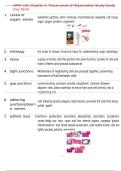
APHY 101 Chapter 4: Tissue Level of Organization Study Guide
(Ivy Tech)
1. Levels of
Subatomic particles, atom, molecule, macromolecule, organelle, cell, tissue,
organi- zation
organ, organ system, organism
2. histology the study of tissues; structural basis for understanding organ physiology
3. tissue a group of similar cells that perform the same function; consists of cells and
matrix (fibers and ground substance)
4. tight junctions Membranes of neighboring cells are pressed together, preventing
movement of fluid between cells
5. gap junctions (communicating junctions) provide cytoplasmic channels between
adjacent cells; allow materials to move from one cell directly into a
neighboring cell
6. adhering cells linked by protein plaques; resist tension; prevents the cells from being
junctions/desm pulled apart
o- somes
7. epithelial tissue function= protection, excretion, absorption, secretion. Location=
cover body sur- face, cover and line internal organs, compose glands.
characteristics= lack blood vessels (avascular), cells readily divide, cells are
tightly packed, polarity, innervated
, APHY 101 Chapter 4: Tissue Level of Organization Study Guide
(Ivy Tech)
8. connective tissue
, APHY 101 Chapter 4: Tissue Level of Organization Study Guide
(Ivy Tech)
function= bind, support, protect, fill spaces, store fat, and produce blood cells. location= widely
distributed throughout the body. characteristics= good blood supply,
cells are farther apart, have extracellular matrix in between
9. muscle tissue function= movement. location= attached to bones, in the walls of
hollow internal organs, heart. characteristics= contract in response
to stimuli
10. nervous tissue function= conduct impulses for coordination, regulation, integration,
and sensory reception. location= brain, spinal cord, nerves.
characteristics= communicate with each other and other body parts
11. basement anchors epithelium to underlying connective tissue
mem- brane
of epithe- lial
tissues
12. simple a single layer of cells
(Ivy Tech)
1. Levels of
Subatomic particles, atom, molecule, macromolecule, organelle, cell, tissue,
organi- zation
organ, organ system, organism
2. histology the study of tissues; structural basis for understanding organ physiology
3. tissue a group of similar cells that perform the same function; consists of cells and
matrix (fibers and ground substance)
4. tight junctions Membranes of neighboring cells are pressed together, preventing
movement of fluid between cells
5. gap junctions (communicating junctions) provide cytoplasmic channels between
adjacent cells; allow materials to move from one cell directly into a
neighboring cell
6. adhering cells linked by protein plaques; resist tension; prevents the cells from being
junctions/desm pulled apart
o- somes
7. epithelial tissue function= protection, excretion, absorption, secretion. Location=
cover body sur- face, cover and line internal organs, compose glands.
characteristics= lack blood vessels (avascular), cells readily divide, cells are
tightly packed, polarity, innervated
, APHY 101 Chapter 4: Tissue Level of Organization Study Guide
(Ivy Tech)
8. connective tissue
, APHY 101 Chapter 4: Tissue Level of Organization Study Guide
(Ivy Tech)
function= bind, support, protect, fill spaces, store fat, and produce blood cells. location= widely
distributed throughout the body. characteristics= good blood supply,
cells are farther apart, have extracellular matrix in between
9. muscle tissue function= movement. location= attached to bones, in the walls of
hollow internal organs, heart. characteristics= contract in response
to stimuli
10. nervous tissue function= conduct impulses for coordination, regulation, integration,
and sensory reception. location= brain, spinal cord, nerves.
characteristics= communicate with each other and other body parts
11. basement anchors epithelium to underlying connective tissue
mem- brane
of epithe- lial
tissues
12. simple a single layer of cells