Objective Assessment:Learners and Learning
Science study guide(2025/2026 VERIFIED
100%A+
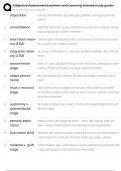
1. acquisition: learning new information by actively paying attention
and engaging with the material
2. consolidation: organizing and reinforcing new information by
connecting it to what you already know and practicing it to better
remember it
3. short-term memory (STM): a mental space that temporarily
holds a small amount of information for a short time, usually a few
seconds to a minute
4. long-term memory (LTM): the storage of information for a
long time, including knowledge, skills, and experiences
5. sensorimotor stage: infants (0-2 years old) explore through
senses and actions, developing an under- standing of object
permanence and laying cognitive foundations
6. object permanence: the understanding that something still exists
even though it cannot be seen or heard
7. trust v. mistrust stage: infants learn to rely on caregivers for
their basic needs, fostering trust while inconsistency in meeting
these needs can lead to mistrust, suspicion, and anxiety about their
environment
8. autonomy v. shame/doubt stage: the shame and doubt
stage involves a child's journey toward independence and
decision-making
9. sensory exploration: involves activities that engage the
senses—touch, sight, hearing, smell, and taste—helping
children explore and understand the world around them
10. fine motor skills: fine motor skills involve tiny muscles working
1/9
, with the brain and nervous system to control movements in areas like
the hands, fingers, lips, tongue, and eyes
11. initiative v. guilt stage: children between ages 3 and 6 display
increased assertiveness by taking the lead in play and engaging in
social interactions more actively
12. preoperational stage: children between the ages of 2 and 7
years old think symbolically, using symbols to represent words,
objects, images, individuals, and concepts, enabling the capacity to mimic
behavior through imitation
13. egocentric: demonstrating a cognitive inclination where
individuals find it challenging to acknowledge per- spectives beyond
their own
14. scaffolding: when the teacher breaks down complex concepts
into small, more manageable steps helping children along the way
15. conservation: understanding that certain physical attributes of
objects—such as quantity, mass, volume, and number—remain
constant even when their appearance or arrangement changes
16. industry v. inferiority stage: children between the
ages 5 and 12 develop a growing sense of competence and
accomplishment as they develop a greater understanding of their
capabilities and limitations
17. concrete operational stage: in children between ages 7
and 11, thinking becomes more logical, organized, and
systematic
2/9
Science study guide(2025/2026 VERIFIED
100%A+
1. acquisition: learning new information by actively paying attention
and engaging with the material
2. consolidation: organizing and reinforcing new information by
connecting it to what you already know and practicing it to better
remember it
3. short-term memory (STM): a mental space that temporarily
holds a small amount of information for a short time, usually a few
seconds to a minute
4. long-term memory (LTM): the storage of information for a
long time, including knowledge, skills, and experiences
5. sensorimotor stage: infants (0-2 years old) explore through
senses and actions, developing an under- standing of object
permanence and laying cognitive foundations
6. object permanence: the understanding that something still exists
even though it cannot be seen or heard
7. trust v. mistrust stage: infants learn to rely on caregivers for
their basic needs, fostering trust while inconsistency in meeting
these needs can lead to mistrust, suspicion, and anxiety about their
environment
8. autonomy v. shame/doubt stage: the shame and doubt
stage involves a child's journey toward independence and
decision-making
9. sensory exploration: involves activities that engage the
senses—touch, sight, hearing, smell, and taste—helping
children explore and understand the world around them
10. fine motor skills: fine motor skills involve tiny muscles working
1/9
, with the brain and nervous system to control movements in areas like
the hands, fingers, lips, tongue, and eyes
11. initiative v. guilt stage: children between ages 3 and 6 display
increased assertiveness by taking the lead in play and engaging in
social interactions more actively
12. preoperational stage: children between the ages of 2 and 7
years old think symbolically, using symbols to represent words,
objects, images, individuals, and concepts, enabling the capacity to mimic
behavior through imitation
13. egocentric: demonstrating a cognitive inclination where
individuals find it challenging to acknowledge per- spectives beyond
their own
14. scaffolding: when the teacher breaks down complex concepts
into small, more manageable steps helping children along the way
15. conservation: understanding that certain physical attributes of
objects—such as quantity, mass, volume, and number—remain
constant even when their appearance or arrangement changes
16. industry v. inferiority stage: children between the
ages 5 and 12 develop a growing sense of competence and
accomplishment as they develop a greater understanding of their
capabilities and limitations
17. concrete operational stage: in children between ages 7
and 11, thinking becomes more logical, organized, and
systematic
2/9