ADVANCED PATHOPHYSIOLOGY UTMB 5355
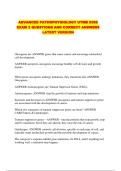
EXAM 2 QUESTIONS AND CORRECT ANSWERS
LATEST VERSION
Oncogenes are ANSWER genes that cause cancer and encourage unchecked
cell development.
ANSWER and proto-oncogenes encourage healthy cell division and growth
factors.
When proto-oncogenes undergo mutations, they transform into ANSWER
Oncogenes.
ANSWER Antioncogenes are Tumour Supressor Genes (TSGs).
Antioncogenes: ANSWER stop the growth of tumours and stop mutations
Increases and decreases in ANSWER oncogenes and tumour suppressor genes
are associated with the development of cancer.
Which two categories of tumour suppressor genes are there? ANSWER
CARETAkers & Gatekeepers
Tumour suppressor genes—ANSWER—encode proteins that stop growth, stop
and fix mutations, but if they are altered, they raise the risk of cancer.
Gatekeeper: ANSWER controls cell division, specific to each type of cell, and
typically stops unchecked growth and the possible development of cancer.
The caregiver's response inhibit gene mutations, fix DNA, and if anything isn't
working well, a mutation may happen.
, How does cancer arise from persistent inflammation? ANSWER Reactive
oxygen species and free radicals are increased by inflammation, which
encourages mutation.
disrupt insulin signalling, resulting in Type 2 diabetes, obesity, and insulin
resistance under stress. ANSWER Cytokines that promote inflammation
If the TP53 gene, an ANSWER tumour suppressor gene, is mutated, cells can
divide forever and avoid apoptosis, which raises the risk of cancer.
Tumour necrosis factor is a pro-inflammatory cytokine that may be linked to
carcinogenesis.
TNF has four roles: 1) cell survival
2) proliferation of cells 3) differentiation of cells
4) Death of cells
TNF and CA therapy: ANSWER Modulation of TNF/receptors
ANSWER for tumour markers Although not utilised for diagnosis, it can be
helpful for cancer surveillance or after cancer treatments, as it is raised in some
tumours.
Both ANSWER benign and malignant cells create tumour markers, with
cancerous and noncancerous tumours exhibiting elevated quantities of these
markers.
ANSWER hormones, enzymes, genes, antigens, and antibodies are examples of
tumour markers.
ANSWER pancreatic cancer CA19-9
ANSWER ovarian cancer, CA-125
ANSWER hepatic, germ cell CA alpha-fetoprotein (AFP)
ANSWER colon cancer CEA
ANSWER Prostate CA PSA
Telomerase is an ANSWER enzyme that is involved in DNA replication.
At the end of every - - ANSWER chromosome are telomeres.
EXAM 2 QUESTIONS AND CORRECT ANSWERS
LATEST VERSION
Oncogenes are ANSWER genes that cause cancer and encourage unchecked
cell development.
ANSWER and proto-oncogenes encourage healthy cell division and growth
factors.
When proto-oncogenes undergo mutations, they transform into ANSWER
Oncogenes.
ANSWER Antioncogenes are Tumour Supressor Genes (TSGs).
Antioncogenes: ANSWER stop the growth of tumours and stop mutations
Increases and decreases in ANSWER oncogenes and tumour suppressor genes
are associated with the development of cancer.
Which two categories of tumour suppressor genes are there? ANSWER
CARETAkers & Gatekeepers
Tumour suppressor genes—ANSWER—encode proteins that stop growth, stop
and fix mutations, but if they are altered, they raise the risk of cancer.
Gatekeeper: ANSWER controls cell division, specific to each type of cell, and
typically stops unchecked growth and the possible development of cancer.
The caregiver's response inhibit gene mutations, fix DNA, and if anything isn't
working well, a mutation may happen.
, How does cancer arise from persistent inflammation? ANSWER Reactive
oxygen species and free radicals are increased by inflammation, which
encourages mutation.
disrupt insulin signalling, resulting in Type 2 diabetes, obesity, and insulin
resistance under stress. ANSWER Cytokines that promote inflammation
If the TP53 gene, an ANSWER tumour suppressor gene, is mutated, cells can
divide forever and avoid apoptosis, which raises the risk of cancer.
Tumour necrosis factor is a pro-inflammatory cytokine that may be linked to
carcinogenesis.
TNF has four roles: 1) cell survival
2) proliferation of cells 3) differentiation of cells
4) Death of cells
TNF and CA therapy: ANSWER Modulation of TNF/receptors
ANSWER for tumour markers Although not utilised for diagnosis, it can be
helpful for cancer surveillance or after cancer treatments, as it is raised in some
tumours.
Both ANSWER benign and malignant cells create tumour markers, with
cancerous and noncancerous tumours exhibiting elevated quantities of these
markers.
ANSWER hormones, enzymes, genes, antigens, and antibodies are examples of
tumour markers.
ANSWER pancreatic cancer CA19-9
ANSWER ovarian cancer, CA-125
ANSWER hepatic, germ cell CA alpha-fetoprotein (AFP)
ANSWER colon cancer CEA
ANSWER Prostate CA PSA
Telomerase is an ANSWER enzyme that is involved in DNA replication.
At the end of every - - ANSWER chromosome are telomeres.