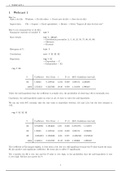
1 WEBCAST 1
1 Webcast 1
How to:
Open a do file: Windows → Do file editor → Create new do file (→ Save the do file)
Import data: File → Import → Excel spreadsheet → Browse → Select "Import all data for first row"
How to (in command line or do file):
Summarize statistics of variable Y: sum Y
More details: sum Y, detail
→ Distribution percentiles (1, 5, 10, 25, 50, 75, 90, 95, 99)
→ Skewness
→ Kurtosis
Histogram of Y: hist Y
Correlations: corr Y X1 X2 X3
Regression: reg Y X2
→ Dependent = Y
→ Independent = X2
reg Y X2:
Y Coefficient Std. Error t P>|t| [95% Confidence interval]
X2 1.92333 0.1598141 12.03 0.000 1.608174 2.236486
_cons 4.555252 0.2237262 20.36 0.000 4.114056 4.996448
Under the null hypothesis that the coefficient is actually zero, the probability of observing 1.92 is essentially zero.
Conclusion: the null hypothesis makes no sense at all, we have to reject the null hypothesis.
We can say with 95% certainty that the true value is somewhere between 1.61 and 2.24, but the best estimate is
1.92.
reg Y X1 X2 X3
Y Coefficient Std. Error t P>|t| [95% Confidence interval]
X1 0.7532983 0.1934045 3.89 0.000 0.3716773 1.134719
X2 1.92333 0.1598141 12.03 0.000 1.608174 2.236486
X3 -0.0054818 0.1930566 -0.03 0.977 -0.3862165 0.3752532
_cons 4.546544 0.2142737 21.22 0.000 4.123966 4.969122
The coefficient of X2 changes slightly, it went down a bit, but it is still significant because the P-value stayed the same.
X1 also positive and significant coefficient. X1 seems also to affect Y significantly.
The t-statistic for X3 is very low and the P-value is very high, so the probability that the null hypothesis is true
is very high. X3 does not matter for Y.
1
1 Webcast 1
How to:
Open a do file: Windows → Do file editor → Create new do file (→ Save the do file)
Import data: File → Import → Excel spreadsheet → Browse → Select "Import all data for first row"
How to (in command line or do file):
Summarize statistics of variable Y: sum Y
More details: sum Y, detail
→ Distribution percentiles (1, 5, 10, 25, 50, 75, 90, 95, 99)
→ Skewness
→ Kurtosis
Histogram of Y: hist Y
Correlations: corr Y X1 X2 X3
Regression: reg Y X2
→ Dependent = Y
→ Independent = X2
reg Y X2:
Y Coefficient Std. Error t P>|t| [95% Confidence interval]
X2 1.92333 0.1598141 12.03 0.000 1.608174 2.236486
_cons 4.555252 0.2237262 20.36 0.000 4.114056 4.996448
Under the null hypothesis that the coefficient is actually zero, the probability of observing 1.92 is essentially zero.
Conclusion: the null hypothesis makes no sense at all, we have to reject the null hypothesis.
We can say with 95% certainty that the true value is somewhere between 1.61 and 2.24, but the best estimate is
1.92.
reg Y X1 X2 X3
Y Coefficient Std. Error t P>|t| [95% Confidence interval]
X1 0.7532983 0.1934045 3.89 0.000 0.3716773 1.134719
X2 1.92333 0.1598141 12.03 0.000 1.608174 2.236486
X3 -0.0054818 0.1930566 -0.03 0.977 -0.3862165 0.3752532
_cons 4.546544 0.2142737 21.22 0.000 4.123966 4.969122
The coefficient of X2 changes slightly, it went down a bit, but it is still significant because the P-value stayed the same.
X1 also positive and significant coefficient. X1 seems also to affect Y significantly.
The t-statistic for X3 is very low and the P-value is very high, so the probability that the null hypothesis is true
is very high. X3 does not matter for Y.
1