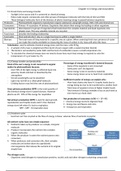
Chapter 13: Energy and ecosystems
13.1 Food chains and energy transfer
- Sunlight is the source and it’s conserved as chemical energy
- Helps make organic compounds and other groups of biological molecules with the help of CO2 and H2O
- These biological molecules form of the biomass of plants meaning energy is passed between organisms
Producers Photosynthetic organisms manufacture organic substances using light energy, H2O, CO2 and mineral ions
Consumers Primary secondary tertiary; Organisms that obtain their energy by feeding on other organisms
Saprobionts (decomposers) A group of organisms that break down the complex material and dead organisms into
simpler ones. This way valuable minerals are recycled
Food chain Describe the feeding relationship
Food webs Most animals don’t rely on a single food source within a single habitat
Biomass The total mass of living material in a specific area at a given. When assessing fresh mass presence of water
can make the results unreliable so measuring the mass of carbon or dry mass will solve this issue.
Colorimeter: used to estimate chemical energy store and dry mass; units KJ/kg
1. A sample of dry mass is weighed and then burnt of pure oxygen with a sealed chamber (bomb)
2. The bomb is surrounded by water bath and the heat of combustion causes a small temperature rise
3. To calculate the chemical energy store we need to know how much heat energy is required to raise the
temperature of 1 g of water by 1°C.
13.2 Energy transfer and productivity
Most of the sun’s energy is not converted to organic Percentage of energy transferred is lowered because:
matter by photosynthesis because: - Some of the organism is not consumed
- Over 90% of the light energy is reflected back into - Some parts can’t be digested
space by clouds and dust or absorbed by the - Some energy is lost in excretory materials
atmosphere - Some energy losses occur as heat from respiration
- Not all wavelengths can be absorbed
- Light may not fall on a chlorophyll molecule Inefficient transfer of energy can explain why:
- Limiting factors may limit the rate of photosynthesis - Most food chains only have 4-5 trophic levels due to
energy being too low to be transferred to another level
Gross primary production (GPP) is the total quantity of Total mass of organism is less at higher trophic levels
the chemical energy store in plant biomass. However - Total amount of energy available is less at each level as
plants use 20 - 50% of this energy for respiration one moves up a food chain
Net primary production (NPP) is used for plant growth, Net production of consumers is (N) = I – ( F + R )
reproduction and trophic levels and it’s the chemical I – chemical energy stored in digested food
energy store left when it’s lost to respiration: F – Energy loss and faeces and urine
NPP = GPP – R (respiration loss) R – Energy loss and respiration
13.3 Nutrient cycles
- Heat lost can’t be recycled so the flow of energy is linear, whereas flow of nutrients is psychic
All nutrient cycles have one simple sequence:
1. Nutrients taken up by producer as a simple, inorganic
molecule
2. Producer incorporates the nutrient into complex
organic molecules
3. When the producer is eaten the nutrient passes onto
consumers
4. When producers and consumers die, their complex
molecules are broken down by saprobiontic
microorganisms that release the nutrient in its original
simple form
The nitrogen cycle:
- Organisms need nitrogen to manufacture proteins, nucleic acid and other nitrogen-containing compounds
13.1 Food chains and energy transfer
- Sunlight is the source and it’s conserved as chemical energy
- Helps make organic compounds and other groups of biological molecules with the help of CO2 and H2O
- These biological molecules form of the biomass of plants meaning energy is passed between organisms
Producers Photosynthetic organisms manufacture organic substances using light energy, H2O, CO2 and mineral ions
Consumers Primary secondary tertiary; Organisms that obtain their energy by feeding on other organisms
Saprobionts (decomposers) A group of organisms that break down the complex material and dead organisms into
simpler ones. This way valuable minerals are recycled
Food chain Describe the feeding relationship
Food webs Most animals don’t rely on a single food source within a single habitat
Biomass The total mass of living material in a specific area at a given. When assessing fresh mass presence of water
can make the results unreliable so measuring the mass of carbon or dry mass will solve this issue.
Colorimeter: used to estimate chemical energy store and dry mass; units KJ/kg
1. A sample of dry mass is weighed and then burnt of pure oxygen with a sealed chamber (bomb)
2. The bomb is surrounded by water bath and the heat of combustion causes a small temperature rise
3. To calculate the chemical energy store we need to know how much heat energy is required to raise the
temperature of 1 g of water by 1°C.
13.2 Energy transfer and productivity
Most of the sun’s energy is not converted to organic Percentage of energy transferred is lowered because:
matter by photosynthesis because: - Some of the organism is not consumed
- Over 90% of the light energy is reflected back into - Some parts can’t be digested
space by clouds and dust or absorbed by the - Some energy is lost in excretory materials
atmosphere - Some energy losses occur as heat from respiration
- Not all wavelengths can be absorbed
- Light may not fall on a chlorophyll molecule Inefficient transfer of energy can explain why:
- Limiting factors may limit the rate of photosynthesis - Most food chains only have 4-5 trophic levels due to
energy being too low to be transferred to another level
Gross primary production (GPP) is the total quantity of Total mass of organism is less at higher trophic levels
the chemical energy store in plant biomass. However - Total amount of energy available is less at each level as
plants use 20 - 50% of this energy for respiration one moves up a food chain
Net primary production (NPP) is used for plant growth, Net production of consumers is (N) = I – ( F + R )
reproduction and trophic levels and it’s the chemical I – chemical energy stored in digested food
energy store left when it’s lost to respiration: F – Energy loss and faeces and urine
NPP = GPP – R (respiration loss) R – Energy loss and respiration
13.3 Nutrient cycles
- Heat lost can’t be recycled so the flow of energy is linear, whereas flow of nutrients is psychic
All nutrient cycles have one simple sequence:
1. Nutrients taken up by producer as a simple, inorganic
molecule
2. Producer incorporates the nutrient into complex
organic molecules
3. When the producer is eaten the nutrient passes onto
consumers
4. When producers and consumers die, their complex
molecules are broken down by saprobiontic
microorganisms that release the nutrient in its original
simple form
The nitrogen cycle:
- Organisms need nitrogen to manufacture proteins, nucleic acid and other nitrogen-containing compounds