Introduction to AI concepts
Generative AI
Term Explanation
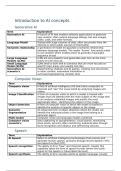
Generative AI A branch of AI that enables software applications to generate
new content; often natural language dialogs, but also images,
video, code, and other formats.
Language Model Trained with huge volumes of data, often documents from the
internet or other public sources of information
Semantic relationship A generative AI model encapsulate a semantic relationship
between language models. The model “knows” how words relate
to one another which enables them to generate meaningful
sequence of text
Large Language LLMs are very powerful and generalize well, but can be more
Models (LLMs) costly to train and use.
Small Language SLMs tend to work well in scenarios that are more focused on
Model (SLMs) specific topic areas, and usually cost less.
Generative AI Implementing chatbots and AI agents, creating new documents
scenario’s or other content, automated translation or
summarizing/explaining complex docs
Computer Vision
Term Explanation
Computer vision A field of artificial intelligence (AI) that trains computers to
interpret and "see" the visual world by analysing images and
videos
Image Classification A form of computer vision in which a model is trained with
images that are labelled with the main subject of the image that
it can analyse unlabelled images and predict the most
appropriate label - identifying the subject of the image.
Object Detection A form of computer vision in which the model is trained to
identify the location of specific objects in the image
Semantic An advanced form of object detection where the model can
Segmentation identify the individual pixels in the image that belong to a
particular object
Multi-modal Computer vision and language models combined
Computer vision Auto-captioning or tag-generation, visual search, monitoring
scenario’s stock levels, security video monitoring, authentication through
facial recognition and robotics and self-driving vehicles.
Speech
Term Explanation
AI Speech Refers to artificial intelligence technologies that process and
generate human speech, primarily through Text-to-Speech (TTS)
and Speech-to-Text (STT).
Speech recognition The ability of AI to "hear" and interpret speech. Usually this
capability takes the form of speech-to-text (where the audio
signal for the speech is transcribed into text).
Speech synthesis The ability of AI to vocalize words as spoken language. Usually
, this capability takes the form of text-to-speech in which
information in text format is converted into an audible signal.
Evolvement of AI speech technology is evolving rapidly to handle challenges like
speech ignoring background noise, detecting interruptions, and
generating increasingly expressive and human-like voices.
AI Speech scenarios Personal AI assistants in phones, computers or household
devices, automated transcription, automating audio descriptions
of video or text and automated speech translation between
language models.
Natural Language processing
Term Explanation
Natural Language A field of artificial intelligence (AI) that empowers computers to
Processing (NLP) understand, interpret, and generate human language, both
spoken and written
Common NLP tasks Entity extraction, text classification, sentiment analysis and
language detection
Entity extraction Identifying mentions of entities like people, places, organizations
in a document
Text classification Assigning document to a specific category.
Sentiment analysis Determining whether a body of text is positive, negative, or
neutral and inferring opinions.
Language detection Identifying the language in which text is written
NLP scenario’s Analysing docs or transcripts to determine key objects and
identify specific mentions of people and more, but also analysing
social media to determine sentiment and opinion. NLP is also a
chatbot that can answer FAQ or orchestrate conversational
dialogues that don’t require generative AI.
Extract data and insights
Term Explanation
Optical character The basis for most document analysis solutions. It can identify
recognition the location of text in an image while more advanced models can
also interpret individual values in the document – and so extract
specific fields
Data extraction While most data extraction models have historically focused on
models extracting fields from text-based forms, more advanced models
that can extract information from audio recording, images, and
videos are becoming more readily available.
Data and insight Automated processing of forms, large-scale digitization from
extraction scenario’s paper forms, indexing documents for search and identifying key
points and follow up actions
Responsible AI
Term Explanation
Fairness AI models are trained using data, which is generally sourced and
selected by humans. There's substantial risk that the data
selection criteria, or the data itself reflects unconscious bias that
may cause a model to produce discriminatory outputs. AI
developers need to take care to minimize bias in training data
, and test AI systems for fairness.
Reliability and AI is based on probabilistic models, it is not infallible. AI-powered
safety applications need to take this into account and mitigate risks
accordingly.
Privacy and security Models are trained using data, which may include personal
information. AI developers have a responsibility to ensure that
the training data is kept secure, and that the trained models
themselves can't be used to reveal private personal or
organizational details.
Inclusiveness The potential of AI to improve lives and drive success should be
open to everyone. AI developers should strive to ensure that their
solutions don't exclude some users.
Transparency AI can sometimes seem like "magic", but it's important to make
users aware of how the system works and any potential
limitations it may have.
Accountability Ultimately, the people and organizations that develop and
distribute AI solutions are accountable for their actions. It's
important for organizations developing AI models and
applications to define and apply a framework of governance to
help ensure that they apply responsible AI principles to their
work.
Introduction to Machine Learning concepts
What is machine learning?
Term Explanation
Machine learning The fundamental idea of machine learning is to use data from
past observations to predict unknown outcomes or values.
Machine learning as A machine learning model is a software application that
a function encapsulates a function to calculate an output value based on
one or more input values. The process of defining that function is
known as training. After the function has been defined, you can
use it to predict new values in a process called inferencing.
Generative AI
Term Explanation
Generative AI A branch of AI that enables software applications to generate
new content; often natural language dialogs, but also images,
video, code, and other formats.
Language Model Trained with huge volumes of data, often documents from the
internet or other public sources of information
Semantic relationship A generative AI model encapsulate a semantic relationship
between language models. The model “knows” how words relate
to one another which enables them to generate meaningful
sequence of text
Large Language LLMs are very powerful and generalize well, but can be more
Models (LLMs) costly to train and use.
Small Language SLMs tend to work well in scenarios that are more focused on
Model (SLMs) specific topic areas, and usually cost less.
Generative AI Implementing chatbots and AI agents, creating new documents
scenario’s or other content, automated translation or
summarizing/explaining complex docs
Computer Vision
Term Explanation
Computer vision A field of artificial intelligence (AI) that trains computers to
interpret and "see" the visual world by analysing images and
videos
Image Classification A form of computer vision in which a model is trained with
images that are labelled with the main subject of the image that
it can analyse unlabelled images and predict the most
appropriate label - identifying the subject of the image.
Object Detection A form of computer vision in which the model is trained to
identify the location of specific objects in the image
Semantic An advanced form of object detection where the model can
Segmentation identify the individual pixels in the image that belong to a
particular object
Multi-modal Computer vision and language models combined
Computer vision Auto-captioning or tag-generation, visual search, monitoring
scenario’s stock levels, security video monitoring, authentication through
facial recognition and robotics and self-driving vehicles.
Speech
Term Explanation
AI Speech Refers to artificial intelligence technologies that process and
generate human speech, primarily through Text-to-Speech (TTS)
and Speech-to-Text (STT).
Speech recognition The ability of AI to "hear" and interpret speech. Usually this
capability takes the form of speech-to-text (where the audio
signal for the speech is transcribed into text).
Speech synthesis The ability of AI to vocalize words as spoken language. Usually
, this capability takes the form of text-to-speech in which
information in text format is converted into an audible signal.
Evolvement of AI speech technology is evolving rapidly to handle challenges like
speech ignoring background noise, detecting interruptions, and
generating increasingly expressive and human-like voices.
AI Speech scenarios Personal AI assistants in phones, computers or household
devices, automated transcription, automating audio descriptions
of video or text and automated speech translation between
language models.
Natural Language processing
Term Explanation
Natural Language A field of artificial intelligence (AI) that empowers computers to
Processing (NLP) understand, interpret, and generate human language, both
spoken and written
Common NLP tasks Entity extraction, text classification, sentiment analysis and
language detection
Entity extraction Identifying mentions of entities like people, places, organizations
in a document
Text classification Assigning document to a specific category.
Sentiment analysis Determining whether a body of text is positive, negative, or
neutral and inferring opinions.
Language detection Identifying the language in which text is written
NLP scenario’s Analysing docs or transcripts to determine key objects and
identify specific mentions of people and more, but also analysing
social media to determine sentiment and opinion. NLP is also a
chatbot that can answer FAQ or orchestrate conversational
dialogues that don’t require generative AI.
Extract data and insights
Term Explanation
Optical character The basis for most document analysis solutions. It can identify
recognition the location of text in an image while more advanced models can
also interpret individual values in the document – and so extract
specific fields
Data extraction While most data extraction models have historically focused on
models extracting fields from text-based forms, more advanced models
that can extract information from audio recording, images, and
videos are becoming more readily available.
Data and insight Automated processing of forms, large-scale digitization from
extraction scenario’s paper forms, indexing documents for search and identifying key
points and follow up actions
Responsible AI
Term Explanation
Fairness AI models are trained using data, which is generally sourced and
selected by humans. There's substantial risk that the data
selection criteria, or the data itself reflects unconscious bias that
may cause a model to produce discriminatory outputs. AI
developers need to take care to minimize bias in training data
, and test AI systems for fairness.
Reliability and AI is based on probabilistic models, it is not infallible. AI-powered
safety applications need to take this into account and mitigate risks
accordingly.
Privacy and security Models are trained using data, which may include personal
information. AI developers have a responsibility to ensure that
the training data is kept secure, and that the trained models
themselves can't be used to reveal private personal or
organizational details.
Inclusiveness The potential of AI to improve lives and drive success should be
open to everyone. AI developers should strive to ensure that their
solutions don't exclude some users.
Transparency AI can sometimes seem like "magic", but it's important to make
users aware of how the system works and any potential
limitations it may have.
Accountability Ultimately, the people and organizations that develop and
distribute AI solutions are accountable for their actions. It's
important for organizations developing AI models and
applications to define and apply a framework of governance to
help ensure that they apply responsible AI principles to their
work.
Introduction to Machine Learning concepts
What is machine learning?
Term Explanation
Machine learning The fundamental idea of machine learning is to use data from
past observations to predict unknown outcomes or values.
Machine learning as A machine learning model is a software application that
a function encapsulates a function to calculate an output value based on
one or more input values. The process of defining that function is
known as training. After the function has been defined, you can
use it to predict new values in a process called inferencing.