1 1
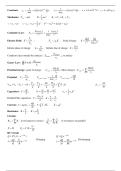
Constants: εo = = 8.85 ×10 −12 Nm
C2
2 , k= = 9.0 ×10 9 Nm 2
, e = 1.6 ×10⁻¹⁹ C, c = 3 × 10 8 m / s
4πk 4πε o C2
1
Mechanics: Fnet = ma K = mv 2 Ki + Ui = K f + U f
2
1
v = v 0 + at x − x 0 = v 0 t + at 2 끫룆 2 − 끫룆0 2 = 2 ( − 0 )
2
k | q1 q 2 | 1 | q1 q 2 |
Coulomb’s Law: F12 = =
r 2
4πε o r 2
Fq kq q
Electric Field: E = o
; Fq = q 0 E Point Charge: E= =
q
o
o , r2 4πε 0 r 2
σ 2kλ
Infinite plane of charge: , Infinite line of charge: E =
E=
2ε 0 r
σ surface
Conductor (just outside the surface): E surface = , ⊥ to surface
ε0
Q
Gauss’ Law: ∫∫ E • dA = enclosed
ε0
kQ1Q2 kQi Q j
Potential energy: a pair of charge: U pair =
r12
, More charges: U total = ∑
pairs rij
UA 1Q kQ
Potential: VA = V po int = Vmetal =
4πε 0 r
ch arg e sphere
q0 , R
UA UB ∆U W AB B dV
V AB = V A − V B = −∆V = − =− = = ∫ E ⋅ ds Es = −
q q q q A ds
Q 2 2 1
Capacitors: C = , =2 = 2
= 2
uE = ε 0 E 2
V 2
Kε 0 A V σ
Parallel Plate capacitors: C = , E= =
d d ε0
dQ
Current: I = nqAv d = , I = ∫ J ⋅ dA , E = ρJ
dt
V L
Resistance: R = , R = ρ
I A
Circuits:
n n
1 1
Req = ∑ R j (n resistances in series) , =∑ (n resistances in parallel)
j =1 Req j =1 R j
V2
P = IV PR = I 2 R =
R
RC Circuit
Q = CV0 (1 − e − t / RC ) Q = Q0 e − t / RC
dQ V0 −t / RC Charging dQ Q Discharging
I= = ( )e I= = ( 0 )e −t / RC
dt R dt RC
,DC Circuits
, Basic Circuit
• Circuit consist of three basic elements
– Source of energy
– Energy “sink”, element uses energy to do “work”
– Conducting loop I
Energy +
Energy
Source Sink
-
• Conventional current out of + on source, back into -
, Energy Source - Battery
• Battery exerts force on
charges. Force across
battery results in voltage
source
• Battery voltage is called
electromotive force (emf)
measured in Volts
+
Constants: εo = = 8.85 ×10 −12 Nm
C2
2 , k= = 9.0 ×10 9 Nm 2
, e = 1.6 ×10⁻¹⁹ C, c = 3 × 10 8 m / s
4πk 4πε o C2
1
Mechanics: Fnet = ma K = mv 2 Ki + Ui = K f + U f
2
1
v = v 0 + at x − x 0 = v 0 t + at 2 끫룆 2 − 끫룆0 2 = 2 ( − 0 )
2
k | q1 q 2 | 1 | q1 q 2 |
Coulomb’s Law: F12 = =
r 2
4πε o r 2
Fq kq q
Electric Field: E = o
; Fq = q 0 E Point Charge: E= =
q
o
o , r2 4πε 0 r 2
σ 2kλ
Infinite plane of charge: , Infinite line of charge: E =
E=
2ε 0 r
σ surface
Conductor (just outside the surface): E surface = , ⊥ to surface
ε0
Q
Gauss’ Law: ∫∫ E • dA = enclosed
ε0
kQ1Q2 kQi Q j
Potential energy: a pair of charge: U pair =
r12
, More charges: U total = ∑
pairs rij
UA 1Q kQ
Potential: VA = V po int = Vmetal =
4πε 0 r
ch arg e sphere
q0 , R
UA UB ∆U W AB B dV
V AB = V A − V B = −∆V = − =− = = ∫ E ⋅ ds Es = −
q q q q A ds
Q 2 2 1
Capacitors: C = , =2 = 2
= 2
uE = ε 0 E 2
V 2
Kε 0 A V σ
Parallel Plate capacitors: C = , E= =
d d ε0
dQ
Current: I = nqAv d = , I = ∫ J ⋅ dA , E = ρJ
dt
V L
Resistance: R = , R = ρ
I A
Circuits:
n n
1 1
Req = ∑ R j (n resistances in series) , =∑ (n resistances in parallel)
j =1 Req j =1 R j
V2
P = IV PR = I 2 R =
R
RC Circuit
Q = CV0 (1 − e − t / RC ) Q = Q0 e − t / RC
dQ V0 −t / RC Charging dQ Q Discharging
I= = ( )e I= = ( 0 )e −t / RC
dt R dt RC
,DC Circuits
, Basic Circuit
• Circuit consist of three basic elements
– Source of energy
– Energy “sink”, element uses energy to do “work”
– Conducting loop I
Energy +
Energy
Source Sink
-
• Conventional current out of + on source, back into -
, Energy Source - Battery
• Battery exerts force on
charges. Force across
battery results in voltage
source
• Battery voltage is called
electromotive force (emf)
measured in Volts
+