Bridging the gap between science and practice
Lecture 1
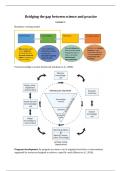
Boundary crossing model:
From knowledge to action framework (Graham et al., 2006):
Program development: by program we mean a set of organized activities or interventions
supported by resources designed to achieve a specific result (Breuer et al., 2016).
, How can science inform practice and vice versa?
Theory development/programme theory
Evaluating the needs
Structural action planning
Effect evaluation (monitoring behavioural change)
Process evaluation (monitoring implementation)
Theories in health promotion
Population at risk approach (LaLonde)
Population approach (Rose) Frohlich & Potvin (2008)
Levels of prevention:
Environmental prevention
Universal prevention
Selective prevention
Indicative prevention (often personal)
Steps involved in the program
From science to practice (IM, Kok et al., 2019)
Intervention mapping continued:
Identifying determinants
Lecture 1
Boundary crossing model:
From knowledge to action framework (Graham et al., 2006):
Program development: by program we mean a set of organized activities or interventions
supported by resources designed to achieve a specific result (Breuer et al., 2016).
, How can science inform practice and vice versa?
Theory development/programme theory
Evaluating the needs
Structural action planning
Effect evaluation (monitoring behavioural change)
Process evaluation (monitoring implementation)
Theories in health promotion
Population at risk approach (LaLonde)
Population approach (Rose) Frohlich & Potvin (2008)
Levels of prevention:
Environmental prevention
Universal prevention
Selective prevention
Indicative prevention (often personal)
Steps involved in the program
From science to practice (IM, Kok et al., 2019)
Intervention mapping continued:
Identifying determinants