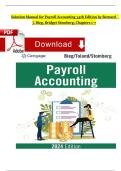
Solution Manual for Payroll Accounting 34th Edition by Bernard
J. Bieg, Bridget Stomberg, Chapters 1-7
, CONTENTS
➢ Chapter 1: The Need for Payroll and Personnel Records
➢ Chapter 2: Computing Wages and Salaries
➢ Chapter 3: Social Security Taxes
➢ Chapter 4: Income Tax Withholding
➢ Chapter 5: Unemployment Compensation Taxes
➢ Chapter 6: Analyzing and Journalizing Payroll
➢ Chapter 7: Payroll Project
,Chapter 1
Which Law?
1. K
2. H
3. B
4. F
5. I
6. J
7. A
8. D
9. G
10. C
11. E
12. L
Which Payroll Law?
1. D
2. A
3. F
4. C
5. G
6. J
7. B
8. I
9. E
10. H
What’s Ethical?
1. Answers will vary. Some concerns include data privacy and integrity in the software
switchover, tax and employee pay integrity on the new software, and employee pay methods.
, 2. Answers will vary. Karsyn could choose to ignore her sorority sister’s request, claiming
Confidentiality. She could also discontinue active participation in the sorority. In any case,
Karsyn must not consent to her sorority sister’s request for confidential information.
Confidential Records
As the payroll clerk, your task is to protect the privacy and confidentiality of the information you
maintain for the company. If a student group—or any personnel aside from the company’s payroll
employees and officers—wishes to review confidential records, you should deny their request. If
needed, you should refer the group to your department’s manager to discuss the matterin more depth.
The laws that apply to this situation are the Privacy Act of 1974, U.S. Departmentof Health and Human
Services Privacy Act 09-40-0006, Common-Law Privacy Act, Computer Fraud and Abuse Act, and
potentially HIPAA.
Large vs. Small
1. Large companies face issues with multiple departments, employee access to online
personnel portals, employee data security, and timekeeping accuracy.
2. For small companies, payroll processing will involve fewer employees than for larger
companies. Smaller companies could maintain their payroll needs using company
personnel because of the lower volume of transactions. Larger companies need to consider
their available trained payroll accountants and other staff to determine if theycan reliably
handle the volume of payroll needs in a timely and accurate manner.
What Is the Difference?
J. Bieg, Bridget Stomberg, Chapters 1-7
, CONTENTS
➢ Chapter 1: The Need for Payroll and Personnel Records
➢ Chapter 2: Computing Wages and Salaries
➢ Chapter 3: Social Security Taxes
➢ Chapter 4: Income Tax Withholding
➢ Chapter 5: Unemployment Compensation Taxes
➢ Chapter 6: Analyzing and Journalizing Payroll
➢ Chapter 7: Payroll Project
,Chapter 1
Which Law?
1. K
2. H
3. B
4. F
5. I
6. J
7. A
8. D
9. G
10. C
11. E
12. L
Which Payroll Law?
1. D
2. A
3. F
4. C
5. G
6. J
7. B
8. I
9. E
10. H
What’s Ethical?
1. Answers will vary. Some concerns include data privacy and integrity in the software
switchover, tax and employee pay integrity on the new software, and employee pay methods.
, 2. Answers will vary. Karsyn could choose to ignore her sorority sister’s request, claiming
Confidentiality. She could also discontinue active participation in the sorority. In any case,
Karsyn must not consent to her sorority sister’s request for confidential information.
Confidential Records
As the payroll clerk, your task is to protect the privacy and confidentiality of the information you
maintain for the company. If a student group—or any personnel aside from the company’s payroll
employees and officers—wishes to review confidential records, you should deny their request. If
needed, you should refer the group to your department’s manager to discuss the matterin more depth.
The laws that apply to this situation are the Privacy Act of 1974, U.S. Departmentof Health and Human
Services Privacy Act 09-40-0006, Common-Law Privacy Act, Computer Fraud and Abuse Act, and
potentially HIPAA.
Large vs. Small
1. Large companies face issues with multiple departments, employee access to online
personnel portals, employee data security, and timekeeping accuracy.
2. For small companies, payroll processing will involve fewer employees than for larger
companies. Smaller companies could maintain their payroll needs using company
personnel because of the lower volume of transactions. Larger companies need to consider
their available trained payroll accountants and other staff to determine if theycan reliably
handle the volume of payroll needs in a timely and accurate manner.
What Is the Difference?