Lesson 1 Cells and organelles & membrane structure
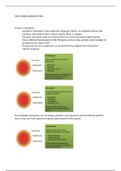
Eukaryotic cell
Mitochondria and chloroplasts
An anaerobic bacterium once engulfed an aerobic bacterium, the
mitochondria
Ú Mitochondria has their own DNA, ribosomes, RNA and proteins
Ú Mitochondria has a double membrane
An early eukaryotic cell once engulfed a photosynthetic bacterium, the
chloroplasts
Ú Chloroplasts has their own DNA, ribosomes, RNA and proteins
Ú Chloroplasts has a double membrane
Plasma membrane
Ú Defines a cell
Ú Provides shape and strength (together with cytoskeleton)
Ú Important in facilitating:
o Intercellular communication
o Exchange of substances (import and export)
o Cell growth and mobility
Consists of:
Ú Lipids, proteins and sterols (cholesterol)
o Selective barrier
o Bilayer
o Non-covalent interactions
o Fluid bilayer
1
,Phosphoglycerides (phospholipids)
Ú Amphiphilic: hydrophilic head – hydrophobic tail
Ú 1 phosphate, 1 glycerol, 2 fatty acids (hydrocarbon tail)
Phospholipids and sphingolipids are the major phospholipids in
cell membranes
Ú Sphingolipids do not have a glycerol, but a sphingosine
Ú Sphingolipids have 1 fatty chain and 1 fatty acid tail
Sterols
Ú Cholesterol: most common sterol in plasma membrane
Ú 4 ring structure
Ú Cholesterol stabilizes and stiffens membrane
Ú Hydroxyl group is oriented towards the polar
head group
Membrane composition differs between various cells and organelles. Depending on which
cell and function of place within a cell, the membranes have various compositions
Free-energy costs is minimized in the following structures self-organization
Lipid bilayer is a fluid
Ú Fluid bilayer
Ú Lateral diffusion possible
Ú Flip-flop occurs rarely (enzymatic)
Fluidity depends on its composition
Ú Saturated hydrocarbon chains make the membranes less fluid
Ú Unsaturated hydrocarbon chains make the membrane more fluid
Lipids rafts
Ú Enriched in cholesterol and sphingolipids and glycolipids
(sugar lipids)
Ú Facilitate protein-protein interactions
Membrane proteins
Ú Give properties to the cell membrane
Ú Proteins can associate in various ways with the membrane
Ú Amphiphilic
Ú Transmembrane proteins (stick out on 2 sides)
2
, Ú Membrane-associated protein of peripheral membrane proteins (only stick out on 1
side)
Types of membrane proteins
Transmembrane/integral membrane proteins
1 Single ⍺-helix
2 Multiple ⍺-helixes
3 β-barrel
Peripheral membrane proteins
4 Peripheral protein with ⍺-helix attached
5 Covalent bound lipid chain
6 Covalent bound lipid chain
7 Bound to other proteins
8 Bound via other proteins
Transmembrane protein
Ú Amino acids IN the membrane are hydrophobic
Ú Most transmembrane proteins cross the lipid bilayer with an ⍺-helix
o Why ⍺-helix formed? no water present, so H-H bonds are
formed with each other since there is no water
Ú Transmembrane part is 20-30 amino acids long
Hydropathy plots predict membrane proteins
Amino acids in the transmembrane region are mostly hydrophobic,
since the transmembrane part is 20-30 AA long, and it is below the
0 hydrophilic (everything below 0 is hydrophilic)
Graph A: passes the membrane once (above the 0 hydrophobic),
so it is a transmembrane protein with a single ⍺-helix
Graph B: passes the membrane 7 times, so it is a
transmembrane protein with multiple (7) ⍺-helices
Transmembrane ⍺-helix interacts with each other for
proper structure and function
3
Eukaryotic cell
Mitochondria and chloroplasts
An anaerobic bacterium once engulfed an aerobic bacterium, the
mitochondria
Ú Mitochondria has their own DNA, ribosomes, RNA and proteins
Ú Mitochondria has a double membrane
An early eukaryotic cell once engulfed a photosynthetic bacterium, the
chloroplasts
Ú Chloroplasts has their own DNA, ribosomes, RNA and proteins
Ú Chloroplasts has a double membrane
Plasma membrane
Ú Defines a cell
Ú Provides shape and strength (together with cytoskeleton)
Ú Important in facilitating:
o Intercellular communication
o Exchange of substances (import and export)
o Cell growth and mobility
Consists of:
Ú Lipids, proteins and sterols (cholesterol)
o Selective barrier
o Bilayer
o Non-covalent interactions
o Fluid bilayer
1
,Phosphoglycerides (phospholipids)
Ú Amphiphilic: hydrophilic head – hydrophobic tail
Ú 1 phosphate, 1 glycerol, 2 fatty acids (hydrocarbon tail)
Phospholipids and sphingolipids are the major phospholipids in
cell membranes
Ú Sphingolipids do not have a glycerol, but a sphingosine
Ú Sphingolipids have 1 fatty chain and 1 fatty acid tail
Sterols
Ú Cholesterol: most common sterol in plasma membrane
Ú 4 ring structure
Ú Cholesterol stabilizes and stiffens membrane
Ú Hydroxyl group is oriented towards the polar
head group
Membrane composition differs between various cells and organelles. Depending on which
cell and function of place within a cell, the membranes have various compositions
Free-energy costs is minimized in the following structures self-organization
Lipid bilayer is a fluid
Ú Fluid bilayer
Ú Lateral diffusion possible
Ú Flip-flop occurs rarely (enzymatic)
Fluidity depends on its composition
Ú Saturated hydrocarbon chains make the membranes less fluid
Ú Unsaturated hydrocarbon chains make the membrane more fluid
Lipids rafts
Ú Enriched in cholesterol and sphingolipids and glycolipids
(sugar lipids)
Ú Facilitate protein-protein interactions
Membrane proteins
Ú Give properties to the cell membrane
Ú Proteins can associate in various ways with the membrane
Ú Amphiphilic
Ú Transmembrane proteins (stick out on 2 sides)
2
, Ú Membrane-associated protein of peripheral membrane proteins (only stick out on 1
side)
Types of membrane proteins
Transmembrane/integral membrane proteins
1 Single ⍺-helix
2 Multiple ⍺-helixes
3 β-barrel
Peripheral membrane proteins
4 Peripheral protein with ⍺-helix attached
5 Covalent bound lipid chain
6 Covalent bound lipid chain
7 Bound to other proteins
8 Bound via other proteins
Transmembrane protein
Ú Amino acids IN the membrane are hydrophobic
Ú Most transmembrane proteins cross the lipid bilayer with an ⍺-helix
o Why ⍺-helix formed? no water present, so H-H bonds are
formed with each other since there is no water
Ú Transmembrane part is 20-30 amino acids long
Hydropathy plots predict membrane proteins
Amino acids in the transmembrane region are mostly hydrophobic,
since the transmembrane part is 20-30 AA long, and it is below the
0 hydrophilic (everything below 0 is hydrophilic)
Graph A: passes the membrane once (above the 0 hydrophobic),
so it is a transmembrane protein with a single ⍺-helix
Graph B: passes the membrane 7 times, so it is a
transmembrane protein with multiple (7) ⍺-helices
Transmembrane ⍺-helix interacts with each other for
proper structure and function
3