100% tevredenheidsgarantie Direct beschikbaar na je betaling Lees online óf als PDF Geen vaste maandelijkse kosten 4.2 TrustPilot
logo-home
Tentamen (uitwerkingen)

EST1501 PORTFOLIO Assignment (DETAILED ANSWERS) 2025 - DISTINCTION GUARANTEED

Beoordeling
-
Verkocht
-
Pagina's
12
Cijfer
A+
Geüpload op
27-09-2025
Geschreven in
2025/2026

EST1501 PORTFOLIO Assignment (DETAILED ANSWERS) 2025 - DISTINCTION GUARANTEED - DISTINCTION GUARANTEED - DISTINCTION GUARANTEED Answers, guidelines, workings and references ,... QUESTION 1 1.1 GRAMMAR [10] Identify and explain the grammatical error in each of the sentences below and rewrite the sentences following the correct grammatical rules: 1.1.1 The students is excited about the upcoming university orientation. (2) 1.1.2 The professor and the students was eager to discuss the new syllabus. (2) Read the following sentences and identify the adverbs. Then, rewrite the sentences with corrections or improvements where necessary. 1.1.3 She runs very quick every morning. (1) 1.1.4 The professor explains the concepts clear to the students. (1) Identify the two independent clauses and correct the punctuation or structure to make the sentence grammatically correct. 1.1.5 I went to the library to study I forgot my notebook at home. (1) Identify the error in the sentence below and rewrite it so that it is grammatically correct: 1.1.6 Because I was tired after the long day. (1) Use the correct conjunctions to connect the below sentences to form a compound sentence: 1.1.7 I wanted to go to the concert. I couldn't find my tickets. (1) Use the correct conjunctions to connect the below sentences to form a complex sentence: 1.1.8 It was raining heavily. We decided to go for a walk in the park. (1) TOTAL FOR QUESTION 1: (10) QUESTION 2 2.1 SUMMARY WRITING [15] 2.1.1 Read the text below and create an illustration of a topical map outlining key factors, sub-factors, and supporting information. (5) The Basic Education Laws Amendment ( Bill, which President Cyril Ramaphosa is set to sign into law on 13 September 2024, represents one of the most controversial pieces of education legislation in South Africa’s recent history. The bill proposes various amendm ents to the South African Schools Act (84 of 1996) and the Employment of Educators Act (76 of 1998), ostensibly to modernise and streamline governance within the education sector. However, it has faced substantial opposition from a wide array of political parties, civil society groups, and education stakeholders. What is the BELA Bill? At its core, the BELA bill seeks to make several significant changes to South Africa’s educational landscape. IOL highlights the most notable amendments: Making Grade R compulsory: The bill mandates that Grade R becomes part of the compulsory education system. Currently, many parents, particularly in disadvantaged areas, cannot afford to send their children to Grade R due to financial constraints. By making it compulsory, the bill aims to level the playing field and ensure that all children begin their formal education on an equal footing. Language policy in schools: One of the most contentious aspects of the BELA Bill is the proposal to give provincial Heads of Departments (HODs) more control over schools’ language and admission policies, removing some decision-making power from School Governing Bodies (SGBs). This provision has been seen as a direct attack on schools that teach in Afrikaans, with critics arguing that it undermines the constitutional right to mother-tongue education. Penalties for non-compliance: The bill imposes strict penalties for parents who fail to ensure their children attend school, with possible jail time for neglecting this duty. Additionally, it strengthens rules around student misconduct, giving schools the power to immediately suspend students for serious infractions. Home-schooling regulations: The bill introduces stringent new requirements for parents who choose to home- school their children, including compulsory registration and independent assessments of the children’s educational progress. Ban on corporal punishment and initiation practices: The bill reinforces the ban on corporal punishment and harsh initiation practices in schools, which aligns with broader child protection laws in South Africa. Why are some parties opposed to the BELA Bill? Daily Maverick reports that some key members of the Government of National Unity (GNU) have been vocal in its opposition to the BELA Bill. They have expressed concerns that the bill is unconstitutional, particularly in its handling of language policy, reports Mail&Guardian. They argue that the bill violates the right to mother-tongue education, enshrined in the South African Constitution. They also believe that transferring decision-making authority on language and admissions from SGBs to provincial education departments is a power grab by the government, effectively centralising control over schools and reducing the autonomy of local communities and parents. Moreover, they fear that the bill’s passage could jeopardise the stability of the GNU, as it directly contradicts the spirit of cooperation and compromise that underpins the coalition government. They have warned that if Ramaphosa proceeds with signing the bill, they may consider withdrawing from the coalition, which could lead to significant political instability. Mother-tongue education: A constitutional right? At the heart of the controversy surrounding the BELA Bill is the issue of mother-tongue education. Critics argue that the bill will force schools to adopt additional languages of instruction, even when it is impractical or unnecessary. They see this as an erosion of the rights of Afrikaans-speaking communities to educate their children in their language of choice. The South African Constitution guarantees the right to receive education in one’s mother tongue where reasonably practicable. By shifting the authority to determine language policy from SGBs to the provincial HODs, the BELA Bill, according to its critics, makes it easier for the state to impose language changes that may dilute this constitutional protection. Another political party has opposed the bill, expressing concerns that the bill’s language policy could be applied unevenly, disproportionately affecting minority-language communities, particularly Afrikaans speakers. This party believes that language policy should remain within the purview of SGBs to ensure that local communities retain a voice in how their children are educated. The broader implications: Education reform or overreach? While the government argues that the BELA Bill is necessary to address issues such as inequality in education and discriminatory admissions practices, opponents see it as a heavy-handed approach that could do more harm than good. For instance, critics argue that while the inclusion of Grade R as a compulsory part of basic education is laudable, the government has not provided sufficient clarity on how this will be funded, particularly in rural and underprivileged areas where access to early childhood development is already limited. Furthermore, the increased regulation of home-schooling is seen as an unnecessary intrusion into parents’ rights to determine how their children are educated. This party’s submission on the bill highlights that while oversight is necessary to ensure children receive a quality education, the broad powers granted to the Minister of Basic Education to regulate home-schooling could lead to excessive bureaucratic interference. Will the BELA Bill survive court challenges? Several groups have indicated that they will challenge the constitutionality of the BELA Bill in court if it is signed into law. These challenges are likely to focus on the bill’s implications for mother-tongue education, the centralisation of power, and the imposition of criminal penalties on parents. Should these challenges succeed, the bill could be struck down, dealing a significant blow to the government’s education reform agenda. On the other hand, if the bill is upheld, it could pave the way for further centralisation of educational governance in South Africa, a move that could have far-reaching implications for schools, parents, and communities across the country. 2.1.2 Guided by the topical map, briefly summarise the central argument or key points presented. The summary must be in one paragraph of 150 words. Indicate the word count at the end of the summary. (10) 2.2 PARAGRAPH WRITING [15] 2.2.1 You are a student who has just transitioned from high school to university. The change has been significant, and you are now reflecting on the challenges and opportunities you have encountered. Your task is to write a reflective paragraph about this transition. This exercise will help you practise organising ideas, expressing your thoughts clearly, and using correct English grammar and sentence structure. Your paragraph must have a title, topic sentence, thesis statement, supporting details, and examples. The paragraph must be 150 words in length. Indicate the word count at the end of the paragraph. (10) 2.2.2 Using the paragraph you created in Question 2.2.1, complete the following table: Title Topic sentence Thesis statement Details and examples (5) TOTAL FOR QUESTION 2: (30) QUESTION 3 3.1 Analyse Text A, below, in terms of field, tenor, and mode. Text A ( Conclusion Conclusion The BELA Bill represents a significant shift in how South Africa’s education system is governed, with major The BELA Bill represents a significant shift in how South Africa’s education system is governed, with major implications for schools, parents, and cations for schools, parents, and learners. While While thethe government insistsgovernment insists that thethat the billbill isis necessary tonecessary to modernise themodernise the education systemeducation system andand addressaddress inequality, inequality, itsits criticscritics seesee itit asas anan unconstitutionalunconstitutional powerpower grabgrab thatthat underminesundermines locallocal controlcontrol overover ls. WithWith somesome parties parties threatening to withdraw from the threatening to withdraw from the GNUGNU and multiple court challenges looming, the future of the BELA Bill remains and multiple court challenges looming, the future of the BELA Bill remains . Now find your own example of a text (Text B). Copy, scan or paste the text in your portfolio. Analyse it in the same way as Text A. Note that all forms of communication, in any language, are referred to as texts. Present you answer in the following way: Situational description Text A Text B Field Tenor Mode (15) TOTAL FOR QUESTION 3: (15) QUESTION 4 [45] 4.1 REFLECTIVE ESSAY (35) Select a topic from units 1 – 5: • Reading techniques for various texts and purposes • Textbook/study guide reading skills • Content organisation skills • Preparing to write an assignment or take an examination • Time management • How to overcome anxiety • Subjects and verbs • Subject-verb agreement • Adjectives and adverbs • Punctuation and capital letters • Using the library • Using a dictionary • Improving your spelling and vocabulary • Effective word choice • Sentence variety • The use of language in society • Language, context and text • Visual literacy • Media theories • Contextual analysis framework Define your initial understanding of the topic. Discuss how the module has altered your understanding of the topic. If you still hold the same perception, discuss why your perception has not changed. For either stance, substantiate with evidence from the study guide. Discuss how the module has contributed to your individual development and cite evidence from the study guide. This essay must be reflective and capture the essence of your learning journey. It is not merely a list of learning that occurred and should show significant and deep insight into your personal development journey. Use the rubric attached as Appendix A for guidance. 4.2 Provide evidence that you have employed the following steps in your writing process: • Pre-writing • Writing outline • Revising, editing, and proofreading

Meer zien Lees minder
Instelling
Vak


Oeps! We kunnen je document nu niet laden. Probeer het nog eens of neem contact op met support.

Gekoppeld boek

Geschreven voor

Instelling
Vak

Documentinformatie

Geüpload op
27 september 2025
Aantal pagina's
12
Geschreven in
2025/2026
Type
Tentamen (uitwerkingen)
Bevat
Vragen en antwoorden

Onderwerpen

Voorbeeld van de inhoud

EST1501
Assignment PORTFOLIO 2025

Due Date: October 2025

Detailed solutions, explanations, workings
and references.

+27 81 278 3372

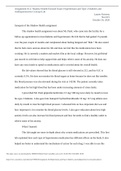
, QUESTION 1

1.1.1
Error: Subject–verb agreement. “Students is” should be “students are.”

Corrected: The students are excited about the upcoming university orientation.

1.1.2
Error: Subject–verb agreement. Compound subject (professor and students) needs
plural verb.

Corrected: The professor and the students were eager to discuss the new
syllabus.

1.1.3
Adverb: very quick → “quick” is an adjective; the adverb should be quickly.

Corrected: She runs very quickly every morning.

1.1.4
Adverb: clear should be clearly.

Corrected: The professor explains the concepts clearly to the students.

1.1.5
Error: Run-on sentence; missing punctuation or conjunction between two
independent clauses.

Corrected: I went to the library to study, but I forgot my notebook at home.

1.1.6
Error: Sentence fragment. Needs a main clause to complete the thought.

Corrected: Because I was tired after the long day, I went straight to bed.

1.1.7
Error: Two independent sentences need a coordinating conjunction.

Corrected: I wanted to go to the concert, but I couldn't find my tickets.


Varsity Cube 2025 +27 81 278 3372

Maak kennis met de verkoper

Seller avatar
De reputatie van een verkoper is gebaseerd op het aantal documenten dat iemand tegen betaling verkocht heeft en de beoordelingen die voor die items ontvangen zijn. Er zijn drie niveau’s te onderscheiden: brons, zilver en goud. Hoe beter de reputatie, hoe meer de kwaliteit van zijn of haar werk te vertrouwen is.
VarsityC AAA School of Advertising
Volgen Je moet ingelogd zijn om studenten of vakken te kunnen volgen
Verkocht
28681
Lid sinds
8 jaar
Aantal volgers
13258
Documenten
3117
Laatst verkocht
4 dagen geleden

4,1

2819 beoordelingen

5
1490
4
581
3
392
2
117
1
239

Recent door jou bekeken

Waarom studenten kiezen voor Stuvia

Gemaakt door medestudenten, geverifieerd door reviews

Kwaliteit die je kunt vertrouwen: geschreven door studenten die slaagden en beoordeeld door anderen die dit document gebruikten.

Niet tevreden? Kies een ander document

Geen zorgen! Je kunt voor hetzelfde geld direct een ander document kiezen dat beter past bij wat je zoekt.

Betaal zoals je wilt, start meteen met leren

Geen abonnement, geen verplichtingen. Betaal zoals je gewend bent via iDeal of creditcard en download je PDF-document meteen.

Student with book image

“Gekocht, gedownload en geslaagd. Zo makkelijk kan het dus zijn.”

Alisha Student

Veelgestelde vragen