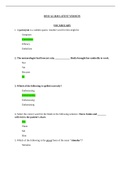
MSSC SAFETY ASSESSMENT| 336 QUESTIONS|
WITH COMPLETE SOLUTIONS
•
1. An
1. customer is a person or organization that
receives services or products in exchange for
compensation.
a) Internal
b) External
c) In-house
d) Departmental: External
2. 2. Improving external customer satisfaction is the main
objective of
.
a) Customer service department.
b) Retired employees
c) Maintenance departments
d) HR departments.: customer service
3. 3. Vendors could be considered what type of customer?
a) Main
b) Substantial
,c) Internal
d) External: external
4. Customer satisfaction should always be the first
4.
objective considered when developing .
a) Vendors
b) New or improved products
c) Teamwork
d) Training matrix: new or improved products
5.5. The of the product describes the features
requested for the product to perform the tasks for which
it was intended.
a) Form
b) Function
c) Cost
d) Utilization: function
6. Product designers should always consider the effects
6.
of tooling design and cost during .
a) Prototype development
,b) Process capability studies
c) Team kickoff meetings
d) Maintenance of a machine: prototype development
7. 7. Product design teams should provide an environment
that encourages
.
a) Criticize other team members at any time
b) Add their design ideas freely
c) Attend meetings whenever they are available
d) Report team meetings to the boss: Add their design ideas free
8.8. Teamwork, concurrent engineering, tools and
techniques are needed in order to make .
a) Product introduction
b) Sales
c) Product scam prevention efforts
d) Safety tests: Product introduction
9. 9. Engineers working with manufacturing to become
, aware of tooling limi- tations and other problems that
may increase production time and cost is an example
of .
a) Brainstorming
b) Product analysis
c) Concurrent engineering
d) Production processing: Concurrent engineering
10.
10. Is a design methodology that designs features
into the product that makes it cheaper to manufacture,
while maintaining its ability to perform its intended
function.
a) Design for Manufacturing and Assembly (DFMA)
b) Design Criteria and Performance (DCP)
c) Design, Manufacture, Deliver (DMD)
Design for Production and Performance (DPP): Design for
d)
Manufacturing and Assembly (DFMA)
11. 11. To be successful must be tied to the company's
business plan.
a) Team goals
WITH COMPLETE SOLUTIONS
•
1. An
1. customer is a person or organization that
receives services or products in exchange for
compensation.
a) Internal
b) External
c) In-house
d) Departmental: External
2. 2. Improving external customer satisfaction is the main
objective of
.
a) Customer service department.
b) Retired employees
c) Maintenance departments
d) HR departments.: customer service
3. 3. Vendors could be considered what type of customer?
a) Main
b) Substantial
,c) Internal
d) External: external
4. Customer satisfaction should always be the first
4.
objective considered when developing .
a) Vendors
b) New or improved products
c) Teamwork
d) Training matrix: new or improved products
5.5. The of the product describes the features
requested for the product to perform the tasks for which
it was intended.
a) Form
b) Function
c) Cost
d) Utilization: function
6. Product designers should always consider the effects
6.
of tooling design and cost during .
a) Prototype development
,b) Process capability studies
c) Team kickoff meetings
d) Maintenance of a machine: prototype development
7. 7. Product design teams should provide an environment
that encourages
.
a) Criticize other team members at any time
b) Add their design ideas freely
c) Attend meetings whenever they are available
d) Report team meetings to the boss: Add their design ideas free
8.8. Teamwork, concurrent engineering, tools and
techniques are needed in order to make .
a) Product introduction
b) Sales
c) Product scam prevention efforts
d) Safety tests: Product introduction
9. 9. Engineers working with manufacturing to become
, aware of tooling limi- tations and other problems that
may increase production time and cost is an example
of .
a) Brainstorming
b) Product analysis
c) Concurrent engineering
d) Production processing: Concurrent engineering
10.
10. Is a design methodology that designs features
into the product that makes it cheaper to manufacture,
while maintaining its ability to perform its intended
function.
a) Design for Manufacturing and Assembly (DFMA)
b) Design Criteria and Performance (DCP)
c) Design, Manufacture, Deliver (DMD)
Design for Production and Performance (DPP): Design for
d)
Manufacturing and Assembly (DFMA)
11. 11. To be successful must be tied to the company's
business plan.
a) Team goals