© strawberrywaffles 2025
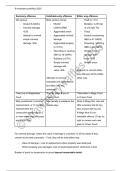
Summary offences Indictable-only offences Either way offences
Not serious: Most serious crimes: - Theft (s.1 TA)
- Assault & battery - Murder - Burglary: (s.9(1)(a)
- Criminal damage - UAM & GNM or s.9(1)(b) TA)
<£5k - Aggravated arson - Fraud
- Attempt to commit - Aggravated criminal - Assault occasioning
simple criminal damage ABH (s.47 OAPA)
damage <£5k - Aggravated burglary - Wounding / inflicting
(s.10 TA) GBH (s.20 OAPA)
- Wounding or causing - Simple criminal
GBH (s.18 OAPA) damage with
- Robbery (s.8 TA) value >£5k
- Simple criminal - Simple arson
damage with
value >£5k Attempts to commit either
way offences will be triable
Attempts to commit either way.
indictable-only offences will
be triable only on
indictment.
Tried only in Magistrates' Tried by judge & jury in Tried either in Mags Court
Court Crown Court or Crown Court
Max punishment: 6 months’ Max penalty is whatever the Goes to Mags first, who will
imprisonment, or 12 months’ statute says offer summary trial (D can
imprisonment (for also choose trial by jury)
consecutive sentences on 2 If Mags think it's an
or more either way offences) indictable offence, D has no
and £5000 fine right to choose and case
goes to Crown Court
For criminal damage, where the value of damage is uncertain, D will be asked if they
consent to be tried summarily – if not, they will be tried either-way.
- Value of damage = cost of replacement where property was destroyed
- Where property was damaged, cost of repair/replacement, whichever is less
Burden of proof on prosecution to prove beyond reasonable doubt.
, © strawberrywaffles 2025
NB: rarely, burden of proof on D e.g. defence of diminished responsibility in murder →
standard is balance of probabilities
Key principles
Negligence
Mens rea: judged against the standard of a reasonable person (objective test)
Causation
Step 1: factual causation (but-for test)
Step 2: legal causation
1. D's act must be a substantial (i.e. more than de minimis) cause
2. Consequence must be caused by D's act (child would have been run over whether D
was holding the reins or not → no legal causation)
3. D's act need not be the only cause
4. No intervening acts – different tests for different situations
a. Acts of third parties: whether they are “free, deliberate and informed”
b. Medical negligence: whether it was so independent of the original action
and so potent in causing the harm that D should escape liability
c. C’s escape: whether the attempted escape was so daft and unexpected
that no reasonable person could have foreseen it
d. C’s own act (e.g. suicide): whether it was reasonably foreseeable
Intervening act Not an intervening act
- Medical - Reasonably foreseeable attempted escape e.g.
maltreatment that jumping out of a moving car when confronted with
was so unwanted sexual advances/robbery
independent of the - Medical maltreatment (e.g. dropped on the way to
original action and hospital)
so potent in - Police self-defence for self-preservation (shooting
causing the death back at D, after D shoots them)
that the original D
Summary offences Indictable-only offences Either way offences
Not serious: Most serious crimes: - Theft (s.1 TA)
- Assault & battery - Murder - Burglary: (s.9(1)(a)
- Criminal damage - UAM & GNM or s.9(1)(b) TA)
<£5k - Aggravated arson - Fraud
- Attempt to commit - Aggravated criminal - Assault occasioning
simple criminal damage ABH (s.47 OAPA)
damage <£5k - Aggravated burglary - Wounding / inflicting
(s.10 TA) GBH (s.20 OAPA)
- Wounding or causing - Simple criminal
GBH (s.18 OAPA) damage with
- Robbery (s.8 TA) value >£5k
- Simple criminal - Simple arson
damage with
value >£5k Attempts to commit either
way offences will be triable
Attempts to commit either way.
indictable-only offences will
be triable only on
indictment.
Tried only in Magistrates' Tried by judge & jury in Tried either in Mags Court
Court Crown Court or Crown Court
Max punishment: 6 months’ Max penalty is whatever the Goes to Mags first, who will
imprisonment, or 12 months’ statute says offer summary trial (D can
imprisonment (for also choose trial by jury)
consecutive sentences on 2 If Mags think it's an
or more either way offences) indictable offence, D has no
and £5000 fine right to choose and case
goes to Crown Court
For criminal damage, where the value of damage is uncertain, D will be asked if they
consent to be tried summarily – if not, they will be tried either-way.
- Value of damage = cost of replacement where property was destroyed
- Where property was damaged, cost of repair/replacement, whichever is less
Burden of proof on prosecution to prove beyond reasonable doubt.
, © strawberrywaffles 2025
NB: rarely, burden of proof on D e.g. defence of diminished responsibility in murder →
standard is balance of probabilities
Key principles
Negligence
Mens rea: judged against the standard of a reasonable person (objective test)
Causation
Step 1: factual causation (but-for test)
Step 2: legal causation
1. D's act must be a substantial (i.e. more than de minimis) cause
2. Consequence must be caused by D's act (child would have been run over whether D
was holding the reins or not → no legal causation)
3. D's act need not be the only cause
4. No intervening acts – different tests for different situations
a. Acts of third parties: whether they are “free, deliberate and informed”
b. Medical negligence: whether it was so independent of the original action
and so potent in causing the harm that D should escape liability
c. C’s escape: whether the attempted escape was so daft and unexpected
that no reasonable person could have foreseen it
d. C’s own act (e.g. suicide): whether it was reasonably foreseeable
Intervening act Not an intervening act
- Medical - Reasonably foreseeable attempted escape e.g.
maltreatment that jumping out of a moving car when confronted with
was so unwanted sexual advances/robbery
independent of the - Medical maltreatment (e.g. dropped on the way to
original action and hospital)
so potent in - Police self-defence for self-preservation (shooting
causing the death back at D, after D shoots them)
that the original D