Biology: A Global Approach
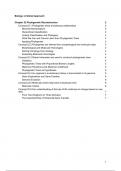
Chapter 25 Macroevolution 2
Concept 25.1 Conditions on early Earth made the origin of life possible 2
Concept 25.2 The fossil record documents the history of life 3
Concept 25.3 Key events in life’s history include the origins of unicellular and
multicellular organisms and the colonization of land. 4
Concept 25.4 The rise and fall of groups of organisms reflect differences in speciation
and extinction rates 7
Concept 25.5 Major changes in body form can result from changes in the sequences and
regulation of developmental genes 9
Concept 25.6 Evolution is not goal oriented 10
1
, Chapter 25 Macroevolution
Concept 25.1 Conditions on early Earth made the origin of life possible
Direct evidence of life on early Earth comes from fossils of microorganisms that lived 3,5
billion years ago. The hypothesis that chemical and physical processes could have produced
simple cells through a sequence of four main stages:
- The abiotic (nonliving) synthesis of small organic molecules, such as amino acids
and nitrogenous bases
- The joining of these small molecules into macromolecules, such as proteins and
nucleic acids.
- The packaging of these molecules into protocells, droplets with membranes that
maintained an interval chemistry different from that of their surroundings.
- The origin of self-replicating molecules that eventually made inheritance possible.
Synthesis of Organic Compounds on Early Earth
OUr planet formed 4,6 billion years ago, condensing from a vast cloud of dust and rocks that
surrounded the young sun. For its first few hundred million years, Earth was bombarded by
huge chunks of rock and ice left from the formation of the solar system. The collisions
generated so much heat that all of the available water was vaporized, preventing the
formation of seas and lakes.
This massive bombardment ended 4 billion years ago, setting the stage of the origin of life.
The first atmosphere had little oxygen and was likely thick with water vapor, along with
compounds released by volcanic eruptions. As Earth cooled, the water vapor condensed into
oceans, and much of the hydrogen escaped into space.
Some evidence suggests that the early atmosphere was made up primarily of nitrogen and
carbon dioxide and was neither reducing nor oxidizing (electron removing). Perhaps the first
organic compounds formed near volcanoes.
Another hypothesis is that organic compounds were first produced in deep-see hydrothermal
vents, areas on the seafloor where heated water and minerals gush from Earth’s interior into
the ocean. Some of these vents, known as ‘black smokers,’ release water so hot that organic
compounds formed there may have been unstable. But other deep-sea vents, called alkaline
vents, release water that has a high pH and is warm rather than hot, an environment that
may have been more suitable for the origin of life.
Studies related to the volcanic atmosphere and alkaline vent hypotheses show that the
abiotic synthesis of organic molecules is possible under various conditions. Another source
of organic molecules may have been meteorites.
Abiotic Synthesis of Macromolecules
The presence of small organic molecules, such as amino acids and nitrogenous bases, is
not sufficient for the emergence of life as we know it. Every cell has many types of
macromolecules, including enzymes and other proteins and the nucleic acids needed for
self-replication.
Protocells
All organisms must be able to carry out both reproduction and energy processing
(metabolism). DNA molecules carry genetic information, including the instructions needed to
replicate themselves accurately during reproduction. But DNA replication requires elaborate
enzymatic machinery, along with an abundant supply of nucleotide building blocks provided
2
Chapter 25 Macroevolution 2
Concept 25.1 Conditions on early Earth made the origin of life possible 2
Concept 25.2 The fossil record documents the history of life 3
Concept 25.3 Key events in life’s history include the origins of unicellular and
multicellular organisms and the colonization of land. 4
Concept 25.4 The rise and fall of groups of organisms reflect differences in speciation
and extinction rates 7
Concept 25.5 Major changes in body form can result from changes in the sequences and
regulation of developmental genes 9
Concept 25.6 Evolution is not goal oriented 10
1
, Chapter 25 Macroevolution
Concept 25.1 Conditions on early Earth made the origin of life possible
Direct evidence of life on early Earth comes from fossils of microorganisms that lived 3,5
billion years ago. The hypothesis that chemical and physical processes could have produced
simple cells through a sequence of four main stages:
- The abiotic (nonliving) synthesis of small organic molecules, such as amino acids
and nitrogenous bases
- The joining of these small molecules into macromolecules, such as proteins and
nucleic acids.
- The packaging of these molecules into protocells, droplets with membranes that
maintained an interval chemistry different from that of their surroundings.
- The origin of self-replicating molecules that eventually made inheritance possible.
Synthesis of Organic Compounds on Early Earth
OUr planet formed 4,6 billion years ago, condensing from a vast cloud of dust and rocks that
surrounded the young sun. For its first few hundred million years, Earth was bombarded by
huge chunks of rock and ice left from the formation of the solar system. The collisions
generated so much heat that all of the available water was vaporized, preventing the
formation of seas and lakes.
This massive bombardment ended 4 billion years ago, setting the stage of the origin of life.
The first atmosphere had little oxygen and was likely thick with water vapor, along with
compounds released by volcanic eruptions. As Earth cooled, the water vapor condensed into
oceans, and much of the hydrogen escaped into space.
Some evidence suggests that the early atmosphere was made up primarily of nitrogen and
carbon dioxide and was neither reducing nor oxidizing (electron removing). Perhaps the first
organic compounds formed near volcanoes.
Another hypothesis is that organic compounds were first produced in deep-see hydrothermal
vents, areas on the seafloor where heated water and minerals gush from Earth’s interior into
the ocean. Some of these vents, known as ‘black smokers,’ release water so hot that organic
compounds formed there may have been unstable. But other deep-sea vents, called alkaline
vents, release water that has a high pH and is warm rather than hot, an environment that
may have been more suitable for the origin of life.
Studies related to the volcanic atmosphere and alkaline vent hypotheses show that the
abiotic synthesis of organic molecules is possible under various conditions. Another source
of organic molecules may have been meteorites.
Abiotic Synthesis of Macromolecules
The presence of small organic molecules, such as amino acids and nitrogenous bases, is
not sufficient for the emergence of life as we know it. Every cell has many types of
macromolecules, including enzymes and other proteins and the nucleic acids needed for
self-replication.
Protocells
All organisms must be able to carry out both reproduction and energy processing
(metabolism). DNA molecules carry genetic information, including the instructions needed to
replicate themselves accurately during reproduction. But DNA replication requires elaborate
enzymatic machinery, along with an abundant supply of nucleotide building blocks provided
2