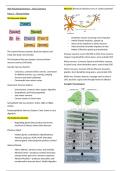
AQA Psychology Revision – Topic Summary Neurons: Electrical impulses carry as ‘action potential’
Paper 2 – Biopsychology
The Nervous System:
Dendrites receive incoming nerve impulses
- Myelin Sheath insulates, speeds up
- Axon carries impulses to other neurons
- Axon terminal transmits impulses to next
- Nodes of Ranvier speed up transmission
The Central Nervous System: Brain and spinal cord
(relay info brain rest of body) Sensory neurons: Carry info PNS to CNS, from sensory,
tongue, long dendrites short axons, soma outside CNS
The Peripheral Nervous System: Sensory/Motor
neurons connect CNS body Relay neurons: Connects Sensory and Motor neurons,
in spinal cord, short dendrites axons, soma inside CNS
Somatic Nervous System:
Motor neurons: Connect CNS to effectors (muscles,
- Conscious, connects CNS to senses, connected glands), short dendrites long axons, soma inside CNS
to skeletal muscles, e.g. running, jumping
- Sensory and motor pathways Reflex Arc: Sensory detects, message sent in relay in
- Commands from motor cortex CNS, decision, signal sent through motor to effector
Autonomic Nervous System: Synaptic Transmission:
- Unconscious, connects inter organs, digestion
- Sympathetic and Parasympathetic
- Just motor neurons
- Control centres in brain stem
Sympathetic Nervous System: Active, fight or flight,
excites
Parasympathetic Nervous System: Calm, down to rest,
digestion
The Endocrine System:
- Regulating glands that produce hormones,
chemicals in blood, slower than Nervous
Pituitary Gland:
- Master gland, controlled by Hypothalamus
- Anterior produces ACHT, ACHT stimulates
adrenal gland, adrenal glands produce cortisol
Adrenal Glands:
- Above kidneys, adrenal cortex, and medulla
- Adrenal Cortex = produces cortisol (increases
energy lowers pain sens, immune response)
- Adrenal Medulla = produces adrenaline and
noradrenaline increase heart, inhibit digestion
, GABA – inhibitory, Dopamine – Excitatory Visual area – occipital lobe, responsible visual
processing for the opposite visual fields, both hems
Fight or Flight Response:
Auditory area – mainly in temporal lobes both sides,
- Acute stressor, stressor perceived
processes for opposite ear
- Sends message hypothalamus, communicates
rest of body through sympathetic nervous Broca’s area – frontal lobe only left hemisphere,
- Switches autonomic nervous system from the language produce, ‘Tan’, damage = Broca’s aphasia
parasympathetic state (resting) to sympathetic
- SNS prepares body for action by send message Wernicke’s area – left temporal lobe, language
adrenal medulla, produce adrenaline and nor understanding, sensory input language, close auditory
- Adrenaline increases heart rate, blood somatosensory cortex, damage = Wernicke’s aphasia
pressure, pupil size and oxygen to brain,
Evaluation of localisation of function:
lowers digestion activity, muscle tension
- Once threat passed PNS returns body to rest - Research Broca’s area with patient Tan
Chronic Stress Response: - Peterson et al (1988) brain scans identify that
Wernicke’s area active during listening task
- Not acute stressor, stressor perceived Broca’s area active during a reading task
- Sends message to hypothalamus, hypo cause - Simpler functions likely more localised
pituitary produce ACHT which travels kidneys
complex involve many areas = consciousness
- Adrenal cortex releases cortisol increases pain
- Lashley (1950) suggests cognitive processes
threshold, gives energy but impairs cognition,
like learning distributed, removed areas of
inc blood pressure, lower immune response
cortex rats learning maze, found no area more
- If levels are too high ACHT reduction
important than another in ability to learn
Evaluation of Fight or Flight Response: - Plasticity argues against localisation cortical
- Lee and Harley found a gene only in males remapping damage recover
that primes them to have fight or flight Lateralisation and Split Brain Research:
response to stress
- Outdated, we rarely need to use fight or flight Lateralisation – two hemispheres diff functions
- Neglects the idea of freeze response, animals
Left hemisphere – right side of the body right visual
- Taylor et al (2000) found women have ‘tend or
field, speech, language, time and sequencing
befriend’ response, protect offspring or
themselves or seek help from other women Right hemisphere – left side of the body left visual
Localisation of Function: field, creative, spatial, recognition (faces, places)
Localisation – different areas brain diff jobs/activities Split Brain Research: Sensory stimuli right visual fields
seen both eyes, BUT it is processed left hemisphere
Corpus Callosum – bundle of nerve fibres connecting
the two hemispheres, transfers information between
Motor Cortex – frontal lobe, voluntary moves, both,
each side controls opposite body
Somatosensory Cortex – parietal lobe, detect sensory
events: touch, both, detect opposite side
Paper 2 – Biopsychology
The Nervous System:
Dendrites receive incoming nerve impulses
- Myelin Sheath insulates, speeds up
- Axon carries impulses to other neurons
- Axon terminal transmits impulses to next
- Nodes of Ranvier speed up transmission
The Central Nervous System: Brain and spinal cord
(relay info brain rest of body) Sensory neurons: Carry info PNS to CNS, from sensory,
tongue, long dendrites short axons, soma outside CNS
The Peripheral Nervous System: Sensory/Motor
neurons connect CNS body Relay neurons: Connects Sensory and Motor neurons,
in spinal cord, short dendrites axons, soma inside CNS
Somatic Nervous System:
Motor neurons: Connect CNS to effectors (muscles,
- Conscious, connects CNS to senses, connected glands), short dendrites long axons, soma inside CNS
to skeletal muscles, e.g. running, jumping
- Sensory and motor pathways Reflex Arc: Sensory detects, message sent in relay in
- Commands from motor cortex CNS, decision, signal sent through motor to effector
Autonomic Nervous System: Synaptic Transmission:
- Unconscious, connects inter organs, digestion
- Sympathetic and Parasympathetic
- Just motor neurons
- Control centres in brain stem
Sympathetic Nervous System: Active, fight or flight,
excites
Parasympathetic Nervous System: Calm, down to rest,
digestion
The Endocrine System:
- Regulating glands that produce hormones,
chemicals in blood, slower than Nervous
Pituitary Gland:
- Master gland, controlled by Hypothalamus
- Anterior produces ACHT, ACHT stimulates
adrenal gland, adrenal glands produce cortisol
Adrenal Glands:
- Above kidneys, adrenal cortex, and medulla
- Adrenal Cortex = produces cortisol (increases
energy lowers pain sens, immune response)
- Adrenal Medulla = produces adrenaline and
noradrenaline increase heart, inhibit digestion
, GABA – inhibitory, Dopamine – Excitatory Visual area – occipital lobe, responsible visual
processing for the opposite visual fields, both hems
Fight or Flight Response:
Auditory area – mainly in temporal lobes both sides,
- Acute stressor, stressor perceived
processes for opposite ear
- Sends message hypothalamus, communicates
rest of body through sympathetic nervous Broca’s area – frontal lobe only left hemisphere,
- Switches autonomic nervous system from the language produce, ‘Tan’, damage = Broca’s aphasia
parasympathetic state (resting) to sympathetic
- SNS prepares body for action by send message Wernicke’s area – left temporal lobe, language
adrenal medulla, produce adrenaline and nor understanding, sensory input language, close auditory
- Adrenaline increases heart rate, blood somatosensory cortex, damage = Wernicke’s aphasia
pressure, pupil size and oxygen to brain,
Evaluation of localisation of function:
lowers digestion activity, muscle tension
- Once threat passed PNS returns body to rest - Research Broca’s area with patient Tan
Chronic Stress Response: - Peterson et al (1988) brain scans identify that
Wernicke’s area active during listening task
- Not acute stressor, stressor perceived Broca’s area active during a reading task
- Sends message to hypothalamus, hypo cause - Simpler functions likely more localised
pituitary produce ACHT which travels kidneys
complex involve many areas = consciousness
- Adrenal cortex releases cortisol increases pain
- Lashley (1950) suggests cognitive processes
threshold, gives energy but impairs cognition,
like learning distributed, removed areas of
inc blood pressure, lower immune response
cortex rats learning maze, found no area more
- If levels are too high ACHT reduction
important than another in ability to learn
Evaluation of Fight or Flight Response: - Plasticity argues against localisation cortical
- Lee and Harley found a gene only in males remapping damage recover
that primes them to have fight or flight Lateralisation and Split Brain Research:
response to stress
- Outdated, we rarely need to use fight or flight Lateralisation – two hemispheres diff functions
- Neglects the idea of freeze response, animals
Left hemisphere – right side of the body right visual
- Taylor et al (2000) found women have ‘tend or
field, speech, language, time and sequencing
befriend’ response, protect offspring or
themselves or seek help from other women Right hemisphere – left side of the body left visual
Localisation of Function: field, creative, spatial, recognition (faces, places)
Localisation – different areas brain diff jobs/activities Split Brain Research: Sensory stimuli right visual fields
seen both eyes, BUT it is processed left hemisphere
Corpus Callosum – bundle of nerve fibres connecting
the two hemispheres, transfers information between
Motor Cortex – frontal lobe, voluntary moves, both,
each side controls opposite body
Somatosensory Cortex – parietal lobe, detect sensory
events: touch, both, detect opposite side