Chapter 10: Prohibited Contracts
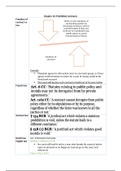
Freedom of
limits on the freedom of
contract vs
contracting parties by
law declaring contracts void or
unenforceable if they are
contrary to mandatory law,
public policy or good
morals (bonos mores)
freedom of
contract
Example
Marjolein agrees to sell nuclear arms to a terrorist group, or if Jens
agrees to kill someone in return for a sum of money wired to his
Swiss bank account
The court will declare such contracts invalid out of its own motion
French law
German law
Dutch law Art. 3:40 Dutch Civil Code
English law Holman v Johnson (1775)
No court will lend its aid to a man who founds his cause of action
upon an immoral or an illegal act (cannot go to the court and
enforce it)
Patel v Mirza 2016
, The courts will generally not enforce an illegal contract
Two 1. When exactly a contract goes against a statutory prohibition, public
questions policy (ordre public, openbare orde) or good morals?
Opend-ended clauses that leave a lot of discretion to the court
Allows the court to deal with changing conceptions of what should
be prohibited vs hard to decide on requirements of public policy or
good morals since judges are not allowed to impose their own
standards
Feel out what society as a whole believes to be morally unjustifiable
PECL
Shallow provision on prohibited contracts (Art. 15:101), which
states that a contract is of no effect to the extent that it is ‘contrary
to principles recognized as fundamental in the laws of the member
states of the European Union’
2. What must be the effect of a prohibited contract if it has already
been performed?
A. When is a contract prohibited?
A. Statutory Statutory provisions
illegality provisions that prohibit the conclusion of certain types of contract
The court no longer needs to ask itself what public policy or good
morals exactly require (advantage of being able to refer to a
statutory provision
Example
Incitement: encouraging someone to commit a crime by paying
this person money (hitman) is a criminal offence
Fencing: knowingly buying stolen property
Statutory illegality
Against public policy or good morals
Sanctions
Not all contracts violating a statutory rule will be declared void
(the provision might aim to protect just one party) (Art. 3:40 (2)
BW- but also accepted in the case law of the jurisdictions)
A statutory provision prohibits a contract, but does not purport to
invalidate it in any way (Art. 3:40 (3) BW)
Art. 101 TFEU
Prohibits agreements between competitors that restrict
competition on the European internal market, such as cartels and
price-fixing agreements
Freedom of
limits on the freedom of
contract vs
contracting parties by
law declaring contracts void or
unenforceable if they are
contrary to mandatory law,
public policy or good
morals (bonos mores)
freedom of
contract
Example
Marjolein agrees to sell nuclear arms to a terrorist group, or if Jens
agrees to kill someone in return for a sum of money wired to his
Swiss bank account
The court will declare such contracts invalid out of its own motion
French law
German law
Dutch law Art. 3:40 Dutch Civil Code
English law Holman v Johnson (1775)
No court will lend its aid to a man who founds his cause of action
upon an immoral or an illegal act (cannot go to the court and
enforce it)
Patel v Mirza 2016
, The courts will generally not enforce an illegal contract
Two 1. When exactly a contract goes against a statutory prohibition, public
questions policy (ordre public, openbare orde) or good morals?
Opend-ended clauses that leave a lot of discretion to the court
Allows the court to deal with changing conceptions of what should
be prohibited vs hard to decide on requirements of public policy or
good morals since judges are not allowed to impose their own
standards
Feel out what society as a whole believes to be morally unjustifiable
PECL
Shallow provision on prohibited contracts (Art. 15:101), which
states that a contract is of no effect to the extent that it is ‘contrary
to principles recognized as fundamental in the laws of the member
states of the European Union’
2. What must be the effect of a prohibited contract if it has already
been performed?
A. When is a contract prohibited?
A. Statutory Statutory provisions
illegality provisions that prohibit the conclusion of certain types of contract
The court no longer needs to ask itself what public policy or good
morals exactly require (advantage of being able to refer to a
statutory provision
Example
Incitement: encouraging someone to commit a crime by paying
this person money (hitman) is a criminal offence
Fencing: knowingly buying stolen property
Statutory illegality
Against public policy or good morals
Sanctions
Not all contracts violating a statutory rule will be declared void
(the provision might aim to protect just one party) (Art. 3:40 (2)
BW- but also accepted in the case law of the jurisdictions)
A statutory provision prohibits a contract, but does not purport to
invalidate it in any way (Art. 3:40 (3) BW)
Art. 101 TFEU
Prohibits agreements between competitors that restrict
competition on the European internal market, such as cartels and
price-fixing agreements