
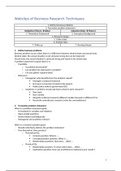
Webclips of Business Research Techniques
1. Define business problems
2. Formulate problem statement
Deductive (Theory Data) Inductive (Data Theory)
3. Theoretical framework 3. Conceptual background
4. Research design
5. Collect data
6. Analyze data
7. Write up 7. Develop theory
1. Define business problems
Business problem occurs when there is a difference between desired state and actual state.
Desired state; the actual situation is not seriously wrong but can be improved
Actual state; the actual situation is seriously wrong and needs to be solved asap
A problem statement is good when it is:
- Feasibility
o Is problem demarcated?
o Can problem be expressed in variables?
o Can you gather required data?
- Relevance
o Managerial; who benefits from the problem solved?
Managers (company/industry)
End users (consumers/investors/tax payers)
Public policy makers (government/EU)
o Academic; is problem not already been solved in prior research?
New topic
New context
Integrate scattered research (different studies focused on different IV’s)
Reconcile contradictory research (solve the contradictions)
2. Formulate problem statement
When is a problem statement good:
- Formulated in variables and relations
- Open-ended questions
- Stated clearly/unambiguously
- Managerial and academic relevant
When is a research question good:
- Should collectively address the problem statement
- First theoretical, then practical
o Theoretical RQ;
Context question; What is …..
Conceptualization question; What is ….
Relationship questions; How does … affect …
o Practical RQ;
Relationship question; To what extent does … affect …
Implication question; How can practitioners implement your results?
1
1. Define business problems
2. Formulate problem statement
Deductive (Theory Data) Inductive (Data Theory)
3. Theoretical framework 3. Conceptual background
4. Research design
5. Collect data
6. Analyze data
7. Write up 7. Develop theory
1. Define business problems
Business problem occurs when there is a difference between desired state and actual state.
Desired state; the actual situation is not seriously wrong but can be improved
Actual state; the actual situation is seriously wrong and needs to be solved asap
A problem statement is good when it is:
- Feasibility
o Is problem demarcated?
o Can problem be expressed in variables?
o Can you gather required data?
- Relevance
o Managerial; who benefits from the problem solved?
Managers (company/industry)
End users (consumers/investors/tax payers)
Public policy makers (government/EU)
o Academic; is problem not already been solved in prior research?
New topic
New context
Integrate scattered research (different studies focused on different IV’s)
Reconcile contradictory research (solve the contradictions)
2. Formulate problem statement
When is a problem statement good:
- Formulated in variables and relations
- Open-ended questions
- Stated clearly/unambiguously
- Managerial and academic relevant
When is a research question good:
- Should collectively address the problem statement
- First theoretical, then practical
o Theoretical RQ;
Context question; What is …..
Conceptualization question; What is ….
Relationship questions; How does … affect …
o Practical RQ;
Relationship question; To what extent does … affect …
Implication question; How can practitioners implement your results?
1




