Alkenes
Electrophilic Addition
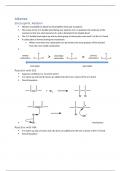
Alkenes susceptible to attack by electrophiles (lone pair acceptors)
This is due to the C=C double bond being very electron rich, so polarises the molecule of the
reactant so that one atom becomes δ+ and is attracted to the double bond
The C=C double bond opens up and an atom/group of atoms joins onto each C of the C=C bond
A carbocation is formed during the mechanism
o Where more than one carbocation can be formed, the main product will be formed
from the more stable carbocation
Reaction with Br2
Aqueous conditions (i.e. bromine water)
C=C opens up and two Br atoms are added onto the two C atoms of the C=C bond
Overall equation:
Mechanism:
Reaction with HBr
C=C opens up and a H atom and a Br atom are added onto the two C atoms of the C=C bond
Overall equation:
Electrophilic Addition
Alkenes susceptible to attack by electrophiles (lone pair acceptors)
This is due to the C=C double bond being very electron rich, so polarises the molecule of the
reactant so that one atom becomes δ+ and is attracted to the double bond
The C=C double bond opens up and an atom/group of atoms joins onto each C of the C=C bond
A carbocation is formed during the mechanism
o Where more than one carbocation can be formed, the main product will be formed
from the more stable carbocation
Reaction with Br2
Aqueous conditions (i.e. bromine water)
C=C opens up and two Br atoms are added onto the two C atoms of the C=C bond
Overall equation:
Mechanism:
Reaction with HBr
C=C opens up and a H atom and a Br atom are added onto the two C atoms of the C=C bond
Overall equation: