Kinetics
Collision Theory
In order for a chemical reaction to take place the reactant particles must:
o Collide
o Possess energy >= the activation energy (Ea)
o Have a suitable orientation]
Activation Energy – The minimum amount of energy required for a successful collision to occur
and a reaction to happen
Maxwell-Boltzmann Distribution
In a gas sample, all the molecules do not have the same energy as they are not all travelling at
the same speed
There is a distribution of energies, known as the Maxwell-Boltzmann distribution
In a sample of gas the molecules are in constant motion, and collide with each other and with
the walls of the container. Such collisions are said to be elastic i.e. no energy is lost during the
collision, but energy may be transferred from one molecule to another
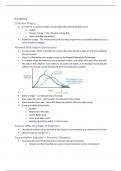
Starts at origin – no molecules have 0 energy
Area under the curve = total number of molecules in the sample
Never touches the x axis – there will always be particles with very high energy
Curve at a higher temperature:
o Broader
o Displaced to the right
o Lower, flatter peak
o Same area under curve
o Number of particles with E >= Ea increases
Factors Affecting Rate of Reaction
The rate of reaction can be defined as the change in concentration of a substance in unit time
Units for rate are mol dm-3 s-1
Concentration (Liquids) + Pressure (Gaseous)
Increasing the concentration/pressure increases the rate of reaction
o Greater number of particles in a given volume (constant volume of container)
Collision Theory
In order for a chemical reaction to take place the reactant particles must:
o Collide
o Possess energy >= the activation energy (Ea)
o Have a suitable orientation]
Activation Energy – The minimum amount of energy required for a successful collision to occur
and a reaction to happen
Maxwell-Boltzmann Distribution
In a gas sample, all the molecules do not have the same energy as they are not all travelling at
the same speed
There is a distribution of energies, known as the Maxwell-Boltzmann distribution
In a sample of gas the molecules are in constant motion, and collide with each other and with
the walls of the container. Such collisions are said to be elastic i.e. no energy is lost during the
collision, but energy may be transferred from one molecule to another
Starts at origin – no molecules have 0 energy
Area under the curve = total number of molecules in the sample
Never touches the x axis – there will always be particles with very high energy
Curve at a higher temperature:
o Broader
o Displaced to the right
o Lower, flatter peak
o Same area under curve
o Number of particles with E >= Ea increases
Factors Affecting Rate of Reaction
The rate of reaction can be defined as the change in concentration of a substance in unit time
Units for rate are mol dm-3 s-1
Concentration (Liquids) + Pressure (Gaseous)
Increasing the concentration/pressure increases the rate of reaction
o Greater number of particles in a given volume (constant volume of container)