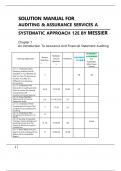
SOLUTION MANUAL FOR
AUDITING & ASSURANCE SERVICES A
SYSTEMATIC APPROACH 12E BY MESSIER
Chapter 1
An Introduction To Assurance And Financial Statement Auditing
Int ernet
Multiple- Assignmen
Review Discussio
Learning Objectives Choice Problems t s/
Question n C ase s
Question Earthwear
s
s Mini-Cases
(Ewmc)
Lo 1-1: Understand Why
Studying Auditing Can Be
Valuable To You Whether Or
1 29 30
Not You Plan To Become An
Auditor, And Why It Is
Different From Studying
Accounting.
Lo 1-2: Understand The
Demand For Auditing And Be
2,3,4 13,14,20 24,25 29
Able To Explain The Desired
Characteristics Of
Auditors And Audit Services.
Lo 1-3: Know The Basic
Definition Of A Financial 5,6 13,14,15,16 25
Statement Audit.
Lo 1-4: Understand Three
Fundamental Concepts That
7 17,18 25
Underlie Financial Statement
Auditing.
Lo 1-5: Understand Why
Sampling Is Important In An 8
Audit.
Lo 1-6: Be Able To Describe
The Basic Financial Statement Ewmc
Auditing Process And The 9, 10 17,19,20 26
Phases In Which An Audit Is
Carried Out.
Lo 1-7: Know What An Audit
Report Is And Understand The 11 21,22,23 27,28
Nature Of An Unqualified
Report.
1
,Lo 1-8: Understand How
Technology And Audit Data
Analytics Are Changing Audits
In Exciting Ways.
Lo 1-9: Understand Why
Auditing 12 30
Demands Logic, Reasoning, And
Resourcefulness.
Note: References To Auditing Standards In The Instructor Manual Follow A Similar Convention To Tha t
Followed In The Text: Aicpa Standards Will Be Referenced By Clarified Au Sectio n And Pcaob Standards
Will Be Referenced By Auditing Standard (As) Number.
2
,End Of Chapter Materials Comparison Chart
Number Number
In 11th Edition Comparison In 12th Edition
1-1 Unchanged 1-1
1-2 Unchanged 1-2
1-3 Unchanged 1-3
1-4 Unchanged 1-4
1-5 Unchanged 1-5
1-6 Revised 1-6
1-7 Unchanged 1-7
1-8 Unchanged 1-8
1-9 Unchanged 1-9
1-10 Unchanged 1-10
1-11 Unchanged 1-11
1-12 Unchanged 1-12
1-13 Unchanged 1-13
1-14 Unchanged 1-14
1-15 Unchanged 1-15
1-16 Unchanged 1-16
1-17 Unchanged 1-17
1-18 Unchanged 1-18
1-19 Unchanged 1-19
1-20 Unchanged 1-20
1-21 Unchanged 1-21
1-22 Unchanged 1-22
1-23 Unchanged 1-23
1-24 Unchanged 1-24
1-25 Revised 1-25
1-26 Revised 1-26
1-27 Unchanged 1-27
1-28 Unchanged 1-28
1-29 Unchanged 1-29
1-30 Unchanged 1-30
When Students Enter The First Introductory Class, They Seldom Understand What
Assurance Or Auditing Entails. Generally, They Will Not Have Read Chapter 1 Before
Class, So It‗S Important To Spend The Time Necessary During The First Class To Capture
Students‗ Attention And Stimulate Their Interest In Auditing.
3
, Introduction
After Going Over The Class Expectations, We Spend The First Part Of Class Discussing
And Illustrating The Demand For Auditing And The Role Of Auditing In Society. If
Students Are To Be Interested And Excited To Dig In And Learn This Daunting New
Material, They Need To Be Convinced That It Is Important And Useful. Thus, We Also
Emphasize That The Concepts Underlying Auditing Are Useful In Many Contexts Other
Than Auditing, Including Consulting And Management.
Later In The Class, We Might Ask The Students How They Would Audit The
Automobile Revenues (Say $100 Billion) Of A Large Automobile Manufacturer. We Tell
Them That Each Car And Truck Has An Invoice On The Window And In The Company's
Computer System, And That 8 Million Cars And Trucks Were Sold. We Then Ask Them
How Many Invoices Out Of 8 Million They Want To Examine In Order To Verify The $100
Billion Of Revenues In The Financial Statements. Of Course, You Will Get Some
Outlandish Answers (E.G., 400,000 Invoices). We Eventually Tell Them That You May Not
Look At Any Invoices And That You May Rely Solely On The Company‗S Internal Controls
In Conjunction With A Careful Ratio Analysis Or Other Type Of Analytical Procedure. This
Type Of Example Quickly Gets The Students' Attention That Auditing Involves A
Substantial Amount Of Judgment And Common Sense.
[Lo 1-1] Tips For Learning Auditing
We Spend A Few Minutes On This Section Emphasizing The Differences Between The
Study Of Accounting (Which They Are Very Familiar With) And The Study Of Auditing
(Which They Are Not). We Try To Make Sure They Understand What Auditing Focuses
On And How It Is Much More Conceptual Than Their Other Accounting Courses. We
Introduce The Idea Of A ―Tool Ki t‖ And How It Relates To What We Will Be Covering
During The Course.
[Lo 1-2] The Demand For Auditing And Assurance
We Spend A Reasonable Amount Of Time During The First Lecture Discussing Why
There Is A Demand For Auditing And Assurance Services. Many Students Think That The
Demand For Auditing Is Driven By The Requirements Of The Securities Laws. It Is
Important That The Students Have Some Basic Understanding Of The Agency
Relationship That Leads To The Demand For Auditing. Figure 1-1 Provides A Good
Framework For This Discussion. We Then Bring In How The Cpa Fits This Need With The
Qualities Of Independence, Integrity, And Objectivity. Sometimes We Do Role -Plays,
Asking Students To Come To The Front Of The Room. One Is Selling A Car, While The
4
AUDITING & ASSURANCE SERVICES A
SYSTEMATIC APPROACH 12E BY MESSIER
Chapter 1
An Introduction To Assurance And Financial Statement Auditing
Int ernet
Multiple- Assignmen
Review Discussio
Learning Objectives Choice Problems t s/
Question n C ase s
Question Earthwear
s
s Mini-Cases
(Ewmc)
Lo 1-1: Understand Why
Studying Auditing Can Be
Valuable To You Whether Or
1 29 30
Not You Plan To Become An
Auditor, And Why It Is
Different From Studying
Accounting.
Lo 1-2: Understand The
Demand For Auditing And Be
2,3,4 13,14,20 24,25 29
Able To Explain The Desired
Characteristics Of
Auditors And Audit Services.
Lo 1-3: Know The Basic
Definition Of A Financial 5,6 13,14,15,16 25
Statement Audit.
Lo 1-4: Understand Three
Fundamental Concepts That
7 17,18 25
Underlie Financial Statement
Auditing.
Lo 1-5: Understand Why
Sampling Is Important In An 8
Audit.
Lo 1-6: Be Able To Describe
The Basic Financial Statement Ewmc
Auditing Process And The 9, 10 17,19,20 26
Phases In Which An Audit Is
Carried Out.
Lo 1-7: Know What An Audit
Report Is And Understand The 11 21,22,23 27,28
Nature Of An Unqualified
Report.
1
,Lo 1-8: Understand How
Technology And Audit Data
Analytics Are Changing Audits
In Exciting Ways.
Lo 1-9: Understand Why
Auditing 12 30
Demands Logic, Reasoning, And
Resourcefulness.
Note: References To Auditing Standards In The Instructor Manual Follow A Similar Convention To Tha t
Followed In The Text: Aicpa Standards Will Be Referenced By Clarified Au Sectio n And Pcaob Standards
Will Be Referenced By Auditing Standard (As) Number.
2
,End Of Chapter Materials Comparison Chart
Number Number
In 11th Edition Comparison In 12th Edition
1-1 Unchanged 1-1
1-2 Unchanged 1-2
1-3 Unchanged 1-3
1-4 Unchanged 1-4
1-5 Unchanged 1-5
1-6 Revised 1-6
1-7 Unchanged 1-7
1-8 Unchanged 1-8
1-9 Unchanged 1-9
1-10 Unchanged 1-10
1-11 Unchanged 1-11
1-12 Unchanged 1-12
1-13 Unchanged 1-13
1-14 Unchanged 1-14
1-15 Unchanged 1-15
1-16 Unchanged 1-16
1-17 Unchanged 1-17
1-18 Unchanged 1-18
1-19 Unchanged 1-19
1-20 Unchanged 1-20
1-21 Unchanged 1-21
1-22 Unchanged 1-22
1-23 Unchanged 1-23
1-24 Unchanged 1-24
1-25 Revised 1-25
1-26 Revised 1-26
1-27 Unchanged 1-27
1-28 Unchanged 1-28
1-29 Unchanged 1-29
1-30 Unchanged 1-30
When Students Enter The First Introductory Class, They Seldom Understand What
Assurance Or Auditing Entails. Generally, They Will Not Have Read Chapter 1 Before
Class, So It‗S Important To Spend The Time Necessary During The First Class To Capture
Students‗ Attention And Stimulate Their Interest In Auditing.
3
, Introduction
After Going Over The Class Expectations, We Spend The First Part Of Class Discussing
And Illustrating The Demand For Auditing And The Role Of Auditing In Society. If
Students Are To Be Interested And Excited To Dig In And Learn This Daunting New
Material, They Need To Be Convinced That It Is Important And Useful. Thus, We Also
Emphasize That The Concepts Underlying Auditing Are Useful In Many Contexts Other
Than Auditing, Including Consulting And Management.
Later In The Class, We Might Ask The Students How They Would Audit The
Automobile Revenues (Say $100 Billion) Of A Large Automobile Manufacturer. We Tell
Them That Each Car And Truck Has An Invoice On The Window And In The Company's
Computer System, And That 8 Million Cars And Trucks Were Sold. We Then Ask Them
How Many Invoices Out Of 8 Million They Want To Examine In Order To Verify The $100
Billion Of Revenues In The Financial Statements. Of Course, You Will Get Some
Outlandish Answers (E.G., 400,000 Invoices). We Eventually Tell Them That You May Not
Look At Any Invoices And That You May Rely Solely On The Company‗S Internal Controls
In Conjunction With A Careful Ratio Analysis Or Other Type Of Analytical Procedure. This
Type Of Example Quickly Gets The Students' Attention That Auditing Involves A
Substantial Amount Of Judgment And Common Sense.
[Lo 1-1] Tips For Learning Auditing
We Spend A Few Minutes On This Section Emphasizing The Differences Between The
Study Of Accounting (Which They Are Very Familiar With) And The Study Of Auditing
(Which They Are Not). We Try To Make Sure They Understand What Auditing Focuses
On And How It Is Much More Conceptual Than Their Other Accounting Courses. We
Introduce The Idea Of A ―Tool Ki t‖ And How It Relates To What We Will Be Covering
During The Course.
[Lo 1-2] The Demand For Auditing And Assurance
We Spend A Reasonable Amount Of Time During The First Lecture Discussing Why
There Is A Demand For Auditing And Assurance Services. Many Students Think That The
Demand For Auditing Is Driven By The Requirements Of The Securities Laws. It Is
Important That The Students Have Some Basic Understanding Of The Agency
Relationship That Leads To The Demand For Auditing. Figure 1-1 Provides A Good
Framework For This Discussion. We Then Bring In How The Cpa Fits This Need With The
Qualities Of Independence, Integrity, And Objectivity. Sometimes We Do Role -Plays,
Asking Students To Come To The Front Of The Room. One Is Selling A Car, While The
4