Neuropsychological Assessment
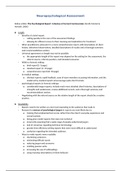
Online article: The Psychological Report: A Review of Current Controversies (Groth‐Marnat & Marnat &
Horvath, 2006)
Length
- benefits of a brief report:
o cutting quickly to the core of the assessment findings
o allowing for efficient access to their meaning and implications for treatment
- Other practitioners advocate for a more comprehensive report, with descriptions of client
history, behavioral observations, detailed descriptions of results and a thorough summary
and recommendations section.
- Universal agreement on length may not be possible:
o the appropriate length of the report may depend on the setting for the assessment, the
referral source, referral question, and intended consumer.
- Within a forensic setting:
o brief report(1–3 page),
o standard report (2–10 page)
o comprehensive report(10–50 page)
- In medical settings:
o shortest reports; rapid feedback, ease of team members accessing information, and the
model set by medical reports all encourage quite short formats.
- psychological reports in forensic settings:
o considerably longer reports; include much more detailed client histories, descriptions of
strengths and weaknesses, review additional records, and a thorough summary and
recommendations section.
- Negotiating with the referral source on the relative length of the report should be a routine
practice.
Readability
- Reports need to be written at a level corresponding to the audience that reads it.
- Reasons for overuse of psychological jargon in reports are most likely due to:
o training that emphasized test scores rather than the client’s everyday experience and
overall context.
o being given model reports that were too technical
o incorrectly assuming that a wide range of people understood jargon
o lack of consensus regarding technical terminology
o greater time efficiency writing reports that were more difficult to understand
o confusion regarding the intended audience.
- Ways to make reports more readable:
o shortening sentences
o minimizing difficult words
o reducing jargon and acronyms
o omitting passive verbs
o increasing the use of subheadings
o using everyday descriptions of client behavior
Online article: The Psychological Report: A Review of Current Controversies (Groth‐Marnat & Marnat &
Horvath, 2006)
Length
- benefits of a brief report:
o cutting quickly to the core of the assessment findings
o allowing for efficient access to their meaning and implications for treatment
- Other practitioners advocate for a more comprehensive report, with descriptions of client
history, behavioral observations, detailed descriptions of results and a thorough summary
and recommendations section.
- Universal agreement on length may not be possible:
o the appropriate length of the report may depend on the setting for the assessment, the
referral source, referral question, and intended consumer.
- Within a forensic setting:
o brief report(1–3 page),
o standard report (2–10 page)
o comprehensive report(10–50 page)
- In medical settings:
o shortest reports; rapid feedback, ease of team members accessing information, and the
model set by medical reports all encourage quite short formats.
- psychological reports in forensic settings:
o considerably longer reports; include much more detailed client histories, descriptions of
strengths and weaknesses, review additional records, and a thorough summary and
recommendations section.
- Negotiating with the referral source on the relative length of the report should be a routine
practice.
Readability
- Reports need to be written at a level corresponding to the audience that reads it.
- Reasons for overuse of psychological jargon in reports are most likely due to:
o training that emphasized test scores rather than the client’s everyday experience and
overall context.
o being given model reports that were too technical
o incorrectly assuming that a wide range of people understood jargon
o lack of consensus regarding technical terminology
o greater time efficiency writing reports that were more difficult to understand
o confusion regarding the intended audience.
- Ways to make reports more readable:
o shortening sentences
o minimizing difficult words
o reducing jargon and acronyms
o omitting passive verbs
o increasing the use of subheadings
o using everyday descriptions of client behavior