Synthesis of Ester Ethyl Ethanoate
During the making of the organic liquid Ester Ethyl Ethanoate, certain health and safety
procedures which are appropriate to this practical had to be followed throughout. This
included:
- Wearing correct PPE (lab coats, goggles)
- Tying back long hair
- Immediately cleaning up spills
- Working carefully with corrosive substances
- Making sure any electricity is away from liquid
- Making sure equipment is clamped securely
Synthesis of Ethyl Ethanoate
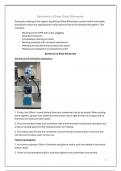
Setting up the distillation apparatus:
1. Firstly, the 250cm3 round bottom flask and condenser had to be joined. When putting
them together, grease was added to ensure there was a tight fit with no air gaps and so
that they can easily be taken apart.
2. The round bottom flask and condenser with a thermometer inside were clamped onto
a stand, leaving space for the heating mantle to fit below.
3. Two tubes were fit onto the condenser, one on the tap to allow water in and one put
into the sink to allow water to flow out.
Measuring reagents:
1. In a fume cupboard, 50cm3 of ethanol and glacial acetic acid was added to the round
bottom flask
2. 10cm3 of concentrated sulfuric acid was added to the same flask and swirled
1
, 3. Around 4-8 anti-bumping chips were then added to the flask to prevent super heating
when put on the heating mantle.
5. The heating mantle was set on 3-5 and mixture was brought to a slow boil for around
10 minutes.
6. As the mixture came to a boil, around 2/3 of the mixture was distilled into a flask and
cooled until it reached room temperature, leaving us with organic ester.
Isolation and neutralisation
1. 25cm3 of 30% sodium carbonate was slowly added to the organic ester in the conical
flask while using a glass rod to gently stir the mixture. This left two separate organic and
aqueous layers when poured into a separating funnel.
2. A stopper was added onto the funnel and shook carefully while occasionally opening
the tap. As high levels of CO2 is produced during neutralisation, the first addition of
sodium carbonate is done in the flask, to prevent the buildup of pressure.
3. After leaving the two layers to settle, the aqueous layer was drained from the funnel
and into a flask and tested until a pH of 5 is achieved, meaning all the aqueous layer has
been drained out.
Drying the Ester
1. Saturated calcium chloride solution was added to the ethyl ethanoate and shook well
to remove the aqueous layer and the neutralised ester solution was drained from the
separating funnel into a clean, dry conical flask with a stopper then weighed. (Before
weighing the ester, the mass of the flask and stopper had to be weighed to subtract from
the final mass of the ester)
2. 1-2g of anhydrous solution was added to the flask and swirled with the stopper on
then left to stand.
2
During the making of the organic liquid Ester Ethyl Ethanoate, certain health and safety
procedures which are appropriate to this practical had to be followed throughout. This
included:
- Wearing correct PPE (lab coats, goggles)
- Tying back long hair
- Immediately cleaning up spills
- Working carefully with corrosive substances
- Making sure any electricity is away from liquid
- Making sure equipment is clamped securely
Synthesis of Ethyl Ethanoate
Setting up the distillation apparatus:
1. Firstly, the 250cm3 round bottom flask and condenser had to be joined. When putting
them together, grease was added to ensure there was a tight fit with no air gaps and so
that they can easily be taken apart.
2. The round bottom flask and condenser with a thermometer inside were clamped onto
a stand, leaving space for the heating mantle to fit below.
3. Two tubes were fit onto the condenser, one on the tap to allow water in and one put
into the sink to allow water to flow out.
Measuring reagents:
1. In a fume cupboard, 50cm3 of ethanol and glacial acetic acid was added to the round
bottom flask
2. 10cm3 of concentrated sulfuric acid was added to the same flask and swirled
1
, 3. Around 4-8 anti-bumping chips were then added to the flask to prevent super heating
when put on the heating mantle.
5. The heating mantle was set on 3-5 and mixture was brought to a slow boil for around
10 minutes.
6. As the mixture came to a boil, around 2/3 of the mixture was distilled into a flask and
cooled until it reached room temperature, leaving us with organic ester.
Isolation and neutralisation
1. 25cm3 of 30% sodium carbonate was slowly added to the organic ester in the conical
flask while using a glass rod to gently stir the mixture. This left two separate organic and
aqueous layers when poured into a separating funnel.
2. A stopper was added onto the funnel and shook carefully while occasionally opening
the tap. As high levels of CO2 is produced during neutralisation, the first addition of
sodium carbonate is done in the flask, to prevent the buildup of pressure.
3. After leaving the two layers to settle, the aqueous layer was drained from the funnel
and into a flask and tested until a pH of 5 is achieved, meaning all the aqueous layer has
been drained out.
Drying the Ester
1. Saturated calcium chloride solution was added to the ethyl ethanoate and shook well
to remove the aqueous layer and the neutralised ester solution was drained from the
separating funnel into a clean, dry conical flask with a stopper then weighed. (Before
weighing the ester, the mass of the flask and stopper had to be weighed to subtract from
the final mass of the ester)
2. 1-2g of anhydrous solution was added to the flask and swirled with the stopper on
then left to stand.
2