
CASE 4
1. MUSCLE STRUCTURE
FUNCTIONS OF SKELETAL MUSCLE
o Force production for locomotion and breathing
o Force production for postural support
o Heat production during cold stress (shivering)
o Latent amino acid reservoir (starvation)
o > 400 skeletal muscles in the human body
SKELETAL MUSCLE STRUCTION
,MACRO-ANATOMY OF A MUSCLE
o Connective tissue, muscle fibers, nerves and blood vessels
o Connective tissue:
- Epimysium: dense irregular tissue that is around the whole muscle.
- Perimysium and fascicles: muscle fibers are grouped into fascicles which are surrounded
by perimysium.
- Endomysium: fine areolar connective tissue that wraps around each individual muscle fiber.
o Skeletal muscles are connected to bones and are over wrapping minimum one joint
o They are attached to the connective tissue of the bone either indirect via the tendon
(aponeurosis)
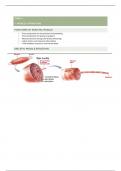
,MICRO-ANATOMY OF THE MUSCLE
o Individual muscle fibers
o Each muscle fiber is a
long cylindrical cell
which has a lot of nuclei
that lies beneath the
sarcolemma (plasma
membrane)
o Cytosol → sarcoplasm
o Each muscle cell
contains thousands of
myofibrils.
- Cell organelles lay
between myofibrils
- Mitochondria
- Sarcoplasmic
reticulum
- T-tubules
o Muscle fibers: Contain dark A band and light I band.
o Myofibrils: Composed of contractile units called sarcomeres, connected end-to-end by Z-line.
o I-band: Contains only thin actin filaments, anchored in the Z-disc.
o A-band: Includes H-zone (only thick myosin filaments) and M-line (myosin filaments connected
by myomesin).
o Myosin filaments: Made of myosin molecules with globular heads and tails, which bind ATP and
generate force by forming cross-bridges with actin.
o Actin filaments:
- Made of G-actin (globular actin), which polymerizes to form F-actin (filamentous actin).
- Stabilized by tropomyosin, which spirals around F-actin and blocks myosin-binding sites
when muscle is relaxed.
o Interacts with troponin, which consists of:
, - TnI: Inhibits actin-myosin interaction.
- TnT: Binds tropomyosin to position it properly.
- TnC: Binds calcium, triggering muscle contraction.
o Titin: Elastic filaments extending from Z-disc to M-line, maintaining sarcomere structure and
preventing overstretching.
o Dystrophin: Connects sarcomere to basal lamina and collagen fibers for structural support.
o Nebulin: Regulates the length of actin filaments.
o The human have approximately 650 muscles and 187 joints
THE SARCOMERE
1. MUSCLE STRUCTURE
FUNCTIONS OF SKELETAL MUSCLE
o Force production for locomotion and breathing
o Force production for postural support
o Heat production during cold stress (shivering)
o Latent amino acid reservoir (starvation)
o > 400 skeletal muscles in the human body
SKELETAL MUSCLE STRUCTION
,MACRO-ANATOMY OF A MUSCLE
o Connective tissue, muscle fibers, nerves and blood vessels
o Connective tissue:
- Epimysium: dense irregular tissue that is around the whole muscle.
- Perimysium and fascicles: muscle fibers are grouped into fascicles which are surrounded
by perimysium.
- Endomysium: fine areolar connective tissue that wraps around each individual muscle fiber.
o Skeletal muscles are connected to bones and are over wrapping minimum one joint
o They are attached to the connective tissue of the bone either indirect via the tendon
(aponeurosis)
,MICRO-ANATOMY OF THE MUSCLE
o Individual muscle fibers
o Each muscle fiber is a
long cylindrical cell
which has a lot of nuclei
that lies beneath the
sarcolemma (plasma
membrane)
o Cytosol → sarcoplasm
o Each muscle cell
contains thousands of
myofibrils.
- Cell organelles lay
between myofibrils
- Mitochondria
- Sarcoplasmic
reticulum
- T-tubules
o Muscle fibers: Contain dark A band and light I band.
o Myofibrils: Composed of contractile units called sarcomeres, connected end-to-end by Z-line.
o I-band: Contains only thin actin filaments, anchored in the Z-disc.
o A-band: Includes H-zone (only thick myosin filaments) and M-line (myosin filaments connected
by myomesin).
o Myosin filaments: Made of myosin molecules with globular heads and tails, which bind ATP and
generate force by forming cross-bridges with actin.
o Actin filaments:
- Made of G-actin (globular actin), which polymerizes to form F-actin (filamentous actin).
- Stabilized by tropomyosin, which spirals around F-actin and blocks myosin-binding sites
when muscle is relaxed.
o Interacts with troponin, which consists of:
, - TnI: Inhibits actin-myosin interaction.
- TnT: Binds tropomyosin to position it properly.
- TnC: Binds calcium, triggering muscle contraction.
o Titin: Elastic filaments extending from Z-disc to M-line, maintaining sarcomere structure and
preventing overstretching.
o Dystrophin: Connects sarcomere to basal lamina and collagen fibers for structural support.
o Nebulin: Regulates the length of actin filaments.
o The human have approximately 650 muscles and 187 joints
THE SARCOMERE



