portage pathophysiology
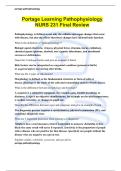
Portage Learning Pathophysiology
NURS 231 Final Review
Pathophysiology is defined as not only the cellular and organ changes that occur
with disease, but also the effects that these changes have on total body function.
What is the definition of "pathophysiology"?
Biologic agents (bacteria, viruses), physical forces (trauma, burns, radiation),
chemical agents (poisons, alcohol), one’s genetic inheritance, and nutritional
excesses or deficiencies.
Name the 5 etiologic factors and give an example if listed.
Risk factors can be categorized as congenital conditions (present at birth)
or acquired defects (occurring after birth).
What are the 2 types of risk factors?
Morphology is defined as the fundamental structure or form of cells or
tissues. Histology is the study of the cells and extracellular matrix of body tissues.
What is the difference between morphology and histology?
A symptom is a subjective complaint, for example pain, trouble breathing, or
dizziness. A sign is an objective manifestation, for example an elevated temperature,
a swollen extremity, or changes in pupil size.
Describe the difference between signs and symptoms and give an example of each.
The diagnostic process requires a careful history, physical examination (PE), and
sometimes diagnostic tests.
What are 3 important processes when coming to a diagnosis?
Validity is how a tool measures what it is intended to measure. Reliability is how
likely the same result will occur if repeated. Sensitivity is the proportion of people
with a disease who are positive for that disease. Specificity are people without the
disease who are negative on a given test.
Explain validity, reliability, sensitivity, and specificity.
portage pathophysiology
,portage pathophysiology
Epidemiology is the study of disease occurrence in human populations. It tracks age,
race, dietary habits, lifestyle, or geographic location.
Define epidemiology and name some things that it tracks.
Incidence is the number of new cases in a population at risk during a specified
time. Prevalence is the number of people with the disease in a population in a given
time.
What is the difference between incidence and prevalence?
Morbidity is the effect of an illness on one’s life. Mortality statistics deal with the
cause of death in a population.
Define mortality and morbidity.
Primary prevention is to remove risk factors to prevent disease from occurring-
taking folic acid while pregnant to prevent neural tube defects, vaccinating children
to prevent communicable disease, eating healthy and exercising to prevent heart
disease, and wearing seatbelts or helmets. Secondary prevention aims to detect and
treat disease early, usually while the disease is asymptomatic and curable- annual
Pap smears to detect early cervical cancer, encouraging smoking cessation, checking
blood pressure and cholesterol, and colonoscopy screening. Tertiary
prevention occurs after a disease has been diagnosed and clinical intervention is
needed to reduce complications or deterioration- certain medications one must take
after a heart attack to help reduce the risk of a future event or death.
Define primary, secondary, and tertiary prevention and give an example of each.
Evidence-based practice is the conscientious, explicit, and judicious use of current
best evidence in making decisions about the care of individual patients. This is to
counteract “the way things have always been done,” and to practice based on
clinical research.
Why is evidence-based practice important?
All eukaryotic cells have three primary structures that are considered the functional
components of the cell. These are the nucleus, the cytoplasm, and the plasma
membrane.
What are the 3 primary structures of the cell?
portage pathophysiology
,portage pathophysiology
The nucleus is the control center for the cell and contains most of the hereditary
material, DNA and RNA.
What is the function of the nucleus?
Chromatin, nucleolus, and nuclear envelope
Name 3 structures within the nucleus.
The organelles in the cytoplasm include the ribosomes, ER, Golgi complex,
mitochondria, and lysosomes.
What organelles are located in the cytoplasm?
The ribosomes are the site of protein synthesis in the cell. The Rough ER has
ribosomes and functions to synthesize lysosomal enzymes. The smooth ER does not
have ribosomes and is the site for lipid, lipoprotein, and steroid hormone synthesis.
What are the roles of the ribosomes, rough ER, and smooth ER?
Lysosomes are the digestive system of the cell. Peroxisomes are smaller than
lysosomes and function in the control of free radicals. The mitochondria are aptly
termed the “power plants” of the cell, as they transform organic compounds (energy
in food) into cellular energy for the cell.
What is the function of the lysosomes, peroxisomes, and mitochondria?
The cytoskeleton contains a network of microtubules, microfilaments, intermediate
filaments, and thick filaments. They control cell shape and movement.
What is contained in the cytoskeleton and what is its function?
Cilia can be found on many epithelial linings, including the nasal sinuses and
bronchi in the upper respiratory system. In the human body, only spermatozoa
contain flagella.
Give examples of where cilia and flagella are found in the human body.
The cell membrane controls the transport of materials from the outside fluids to
within, binds hormone receptors, helps with the conduction of electrical currents in
nerve and muscle cells, and aids in the regulation of cell growth and proliferation.
What are the 4 functions of the cell membrane?
portage pathophysiology
, portage pathophysiology
In complex organisms, cells develop special functions, contribute to growth, and
adapt to changes. Cells must have the ability to communicate with one another,
transport substances in and out, and respond to these changes.
Why do cells need to communicate with one another?
Autocrine, paracrine, endocrine, and synaptic signaling
Name the 4 types of cell signaling.
Every cell has a distinct set of surface receptors that allow it to respond to signaling
molecules in a specific way. These proteins can increase or decrease in number
according to the needs of the cell. When there are too many chemical messengers
present, the number of active receptors decreases in a process called down-
regulation. When the messengers are lacking, the number of active receptors
increases through up-regulation.
Know the process of up and down regulation.
G-protein-linked receptors - largest number, on/off switch, outside of cell
Enzyme linked - bind outside of cell, activates associated domain with enzyme activity
ion-channel linked - nerve and muscle cells, open/close ion channels
Understand the 3 types of receptor proteins.
Diffusion is the process by which electrolytes move from an area of higher
concentration on one side of the membrane to an area of lower concentration on the
other side. Facilitated diffusion uses a transport protein to help lipid insoluble or
large molecules pass through the membrane, that otherwise would not be able to get
through. Active transport is used when cells use energy to move ions against an
electrical or chemical gradient.
Explain diffusion, facilitated diffusion, and active transport.
The most studied active transport system is the sodium-potassium (Na+/K+)-ATPase
pump. The pump moves sodium from inside the cell to the extracellular region and
returns potassium to the inside of the cell. If this process didn’t occur, sodium would
remain in the cell and water would follow, causing the cell to swell.
What is the most important active transport system and why is it important?
portage pathophysiology
Portage Learning Pathophysiology
NURS 231 Final Review
Pathophysiology is defined as not only the cellular and organ changes that occur
with disease, but also the effects that these changes have on total body function.
What is the definition of "pathophysiology"?
Biologic agents (bacteria, viruses), physical forces (trauma, burns, radiation),
chemical agents (poisons, alcohol), one’s genetic inheritance, and nutritional
excesses or deficiencies.
Name the 5 etiologic factors and give an example if listed.
Risk factors can be categorized as congenital conditions (present at birth)
or acquired defects (occurring after birth).
What are the 2 types of risk factors?
Morphology is defined as the fundamental structure or form of cells or
tissues. Histology is the study of the cells and extracellular matrix of body tissues.
What is the difference between morphology and histology?
A symptom is a subjective complaint, for example pain, trouble breathing, or
dizziness. A sign is an objective manifestation, for example an elevated temperature,
a swollen extremity, or changes in pupil size.
Describe the difference between signs and symptoms and give an example of each.
The diagnostic process requires a careful history, physical examination (PE), and
sometimes diagnostic tests.
What are 3 important processes when coming to a diagnosis?
Validity is how a tool measures what it is intended to measure. Reliability is how
likely the same result will occur if repeated. Sensitivity is the proportion of people
with a disease who are positive for that disease. Specificity are people without the
disease who are negative on a given test.
Explain validity, reliability, sensitivity, and specificity.
portage pathophysiology
,portage pathophysiology
Epidemiology is the study of disease occurrence in human populations. It tracks age,
race, dietary habits, lifestyle, or geographic location.
Define epidemiology and name some things that it tracks.
Incidence is the number of new cases in a population at risk during a specified
time. Prevalence is the number of people with the disease in a population in a given
time.
What is the difference between incidence and prevalence?
Morbidity is the effect of an illness on one’s life. Mortality statistics deal with the
cause of death in a population.
Define mortality and morbidity.
Primary prevention is to remove risk factors to prevent disease from occurring-
taking folic acid while pregnant to prevent neural tube defects, vaccinating children
to prevent communicable disease, eating healthy and exercising to prevent heart
disease, and wearing seatbelts or helmets. Secondary prevention aims to detect and
treat disease early, usually while the disease is asymptomatic and curable- annual
Pap smears to detect early cervical cancer, encouraging smoking cessation, checking
blood pressure and cholesterol, and colonoscopy screening. Tertiary
prevention occurs after a disease has been diagnosed and clinical intervention is
needed to reduce complications or deterioration- certain medications one must take
after a heart attack to help reduce the risk of a future event or death.
Define primary, secondary, and tertiary prevention and give an example of each.
Evidence-based practice is the conscientious, explicit, and judicious use of current
best evidence in making decisions about the care of individual patients. This is to
counteract “the way things have always been done,” and to practice based on
clinical research.
Why is evidence-based practice important?
All eukaryotic cells have three primary structures that are considered the functional
components of the cell. These are the nucleus, the cytoplasm, and the plasma
membrane.
What are the 3 primary structures of the cell?
portage pathophysiology
,portage pathophysiology
The nucleus is the control center for the cell and contains most of the hereditary
material, DNA and RNA.
What is the function of the nucleus?
Chromatin, nucleolus, and nuclear envelope
Name 3 structures within the nucleus.
The organelles in the cytoplasm include the ribosomes, ER, Golgi complex,
mitochondria, and lysosomes.
What organelles are located in the cytoplasm?
The ribosomes are the site of protein synthesis in the cell. The Rough ER has
ribosomes and functions to synthesize lysosomal enzymes. The smooth ER does not
have ribosomes and is the site for lipid, lipoprotein, and steroid hormone synthesis.
What are the roles of the ribosomes, rough ER, and smooth ER?
Lysosomes are the digestive system of the cell. Peroxisomes are smaller than
lysosomes and function in the control of free radicals. The mitochondria are aptly
termed the “power plants” of the cell, as they transform organic compounds (energy
in food) into cellular energy for the cell.
What is the function of the lysosomes, peroxisomes, and mitochondria?
The cytoskeleton contains a network of microtubules, microfilaments, intermediate
filaments, and thick filaments. They control cell shape and movement.
What is contained in the cytoskeleton and what is its function?
Cilia can be found on many epithelial linings, including the nasal sinuses and
bronchi in the upper respiratory system. In the human body, only spermatozoa
contain flagella.
Give examples of where cilia and flagella are found in the human body.
The cell membrane controls the transport of materials from the outside fluids to
within, binds hormone receptors, helps with the conduction of electrical currents in
nerve and muscle cells, and aids in the regulation of cell growth and proliferation.
What are the 4 functions of the cell membrane?
portage pathophysiology
, portage pathophysiology
In complex organisms, cells develop special functions, contribute to growth, and
adapt to changes. Cells must have the ability to communicate with one another,
transport substances in and out, and respond to these changes.
Why do cells need to communicate with one another?
Autocrine, paracrine, endocrine, and synaptic signaling
Name the 4 types of cell signaling.
Every cell has a distinct set of surface receptors that allow it to respond to signaling
molecules in a specific way. These proteins can increase or decrease in number
according to the needs of the cell. When there are too many chemical messengers
present, the number of active receptors decreases in a process called down-
regulation. When the messengers are lacking, the number of active receptors
increases through up-regulation.
Know the process of up and down regulation.
G-protein-linked receptors - largest number, on/off switch, outside of cell
Enzyme linked - bind outside of cell, activates associated domain with enzyme activity
ion-channel linked - nerve and muscle cells, open/close ion channels
Understand the 3 types of receptor proteins.
Diffusion is the process by which electrolytes move from an area of higher
concentration on one side of the membrane to an area of lower concentration on the
other side. Facilitated diffusion uses a transport protein to help lipid insoluble or
large molecules pass through the membrane, that otherwise would not be able to get
through. Active transport is used when cells use energy to move ions against an
electrical or chemical gradient.
Explain diffusion, facilitated diffusion, and active transport.
The most studied active transport system is the sodium-potassium (Na+/K+)-ATPase
pump. The pump moves sodium from inside the cell to the extracellular region and
returns potassium to the inside of the cell. If this process didn’t occur, sodium would
remain in the cell and water would follow, causing the cell to swell.
What is the most important active transport system and why is it important?
portage pathophysiology