Week 6 - 7/10/2024
CHAPTER 19
TYPES OG GOODS
1
FACTORS OF DIVIDING GOODS INTO TYPES
. Non-excludable = a good in which people who don’t pay cannot be
easily prevented from using the good (e.g. asteroid deflection)
. Excludable = when a person can be easily prevented from using a
good (e.g. jeans)
. Non-rival = a good in which if it’s used by one person, it doesn’t
reduce the ability of another person to use it (e.g. asteroid deflection)
. Rival = a good that if it’s used, another person can’t use it (e.g. jeans)
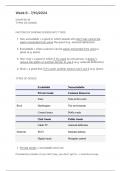
TYPES OF GOODS
4
3
2
1
. Private goods = excludable and rival
Provided by markets (if you don’t pay, you don’t get it) -> incentive to pay
,2
. Public goods = non-excludable and non-rival
Losses from failure to provide a good can be large
Limitless of free rider problem
– Governments can tax to produce the public good and make people
better off
– Prevents free rider, since people involuntarily pay BUT:
Forced rider = someone who pays a share of the costs of a public good but
doesn’t enjoy the benefits
What quantity of the public good should the government produce?
– The amount that maximises consumer plus producer surplus or the
total benefits of the public good minus total costs
BUT some individuals value the public good more than others -> no easy way to
find out exactly how much each person values the good.
Voting and other democratic procedures -> help to produce information about
the demand for public goods
– Unlikely to work as well at providing the optimal amounts of public
goods as do markets at providing the optimal amounts of private
goods
. Club goods = excludable and non-rival
e.g. shows on Netflix (must pay to watch but other people can watch it)
Hard to make a profit out of these goods without losing creativity, diversity and
responsiveness provided by markets
– Advertising can help
. Common resources = non-excludable and rival
E.g. tuna in the ocean -> until they are caught, the tuna are unowned (non-
excludable because hard to prevent anyone from fishing it)
-> when someone catches it, it can’t be caught again (rival)
Tragedy of commons = tendency of any resource that is unowned (non-
excludable) to be overused and undermaintained
Result: these goods are driven towards extinction
, e.g. overfishing
– Not primarily caused by increased demand but because fish are
unowned (unlike chickens so they aren’t going extinct)
Solutions:
– Instituting new property rights
BUT
No automatic and may require extensive understanding of economic principles
and agreement among many of the world’s governments
CHAPTER 32
AGGREGATE DEMAND AND SUPPLY
Business fluctuations = fluctuations in the growth rate of real GDP around its
trend growth rate
Recession = a significant, widespread decline in real income and employment
THE AGGREGATE DEMAND CURVE
= shows all the combinations of inflation and real growth that are consistent
with a specified rate of spending growth
SHIFTS IN THE AGGREGATE DEMAND CURVE
AD curve for a spending growth rate of 5% -> all the points on this line add up
to 5%.
CHAPTER 19
TYPES OG GOODS
1
FACTORS OF DIVIDING GOODS INTO TYPES
. Non-excludable = a good in which people who don’t pay cannot be
easily prevented from using the good (e.g. asteroid deflection)
. Excludable = when a person can be easily prevented from using a
good (e.g. jeans)
. Non-rival = a good in which if it’s used by one person, it doesn’t
reduce the ability of another person to use it (e.g. asteroid deflection)
. Rival = a good that if it’s used, another person can’t use it (e.g. jeans)
TYPES OF GOODS
4
3
2
1
. Private goods = excludable and rival
Provided by markets (if you don’t pay, you don’t get it) -> incentive to pay
,2
. Public goods = non-excludable and non-rival
Losses from failure to provide a good can be large
Limitless of free rider problem
– Governments can tax to produce the public good and make people
better off
– Prevents free rider, since people involuntarily pay BUT:
Forced rider = someone who pays a share of the costs of a public good but
doesn’t enjoy the benefits
What quantity of the public good should the government produce?
– The amount that maximises consumer plus producer surplus or the
total benefits of the public good minus total costs
BUT some individuals value the public good more than others -> no easy way to
find out exactly how much each person values the good.
Voting and other democratic procedures -> help to produce information about
the demand for public goods
– Unlikely to work as well at providing the optimal amounts of public
goods as do markets at providing the optimal amounts of private
goods
. Club goods = excludable and non-rival
e.g. shows on Netflix (must pay to watch but other people can watch it)
Hard to make a profit out of these goods without losing creativity, diversity and
responsiveness provided by markets
– Advertising can help
. Common resources = non-excludable and rival
E.g. tuna in the ocean -> until they are caught, the tuna are unowned (non-
excludable because hard to prevent anyone from fishing it)
-> when someone catches it, it can’t be caught again (rival)
Tragedy of commons = tendency of any resource that is unowned (non-
excludable) to be overused and undermaintained
Result: these goods are driven towards extinction
, e.g. overfishing
– Not primarily caused by increased demand but because fish are
unowned (unlike chickens so they aren’t going extinct)
Solutions:
– Instituting new property rights
BUT
No automatic and may require extensive understanding of economic principles
and agreement among many of the world’s governments
CHAPTER 32
AGGREGATE DEMAND AND SUPPLY
Business fluctuations = fluctuations in the growth rate of real GDP around its
trend growth rate
Recession = a significant, widespread decline in real income and employment
THE AGGREGATE DEMAND CURVE
= shows all the combinations of inflation and real growth that are consistent
with a specified rate of spending growth
SHIFTS IN THE AGGREGATE DEMAND CURVE
AD curve for a spending growth rate of 5% -> all the points on this line add up
to 5%.