100% tevredenheidsgarantie Direct beschikbaar na je betaling Lees online óf als PDF Geen vaste maandelijkse kosten 4.2 TrustPilot
logo-home
Tentamen (uitwerkingen)

ENG1501 Assignment 3 (QUALITY ANSWERS) 2025

Beoordeling
5,0
(1)
Verkocht
5
Pagina's
15
Cijfer
A+
Geüpload op
17-07-2025
Geschreven in
2024/2025

This document contains workings, explanations and solutions to the ENG1501 Assignment 3 (QUALITY ANSWERS) 2025. For assistance whats-app us on 0.6.8..8.1.2..0.9.3.4... Where you have been asked to provide quotations and you do not, marks will be deducted for this omission. • All quotations should be referenced correctly. One mark will be deducted for failure to comply. 1. ‘Man lands on the moon’ sometimes uses first-person narration. How does first-person narration contribute to the story’s meaning? In your discussion, quote at least two instances where first-person narration has been used to support your argument. (7) 2. The central conflict in the story stems from the contrasting beliefs held by Makhulu and her mother. Discuss this conflict and explain how it is resolved. Quote three instances from the text to support your discussion. (7) 3. Discuss how the setting of ‘Man lands on the moon’ impacts the events in the story. You will need to identify the setting first, before explaining how it influences events in the story. Remember to quote from the text to support your answer. (7) 3 4. Explain the significance of the title in relation to the short story. In your discussion, explain why you think the author chose the title. Then, provide a title that you think could be used as an alternative. (7) 5. In your study guide (TL501) you are introduced to a characterisation table (pg. 46-47). Using any THREE prompts from that table discuss the characterisation of one character from the short story. Your answer MUST include the prompt questions, responses to the prompts, as well as evidence from the short story to support the responses. NB: Do not use evidence already given in the study guide (7) For the ENG1501 module team to improve teaching and learning, complete the survey questions below. Copy and paste the tables below and complete your rating of each descriptor, which is rated between 1 and 5, with the following representations for each rating: 1 means strongly disagree 2 means disagree 3 means neutral 4 means agree 5 means strongly agree Learning Material Descriptor Rating out of 5 1. Tutorial Letter 101 was a useful tool to understand what is expected of me in this module. 2. Tutorial Letter 501 (Study Guide) helped me to understand the module content. 3. Tutorial Letter 501 (Study Guide) enabled me to analyse the various prescribed texts according to their genres. 4. The activities for all genres in Tutorial Letter 102 assisted me in developing my skill of literary analysis. 5. The Additional Resources helped me to navigate the module site and the module content. 6. Any further comments on the Learning Material: _________________________________________________________________________________________________________________________________________________________________________________________________________ Virtual teaching Descriptor Rating out of 5 1. The virtual classes were announced on time for me to prepare for attendance. 2. Where I could not attend, video recordings of virtual classes were always accessible for me to catch up. 3. In the virtual classes that I attended, I found that the lecturers presenting had prepared well for the classes. 4. The content of the virtual classes was relevant. 5. The content of the virtual classes addressed my learning needs as a student. 6. The presentation of the module content during the virtual class was clear. 7. During virtual classes, I was offered an opportunity to ask clarity-seeking questions. 8. The lecturers answered questions that students asked during the virtual classes. 9. The e-tutor activities helped to improve my understanding of the module content. 10. The monthly Drop-in sessions were a useful way to engage with lecturers. 11. The Nudging emails helped me to keep up to date with my engagement in the module site and e-tutor group. 12. The Nudging emails helped to remind me of assignment due dates. 13 The Nudging emails helped to keep me motivated after the release of assignment results. 12. Discuss one thing that could improve virtual teaching in this module. A central plot point and theme in the novel Small Things is the narrator’s love for Desiree. His love for her starts when he is a schoolboy and is the first thing relayed in the opening lines of the novel, and his feelings about her remain a significant focus throughout the novel, which spans across his life. His feelings about Desiree range from obsession to desolation, and he poignantly describes his love for her as being like a moth drawn to a flame, “Desiree the confident flame, and I the suicidal moth” (Mohlele 2013: 60).* Question: Using the extract detailed below as a starting point, write an essay in which you discuss the narrator’s love for and relationship with Desiree in the novel. In particular, focus on: the theme of love; on how the narrator summarises his relationship with Desiree in the extract; and on how the narrator describes his feelings towards Desiree, and hers towards him, throughout the novel. Your response should closely consider diction and other literary devices as relevant to the topic. *NB: This page reference is from the electronic edition of the book. In the electronic edition, the extract on which you are required to focus begins on p. 60 with the words, “Something unexpected happens. I watch a moth, …” and ends on p. 61 with the words, “To think. All of three hours” (Mohlele 2013: 60 – 61). If you are using the hardcopy (printed) prescribed edition of the book instead, the extract on which you are required to focus is the same, but it begins on p. 83 with the words, “Something unexpected happens. I watch a moth, …” and ends on p. 84 with the words, “To think. All of three hours” (Mohlele 2013: 83 – 84). When writing your essay: • Focus on the theme of love and how the narrator describes his love for Desiree, both in the given extract and elsewhere in the novel. • Consider how, in turn, Desiree’s love for the narrator (or lack thereof) is described in the novel. • You may also want to consider, as relevant, Desiree’s characterisation (which, remember, we only see through the subjective view of the first-person narrator) in general. • Focus on how the narrator’s relationship with Desiree is depicted throughout the novel. • Consider the impact of the ‘moth to a flame’ metaphor for describing their love and relationship; in particular, consider how Desiree, the flame, is described in this passage, and how the narrator, the moth, is described. • Reflect on how the narrator’s love for Desiree evolves throughout the novel, which spans across several decades of his life. • Ensure that you closely examine diction and other literary devices in discussing the above points. Before you start writing your essay, you should: 1. Revise the sections on ‘Characterisation’ (p. 45) and ‘Theme’ (p. 55) in Unit 3 of your Study Guide (Tutorial Letter 501). 2. Then, carefully study Unit 4 of Tutorial Letter 501. 3. Then, closely consider the given extract from Small Things. When performing your close reading of the extract, please do, as instructed, pay careful attention to diction (that is, how words are used and how they convey meaning). Remember that literary devices such as metaphor, imagery, hyperbole, and so on are all part of diction and are the building blocks of any novel. When doing a careful reading of a novel, or any literary work, examining diction (word choice) is where you start. 4. Carefully plan your essay, following the steps in the section on ‘How to Write about a Novel’ in Unit 4 of your Study Guide. In a response of 300 to 400 words, reflect on Unit 4 of your Study Guide (Tutorial Letter 501) and your experience of the prescribed novel, Small Things. Write your reflections in paragraph form guided by the questions below. 1. Prior to embarking on your study of this module and this unit, did you read any novels? If you did previously read any novels: Share the title of one novel you liked, reflecting on what you liked about it (refer to specific aspects of the novel that appealed to you, such as, for example, its genre, setting and/or characters). If you can, also share the title of a novel you have (tried to) read but did not like, explaining what you did not like about it. If you did not previously read any novels, explain briefly why not: What prevented you from reading a novel (this could be external circumstances or simply your own interests)? 2. Reflecting closely on your study of Unit 4, explain which parts of the unit you understood well (be sure to state something specific you have learnt!), and explain which parts of the unit you found difficult to understand or grasp (remember, be specific!). Refer closely to the unit in your response. 3. Describe your experience of reading the prescribed novel, Small Things, and briefly relay your thoughts on the novel. Did you find it an ‘easy’ or a ‘difficult’ read? Did you find it interesting—why/why not? Who was your favourite character, and why? Who was your least favourite character, and why? How did reading the novel make you feel? What did you think of the ending of the novel? Where you have been asked to provide quotations and you do not, marks will be deducted for this omission. • All quotations should be referenced correctly. One mark will be deducted for failure to comply. 1. ‘Man lands on the moon’ sometimes uses first-person narration. How does first-person narration contribute to the story’s meaning? In your discussion, quote at least two instances where first-person narration has been used to support your argument. (7) 2. The central conflict in the story stems from the contrasting beliefs held by Makhulu and her mother. Discuss this conflict and explain how it is resolved. Quote three instances from the text to support your discussion. (7) 3. Discuss how the setting of ‘Man lands on the moon’ impacts the events in the story. You will need to identify the setting first, before explaining how it influences events in the story. Remember to quote from the text to support your answer. (7) 3 4. Explain the significance of the title in relation to the short story. In your discussion, explain why you think the author chose the title. Then, provide a title that you think could be used as an alternative. (7) 5. In your study guide (TL501) you are introduced to a characterisation table (pg. 46-47). Using any THREE prompts from that table discuss the characterisation of one character from the short story. Your answer MUST include the prompt questions, responses to the prompts, as well as evidence from the short story to support the responses. NB: Do not use evidence already given in the study guide (7)

Meer zien Lees minder
Instelling
Vak


Oeps! We kunnen je document nu niet laden. Probeer het nog eens of neem contact op met support.

Gekoppeld boek

Geschreven voor

Instelling
Vak

Documentinformatie

Geüpload op
17 juli 2025
Aantal pagina's
15
Geschreven in
2024/2025
Type
Tentamen (uitwerkingen)
Bevat
Vragen en antwoorden

Onderwerpen

Voorbeeld van de inhoud

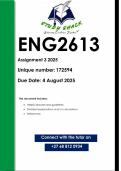
ENG1501
Assignment 3 2025

Unique number:

Due Date: 11 August 2025


This document includes:

 Helpful answers and guidelines
 Detailed explanations and/ or calculations
 References


Connect with the tutor on

+27 68 812 0934

, © Study Shack 2025. All rights Reserved +27 68 812 0934

Beoordelingen van geverifieerde kopers

Alle reviews worden weergegeven
4 maanden geleden

5,0

1 beoordelingen

5
1
4
0
3
0
2
0
1
0
Betrouwbare reviews op Stuvia

Alle beoordelingen zijn geschreven door echte Stuvia-gebruikers na geverifieerde aankopen.

Maak kennis met de verkoper

Seller avatar
De reputatie van een verkoper is gebaseerd op het aantal documenten dat iemand tegen betaling verkocht heeft en de beoordelingen die voor die items ontvangen zijn. Er zijn drie niveau’s te onderscheiden: brons, zilver en goud. Hoe beter de reputatie, hoe meer de kwaliteit van zijn of haar werk te vertrouwen is.
StudyShack Cornerstone College, Pretoria, Gauteng
Volgen Je moet ingelogd zijn om studenten of vakken te kunnen volgen
Verkocht
30697
Lid sinds
9 jaar
Aantal volgers
13937
Documenten
1800
Laatst verkocht
2 weken geleden
Study Guides for Unisa Students

4,1

1780 beoordelingen

5
971
4
335
3
264
2
80
1
130

Recent door jou bekeken

Waarom studenten kiezen voor Stuvia

Gemaakt door medestudenten, geverifieerd door reviews

Kwaliteit die je kunt vertrouwen: geschreven door studenten die slaagden en beoordeeld door anderen die dit document gebruikten.

Niet tevreden? Kies een ander document

Geen zorgen! Je kunt voor hetzelfde geld direct een ander document kiezen dat beter past bij wat je zoekt.

Betaal zoals je wilt, start meteen met leren

Geen abonnement, geen verplichtingen. Betaal zoals je gewend bent via iDeal of creditcard en download je PDF-document meteen.

Student with book image

“Gekocht, gedownload en geslaagd. Zo makkelijk kan het dus zijn.”

Alisha Student

Veelgestelde vragen