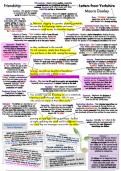
AO1 Planning Sheet
Question: Explain divine command theory
Introduction:
Absolutist, deontological and objective ethical theory, part of normative
ethics which is the study of right and wrong that underlie specific ethical
theories.
Meta-ethics = looks ‘beyond’, coming from ‘meta’ in Greek, specific
ethical theories to larger questions about the meaning, origin and
language of morality.
Theme Content Evidence
Normative theory
What is DCT? raising the meta-ethical
question ‘is ethical
behavior dependent on
a divine being?’
It is absolutist
promoting a standard
of right and wrong for
all humans e.g. ‘do not
kill’
Objective theory so
morality is independent
of one’s feelings or
thoughts.
Deontological because
people believe they
have a duty to act on
God’s laws regardless
of the consequences.
Approach of many “to be religious and to
monotheistic make religious claims is to
, religions = morality be committed to a set of
Morality from a is a response to moral values”
divine source divine revelation. (Braithwaite)
Moses receives 10
commandments,
Jesus announcing the “Your Kingdom come,
principles of the your will be done, on
sermon on the earth as it is in heaven”
mount. Matthew
DCT says that one
sees an action as
‘right’ or ‘wrong’
based on what God
Kant says that we have to
says.
An omnipotent and believe in God because
omniscient God = morality is too much for
can reveal how us to bear. We need
humans ought to act. guidance which is why
‘strong form’ = God divine command theory is
has commanded advantageous.
specific ethical
actions therefore
must be followed to
the last detail.
‘weak form’ = god
does not care about
the minute details
but commands that
determine
boundaries.
Obedience to God’s
ethics ensures good
eschatological
consequences e.g.
going to heaven
By subscribing to
religion = must obey
the divine command
, Does God command X
Euthyphro because it is good, or is X
dilemma good because God
commands it?
If the first part is
true, then God can
no longer be
considered as
omnipotent because
God is not the source
of all goodness
because things can
exist as good
independently.
LIMITED GOD.
If the latter is true,
goodness sis an
arbitrary concept
that can vary
according to the
whim og God. God
could command
murder, genocide
and rape and these
acts would be
considered good.
Conflict with
phronesis because
you don’t need to
know why you do it,
you just accept it.
Even
though God
gave phronesis.
Advantages and Appealing: `Anscombe talks about
, problems of her modern divine
divine command theory where
Gives people something
command to fall back on, people she suggests that we
theory like an authority to lean move away from viewing
on morality as law because
Very simple we have ' given up on
It means moral God's existence', rather
absolutes are a thing we should see morality as
because it means it is a virtue.
easier to get to
heaven
Kai Nielsen questions how
know that God is good
Problematic:
because logically morality
Excuses behaviour and religion have to be
Gives people a independent. We have to
superior complex have a criteria for
It is assuming that
goodness, independent of
God is good God being good.
Questions God’s
omnibenevolence, is
it loving if God
commands what is
right but allows
people to stray from
it?
Questions God’s
omnipotence if
people could just
refuse his
commands.
Specialist Terminology:
Synoptic Links:
Question: Explain divine command theory
Introduction:
Absolutist, deontological and objective ethical theory, part of normative
ethics which is the study of right and wrong that underlie specific ethical
theories.
Meta-ethics = looks ‘beyond’, coming from ‘meta’ in Greek, specific
ethical theories to larger questions about the meaning, origin and
language of morality.
Theme Content Evidence
Normative theory
What is DCT? raising the meta-ethical
question ‘is ethical
behavior dependent on
a divine being?’
It is absolutist
promoting a standard
of right and wrong for
all humans e.g. ‘do not
kill’
Objective theory so
morality is independent
of one’s feelings or
thoughts.
Deontological because
people believe they
have a duty to act on
God’s laws regardless
of the consequences.
Approach of many “to be religious and to
monotheistic make religious claims is to
, religions = morality be committed to a set of
Morality from a is a response to moral values”
divine source divine revelation. (Braithwaite)
Moses receives 10
commandments,
Jesus announcing the “Your Kingdom come,
principles of the your will be done, on
sermon on the earth as it is in heaven”
mount. Matthew
DCT says that one
sees an action as
‘right’ or ‘wrong’
based on what God
Kant says that we have to
says.
An omnipotent and believe in God because
omniscient God = morality is too much for
can reveal how us to bear. We need
humans ought to act. guidance which is why
‘strong form’ = God divine command theory is
has commanded advantageous.
specific ethical
actions therefore
must be followed to
the last detail.
‘weak form’ = god
does not care about
the minute details
but commands that
determine
boundaries.
Obedience to God’s
ethics ensures good
eschatological
consequences e.g.
going to heaven
By subscribing to
religion = must obey
the divine command
, Does God command X
Euthyphro because it is good, or is X
dilemma good because God
commands it?
If the first part is
true, then God can
no longer be
considered as
omnipotent because
God is not the source
of all goodness
because things can
exist as good
independently.
LIMITED GOD.
If the latter is true,
goodness sis an
arbitrary concept
that can vary
according to the
whim og God. God
could command
murder, genocide
and rape and these
acts would be
considered good.
Conflict with
phronesis because
you don’t need to
know why you do it,
you just accept it.
Even
though God
gave phronesis.
Advantages and Appealing: `Anscombe talks about
, problems of her modern divine
divine command theory where
Gives people something
command to fall back on, people she suggests that we
theory like an authority to lean move away from viewing
on morality as law because
Very simple we have ' given up on
It means moral God's existence', rather
absolutes are a thing we should see morality as
because it means it is a virtue.
easier to get to
heaven
Kai Nielsen questions how
know that God is good
Problematic:
because logically morality
Excuses behaviour and religion have to be
Gives people a independent. We have to
superior complex have a criteria for
It is assuming that
goodness, independent of
God is good God being good.
Questions God’s
omnibenevolence, is
it loving if God
commands what is
right but allows
people to stray from
it?
Questions God’s
omnipotence if
people could just
refuse his
commands.
Specialist Terminology:
Synoptic Links: