MULTIPLE CHOICE QUESTIONS
ANSWERS
Bar Professional
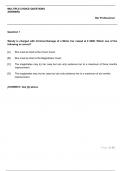
Question 1
Wendy is charged with Criminal Damage of a Motor Car valued at £ 6000. Which one of the
following is correct?
[A] She must be tried at the Crown Court.
[B] She must be tried at the Magistrates’ Court.
[C] The magistrates may try her case but can only sentence her to a maximum of three months
imprisonment.
[D] The magistrates may try her case but can only sentence her to a maximum of six months
imprisonment.
[CORRECT: See [C] above
P a g e 1 | 29
,Question 2
Helen is charged with Theft. The allegation is that she stole some items of clothing from a local
boutique. She denies the charge and is keen to be tried by a jury. Which one of the following is
correct?
[A] If the magistrates decide Helen’s case should be heard in the magistrates’ court then she and
the prosecution have no choice in the matter.
[B] If the magistrates decide Helen’s case should be heard in the Crown Court then she and the
prosecution have no choice in the matter.
[C] If the Prosecution decide Helen’s case should be heard in the Crown Court then she and the
magistrates have no choice in the matter.
[D] If Helen decides her case should be heard in the magistrates’ court then she can insist on the
matter being heard there and the magistrates have no choice in the matter.
[CORRECT: see [A] above]
P a g e 2 | 29
, Question 3
Simon is charged with Criminal Damage to a pub door valued at £200. At his first appearance at
the magistrates’ court his lawyer seeks “initial details” of the prosecution case. The Prosecutor
has on his file (i) a written summary of the evidence on which the prosecution case will be
based, and (ii) copies of the witness statements for the prosecution. Under domestic law which
of the following is correct?
[A] Simon is not entitled to “initial details” of the Prosecution case because he is charged with
Criminal Damage, where the damage is less than the relevant sum.
[B] Simon is entitled, without having to make a request, to copies of (i) or (ii) at, or before, the
beginning of the day of the first hearing. It is the Prosecutor’s decision which to provide, but
Prosecutors often provide both.
[C] Simon is not entitled to “initial details” of the Prosecution case as he is charged with a summary
only offence which must be heard in the Magistrates’ court. However, the Prosecution can
provide “initial details” if they consider it just.
[D] Simon is entitled to both a summary of the evidence on which the prosecution case will be based,
and details of the previous convictions, if any, of all Prosecution witnesses.
[B is CORRECT: See Crim PR part 8]
P a g e 3 | 29
ANSWERS
Bar Professional
Question 1
Wendy is charged with Criminal Damage of a Motor Car valued at £ 6000. Which one of the
following is correct?
[A] She must be tried at the Crown Court.
[B] She must be tried at the Magistrates’ Court.
[C] The magistrates may try her case but can only sentence her to a maximum of three months
imprisonment.
[D] The magistrates may try her case but can only sentence her to a maximum of six months
imprisonment.
[CORRECT: See [C] above
P a g e 1 | 29
,Question 2
Helen is charged with Theft. The allegation is that she stole some items of clothing from a local
boutique. She denies the charge and is keen to be tried by a jury. Which one of the following is
correct?
[A] If the magistrates decide Helen’s case should be heard in the magistrates’ court then she and
the prosecution have no choice in the matter.
[B] If the magistrates decide Helen’s case should be heard in the Crown Court then she and the
prosecution have no choice in the matter.
[C] If the Prosecution decide Helen’s case should be heard in the Crown Court then she and the
magistrates have no choice in the matter.
[D] If Helen decides her case should be heard in the magistrates’ court then she can insist on the
matter being heard there and the magistrates have no choice in the matter.
[CORRECT: see [A] above]
P a g e 2 | 29
, Question 3
Simon is charged with Criminal Damage to a pub door valued at £200. At his first appearance at
the magistrates’ court his lawyer seeks “initial details” of the prosecution case. The Prosecutor
has on his file (i) a written summary of the evidence on which the prosecution case will be
based, and (ii) copies of the witness statements for the prosecution. Under domestic law which
of the following is correct?
[A] Simon is not entitled to “initial details” of the Prosecution case because he is charged with
Criminal Damage, where the damage is less than the relevant sum.
[B] Simon is entitled, without having to make a request, to copies of (i) or (ii) at, or before, the
beginning of the day of the first hearing. It is the Prosecutor’s decision which to provide, but
Prosecutors often provide both.
[C] Simon is not entitled to “initial details” of the Prosecution case as he is charged with a summary
only offence which must be heard in the Magistrates’ court. However, the Prosecution can
provide “initial details” if they consider it just.
[D] Simon is entitled to both a summary of the evidence on which the prosecution case will be based,
and details of the previous convictions, if any, of all Prosecution witnesses.
[B is CORRECT: See Crim PR part 8]
P a g e 3 | 29