SLK 310 Chapter 3 notes
Erin Polyblank
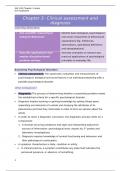
Chapter 3- Clinical assessment and
diagnosis
Learning Outcomes:
Use scientific reasoning to Identify basic biological, psychological
interpret Behaviour: and social components of behavioural
explanations (Eg. Inferences,
observations, operational definitions
and interpretations)
Describe applications that Describe examples of relevant and
employ discipline-based practical applications of psychological
problem solving: principles to everyday life.
Assessing Psychological disorders
Clinical assessment: The systematic evaluation and measurement of
psychological, biological and social factors in an individual presenting with a
possible psychological disorder.
What is Diagnosis?
Diagnosis: The process of determining whether a presenting problem meets
the established criteria for a specific psychological disorder.
Diagnosis implies learning or gaining knowledge by setting things apart,
separating out elements of a whole and studying the attributes of its
phenomena and how they interrelate in order to form an opinion about the
whole.
In order to reach a diagnostic conclusion, the diagnostic process relies on 2
components:
1. It involves securing symptoms and signs and interpreting adjunctive
sources of information- psychological tests, reports by 3 rd parties and
laboratory investigations.
2. Diagnosis requires knowledge of normal functioning and behaviour and
their pathological counterparts.
A symptom characterizes a state, condition or entity.
o In clinical practice, a symptom constitutes any state that indicates the
perceived presence, or absence, of something.
1
,SLK 310 Chapter 3 notes
Erin Polyblank
o Symptoms especially indicate change from a former state.
Eg. A n elderly patient complains that, whereas formerly they managed
to walk to the shops with ease, it now takes great effort, and they
become short of breath.
o A symptom is a manifestation of a state or condition conceptualised as
indicating an abnormality as reported by the affected individual.
Where a sign is a manifestation of a condition that may indicate abnormality
that is observed by another person.
o Detecting signs requires keen observation and needs all our senses.
Distinguishing between symptoms and signs is not always that
straightforward.
o In its simplest form, pain is a symptom; tenderness a sign.
But tenderness could be a symptom, if elicited by the person reporting
it.
Mood is mostly a symptom but can be sensed by others.
o Affect is usually a sign only.
For the diagnostic process we need to know 3 things:
1. Who?
2. Why?
3. What?
Who, why and what?
1. The primary thing that should interest the clinician - psychologist or doctor
- is who is this person in the consultation?
2. Why is this person being consulted?
3. What is it that can be observed?
To answer these basic questions is to understand the person and the
situation.
o This process of understanding, of diagnosing, is handled in a systematised
way and consists of taking a history, examination and special, adjunctive
and supportive investigation.
Psychologists examine by means of observing mental state and behaviour.
o Supportive special investigations in psychological practice consists of
standardised test instruments such as neuropsychological batteries,
intelligence and personality assessments.
2
,SLK 310 Chapter 3 notes
Erin Polyblank
o Special investigations, or tests, serve to confirm a diagnostic hypothesis
more usually than detecting what the problem is in the first place.
Paths to diagnosis
In the process of diagnosis, we gather information and integrate this with
what we understand to be normal behaviour and function and how pathology
presents.
Diagnosis follows a decision tree, or algorithm.
o In this algorithmic approach, all observations are considered against all
their possible causes.
With time and experience, clinicians come to recognise patterns - the typical,
predictable co-occurrence of events and observations.
o This pattern-recognition approach to diagnosis is what most experienced
doctors and psychologists employ.
o While it is efficient, it runs the risk of ignoring unusual presentations.
An intermediate approach is the so-called hypothetico deductive method.
o This method best exemplifies the logical underpinnings of the diagnostic
process.
o Here the clinician forms a hypothesis about the problem right from the
outset.
o Usually, the history presents the main substance of the hypothesis.
Direct further enquiry confirms or refutes this hypothesis.
Examination provides similar information, as do special investigations.
A prudent combination of these 3 approaches is best.
Skilled clinicians can switch between the diagnostic modes to produce
practical but accurate diagnostic formulations.
Pathognomonic diagnosis: There is one symptom or sign, or a set of
symptoms or signs, that uniquely define a condition.
o They are rare, and relying on this approach is perilous.
The process of clinical assessment in psychopathology has been likened to a
funnel.
3
, SLK 310 Chapter 3 notes
Erin Polyblank
o The clinician begins by collecting a lot of information across a broad range
of the individual's condition to determine where the source of the problem
may lie.
o After getting a preliminary sense of the overall functioning of the person,
the clinician narrows the focus by ruling out problems in some areas and
concentrating on areas that seem most relevant.
Types of diagnosis:
o Experiential or phenomenological: If only observed and reported
information is available.
o Phenomenological Diagnosis: Is solely reliant on clinical information.
Eg. A patient who presents as psychotic and disorganised with intact
consciousness can be described only phenomenologically.
Without more behavioural information and a history of how the
condition developed with time, no further conclusions can be drawn.
o Syndromal Diagnosis: Involves the recognition of the occurrence of
predictable clusters of phenomena.
In this case, more is known about the presentation, as enough
phenomena can be observed to recognise clustering.
For phenomena to constitute a syndrome, they must occur together at
a rate higher than would be predicted by chance alone.
Eg. Decreased arousal, poor attention, other cognitive disturbances
and hallucinations indicate delirium.
Delirium is a syndrome, and the available evidence does not shed any
lighter on what caused it and what its outcome might be.
When a syndrome is combined with the evolution of pathological
phenomena over time, the diagnosis is elevated to the level of
disorder.
Mental Disorders/Psychological conditions are understood at the
descriptive, syndromal and disorder level of diagnostic exactness.
o Pathogenic and aetiological diagnoses: where the pathological
process and cause are known.
4
Erin Polyblank
Chapter 3- Clinical assessment and
diagnosis
Learning Outcomes:
Use scientific reasoning to Identify basic biological, psychological
interpret Behaviour: and social components of behavioural
explanations (Eg. Inferences,
observations, operational definitions
and interpretations)
Describe applications that Describe examples of relevant and
employ discipline-based practical applications of psychological
problem solving: principles to everyday life.
Assessing Psychological disorders
Clinical assessment: The systematic evaluation and measurement of
psychological, biological and social factors in an individual presenting with a
possible psychological disorder.
What is Diagnosis?
Diagnosis: The process of determining whether a presenting problem meets
the established criteria for a specific psychological disorder.
Diagnosis implies learning or gaining knowledge by setting things apart,
separating out elements of a whole and studying the attributes of its
phenomena and how they interrelate in order to form an opinion about the
whole.
In order to reach a diagnostic conclusion, the diagnostic process relies on 2
components:
1. It involves securing symptoms and signs and interpreting adjunctive
sources of information- psychological tests, reports by 3 rd parties and
laboratory investigations.
2. Diagnosis requires knowledge of normal functioning and behaviour and
their pathological counterparts.
A symptom characterizes a state, condition or entity.
o In clinical practice, a symptom constitutes any state that indicates the
perceived presence, or absence, of something.
1
,SLK 310 Chapter 3 notes
Erin Polyblank
o Symptoms especially indicate change from a former state.
Eg. A n elderly patient complains that, whereas formerly they managed
to walk to the shops with ease, it now takes great effort, and they
become short of breath.
o A symptom is a manifestation of a state or condition conceptualised as
indicating an abnormality as reported by the affected individual.
Where a sign is a manifestation of a condition that may indicate abnormality
that is observed by another person.
o Detecting signs requires keen observation and needs all our senses.
Distinguishing between symptoms and signs is not always that
straightforward.
o In its simplest form, pain is a symptom; tenderness a sign.
But tenderness could be a symptom, if elicited by the person reporting
it.
Mood is mostly a symptom but can be sensed by others.
o Affect is usually a sign only.
For the diagnostic process we need to know 3 things:
1. Who?
2. Why?
3. What?
Who, why and what?
1. The primary thing that should interest the clinician - psychologist or doctor
- is who is this person in the consultation?
2. Why is this person being consulted?
3. What is it that can be observed?
To answer these basic questions is to understand the person and the
situation.
o This process of understanding, of diagnosing, is handled in a systematised
way and consists of taking a history, examination and special, adjunctive
and supportive investigation.
Psychologists examine by means of observing mental state and behaviour.
o Supportive special investigations in psychological practice consists of
standardised test instruments such as neuropsychological batteries,
intelligence and personality assessments.
2
,SLK 310 Chapter 3 notes
Erin Polyblank
o Special investigations, or tests, serve to confirm a diagnostic hypothesis
more usually than detecting what the problem is in the first place.
Paths to diagnosis
In the process of diagnosis, we gather information and integrate this with
what we understand to be normal behaviour and function and how pathology
presents.
Diagnosis follows a decision tree, or algorithm.
o In this algorithmic approach, all observations are considered against all
their possible causes.
With time and experience, clinicians come to recognise patterns - the typical,
predictable co-occurrence of events and observations.
o This pattern-recognition approach to diagnosis is what most experienced
doctors and psychologists employ.
o While it is efficient, it runs the risk of ignoring unusual presentations.
An intermediate approach is the so-called hypothetico deductive method.
o This method best exemplifies the logical underpinnings of the diagnostic
process.
o Here the clinician forms a hypothesis about the problem right from the
outset.
o Usually, the history presents the main substance of the hypothesis.
Direct further enquiry confirms or refutes this hypothesis.
Examination provides similar information, as do special investigations.
A prudent combination of these 3 approaches is best.
Skilled clinicians can switch between the diagnostic modes to produce
practical but accurate diagnostic formulations.
Pathognomonic diagnosis: There is one symptom or sign, or a set of
symptoms or signs, that uniquely define a condition.
o They are rare, and relying on this approach is perilous.
The process of clinical assessment in psychopathology has been likened to a
funnel.
3
, SLK 310 Chapter 3 notes
Erin Polyblank
o The clinician begins by collecting a lot of information across a broad range
of the individual's condition to determine where the source of the problem
may lie.
o After getting a preliminary sense of the overall functioning of the person,
the clinician narrows the focus by ruling out problems in some areas and
concentrating on areas that seem most relevant.
Types of diagnosis:
o Experiential or phenomenological: If only observed and reported
information is available.
o Phenomenological Diagnosis: Is solely reliant on clinical information.
Eg. A patient who presents as psychotic and disorganised with intact
consciousness can be described only phenomenologically.
Without more behavioural information and a history of how the
condition developed with time, no further conclusions can be drawn.
o Syndromal Diagnosis: Involves the recognition of the occurrence of
predictable clusters of phenomena.
In this case, more is known about the presentation, as enough
phenomena can be observed to recognise clustering.
For phenomena to constitute a syndrome, they must occur together at
a rate higher than would be predicted by chance alone.
Eg. Decreased arousal, poor attention, other cognitive disturbances
and hallucinations indicate delirium.
Delirium is a syndrome, and the available evidence does not shed any
lighter on what caused it and what its outcome might be.
When a syndrome is combined with the evolution of pathological
phenomena over time, the diagnosis is elevated to the level of
disorder.
Mental Disorders/Psychological conditions are understood at the
descriptive, syndromal and disorder level of diagnostic exactness.
o Pathogenic and aetiological diagnoses: where the pathological
process and cause are known.
4