Summary Health Economics week 4
Table of content
4.1 Dupas model
4.2 Barriers to preventive health behaviour
4.3 The Beta-Delta discounting model
4.4 Epidemiology and Self protection
4.5 SIR model of infectious diseases
4.1 Dupas model
Health outcomes at the micro level
A person’s health stock in any year is a function of his health stock at the beginning of the year, the
health shocks (and depreciation) that he experiences, and the health care he receives.
–
Health stock and health environment determine the risks to which someone is exposed.
–
This exposure to health risks, together with choices regarding health input use and health
behaviours, determine the probabilities of health shocks.
When hit by a health shock, the
– types, qualities and prices of available health care services,
– together with household health care financing options, (budget constraint)
help determine choices regarding the type, quantity and quality of health care treatment
received.
T
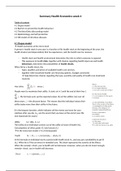
Max Utility ∑ Et ¿ ¿ where ¿
t =1
People want to maximize their utility. It starts at t=1 until the end of their lives (
T
∑ ¿. The formula sums up the expected values (E ) of the utilities (U ) over all
t t
t =1
these years. ¿ = the discount factor. This means that the individual values their
utility today more than their utility in the future.
B is the bequest function, which indicates all the money you leave for your
relatives after you die. AT+1 are the assets that you have at the end of your life.
(not important for exam).
Utility Ut= U(Ht, Ct, Lt)
The Utility of an individual consists out of the utility of stock of health (H t),
Consumptions of other goods (Ct) and Leisure (Lt)
In the Grossman model: C+L=Z (homegoods)
In this formula an individual starts a period with health stock H t-1 and you got a probability to get ill
(πt). When he is ill he can invest in remedial care. The shock represents the severity of the illness.
When the remedy> shock, you’re health will not decrease. However, when you do not invest enough,
remedy< shock, you’re health will decrease.
, The probability of illness can be changed by an individual. In this formula you can see that the
probability of an illness (πt) depends on the preventive investments that you make (prevent t-1) and the
probability that a random shock occurs (ɛt).
Budget constraint pc*Ct + pp*preventt+ pr *remedyt ≤ ω(T-Lt)+ rAt + Wt
An individual cannot spend more money than he has. Therefore the expenditure on consumption
(pc*Ct), prevention (pp*preventt) and remedy (pr *remedyt) should be less or equal to the wage he
earns, the assets he has and other net income.
rAt= assets with deprivation over time (r.) because of value loss.
ω(T-Lt) The total time without the time spend on leisure multiplied by hour wage
4.2 Barriers to preventive health behaviour
Dupas(2011) discusses four main barriers to the adoption of preventive health behaviour
1. Information
lack of information on health risks keeps people from acting towards it. This includes also a
lack of information about benefits of investing in preventive measures. *water contamination,
relative HIV risk by type of partner
lack of information on prevention techniques and their effectiveness *Hygienic practices, such
as hand washing with soap, Insecticide-treated bed nets to prevent malaria
In the Dupas model:
Inform people about the severity of the shock
Inform them about preventive measures that can be taken
The impact of information provision on behaviour change depends on
a. The source of information (government, teachers, parents, social media etc.)
b. The type of information (should be well focused, not to broad)
c. The targeted group (parents vs children)
2a. Learning
requires gaining experience with new behaviour through own experimentation or observation
= affected by cognitive ability (is someone able to comprehend and link information?)
Externalities of learning
– Social learning can increase (technology) adaption (bed nets, menstrual cups)
– But it can also lead to free-riding (waiting with new medicines)
– or it can lead to suboptimal adoption from a social point of view in case of positive health
externalities (e.g. deworming, immunization) –> especially when individuals learn about costs
such as side-effects
2b. Externalities
someone’s health is determined by the health (behaviour) of those around him: there are
many externalities in the world of health, negative and positive
* second hand smoking, infectious diseases, motivational benefits about living among active
people, government taxes
– Without externalities, markets can reach an efficient outcome
– With externalities, government responses may help the market to reach a socially desirable
state
Table of content
4.1 Dupas model
4.2 Barriers to preventive health behaviour
4.3 The Beta-Delta discounting model
4.4 Epidemiology and Self protection
4.5 SIR model of infectious diseases
4.1 Dupas model
Health outcomes at the micro level
A person’s health stock in any year is a function of his health stock at the beginning of the year, the
health shocks (and depreciation) that he experiences, and the health care he receives.
–
Health stock and health environment determine the risks to which someone is exposed.
–
This exposure to health risks, together with choices regarding health input use and health
behaviours, determine the probabilities of health shocks.
When hit by a health shock, the
– types, qualities and prices of available health care services,
– together with household health care financing options, (budget constraint)
help determine choices regarding the type, quantity and quality of health care treatment
received.
T
Max Utility ∑ Et ¿ ¿ where ¿
t =1
People want to maximize their utility. It starts at t=1 until the end of their lives (
T
∑ ¿. The formula sums up the expected values (E ) of the utilities (U ) over all
t t
t =1
these years. ¿ = the discount factor. This means that the individual values their
utility today more than their utility in the future.
B is the bequest function, which indicates all the money you leave for your
relatives after you die. AT+1 are the assets that you have at the end of your life.
(not important for exam).
Utility Ut= U(Ht, Ct, Lt)
The Utility of an individual consists out of the utility of stock of health (H t),
Consumptions of other goods (Ct) and Leisure (Lt)
In the Grossman model: C+L=Z (homegoods)
In this formula an individual starts a period with health stock H t-1 and you got a probability to get ill
(πt). When he is ill he can invest in remedial care. The shock represents the severity of the illness.
When the remedy> shock, you’re health will not decrease. However, when you do not invest enough,
remedy< shock, you’re health will decrease.
, The probability of illness can be changed by an individual. In this formula you can see that the
probability of an illness (πt) depends on the preventive investments that you make (prevent t-1) and the
probability that a random shock occurs (ɛt).
Budget constraint pc*Ct + pp*preventt+ pr *remedyt ≤ ω(T-Lt)+ rAt + Wt
An individual cannot spend more money than he has. Therefore the expenditure on consumption
(pc*Ct), prevention (pp*preventt) and remedy (pr *remedyt) should be less or equal to the wage he
earns, the assets he has and other net income.
rAt= assets with deprivation over time (r.) because of value loss.
ω(T-Lt) The total time without the time spend on leisure multiplied by hour wage
4.2 Barriers to preventive health behaviour
Dupas(2011) discusses four main barriers to the adoption of preventive health behaviour
1. Information
lack of information on health risks keeps people from acting towards it. This includes also a
lack of information about benefits of investing in preventive measures. *water contamination,
relative HIV risk by type of partner
lack of information on prevention techniques and their effectiveness *Hygienic practices, such
as hand washing with soap, Insecticide-treated bed nets to prevent malaria
In the Dupas model:
Inform people about the severity of the shock
Inform them about preventive measures that can be taken
The impact of information provision on behaviour change depends on
a. The source of information (government, teachers, parents, social media etc.)
b. The type of information (should be well focused, not to broad)
c. The targeted group (parents vs children)
2a. Learning
requires gaining experience with new behaviour through own experimentation or observation
= affected by cognitive ability (is someone able to comprehend and link information?)
Externalities of learning
– Social learning can increase (technology) adaption (bed nets, menstrual cups)
– But it can also lead to free-riding (waiting with new medicines)
– or it can lead to suboptimal adoption from a social point of view in case of positive health
externalities (e.g. deworming, immunization) –> especially when individuals learn about costs
such as side-effects
2b. Externalities
someone’s health is determined by the health (behaviour) of those around him: there are
many externalities in the world of health, negative and positive
* second hand smoking, infectious diseases, motivational benefits about living among active
people, government taxes
– Without externalities, markets can reach an efficient outcome
– With externalities, government responses may help the market to reach a socially desirable
state