


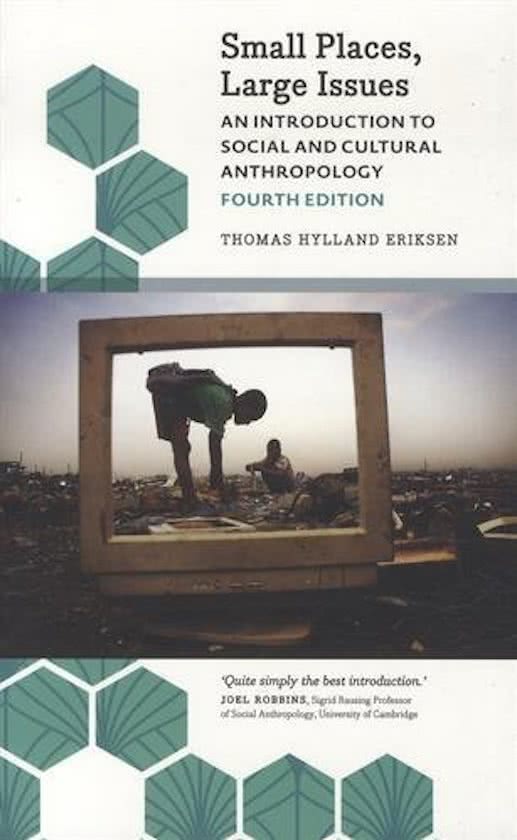
Notities Eriksen ''Small Places Large Issues''
Samenvatting, notities & leesvragen
INHOUD
H1 Anthropology: Comparison and Context...........................................................................2
H2 A Brief History of Anthropology.........................................................................................3
H3 Fieldwork and Ethnography..............................................................................................7
H4 The social person............................................................................................................ 14
Leesvragen....................................................................................................................... 14
H5 Local organisation........................................................................................................... 18
H6 Person and Society.........................................................................................................21
Leesvragen....................................................................................................................... 21
H7 Kinship as Descent......................................................................................................... 28
H8 Marriage and relatedness...............................................................................................32
Leesvragen....................................................................................................................... 32
H9 Gender and Age.............................................................................................................. 39
H10 Caste and Class............................................................................................................ 45
H11 Politics and Power........................................................................................................ 51
Leesvragen....................................................................................................................... 51
H12 Exchange and Consumption.........................................................................................55
H13 Production, Nature and Technology.............................................................................62
1
,H1 Anthropology: Comparison and Context
● Anthropology:
-Anthropos: human
-Logos: reason
● Tries to understand the ways in which human lives are unique, but also the sense in
which we are all similar
● It (anthropology) is in part history, part literature; in part natural science, part social
science; it strives to study men both from within and without; it represents both a
manner of looking at man and a vision of man
● Is about how different people can be, but it also tries to find out in what sense it can
be said that all humans have something in common. It oscillates between the
universal and the particular.
● Tries to understand both connections within societies and connections between
societies.
● Contemporary (hedendaags) anthropological research displays an enormous range,
empirically as well as theoretically.
● The relationship between culture and society can be described in the following way.
Culture refers to the acquired, cognitive and symbolic aspects of existence, whereas
society refers to the social organisation of human life, patterns of interaction and
power relationships.
● Central problem of anthropology: the diversity of human social life.
● Ethnocentrism: evaluating other people from one’s own vantage-point and describing
them in one’s own terms.
-In order to pass judgement on the quality of life in a foreign society, we must first try
to understand that society from the inside; otherwise our judgement has a limited
intellectual interest.
-What is conceived of as ‘the good life’ in the society in which we live may not appear
attractive at all from a different vantage-point.
-A typical statistical criterion such as ‘annual income’ is meaningless in a society
where neither money nor wagework is common.
● Anthropology calls for an understanding of different societies as they appear from
the inside.
● Cultural relativism:
● Theoretical premise and methodological rule-of-thumb in our attempts to understand
other societies in an as unprejudiced way as possible.
● It would be a bad idea to name see everything as ‘’okay’’, as long as it is in a
particular social context. This would in an extreme situation be taken as nihilism.
2
,H2 A Brief History of Anthropology
● History is not primarily a product of the past itself, but is rather shaped by the
concerns of the present.
● there can be no totally objective, neutral history of anthropology (or of anything)
Proto-Anthropology
● Beginnings of a systematic, comparative study of culture:
→ The most famous is perhaps Jean-Jacques Rousseau (1712–78), who saw
the social conditions of ‘savages’ as a utopian ideal;
-Of equal interest is Baron de Montesquieu (1689–1755), whose Lettres Persanes
(‘Persian letters’, 1722) was an early, fictional attempt to describe Europe as seen
through the eyes of non-Europeans.
● Universalism versus relativism (what is common to humanity; what is culturally
specific)
● Ethnocentrism versus cultural relativism (moral judgements versus neutral
descriptions of other peoples),
● Humanity versus (the rest of) the animal kingdom (culture versus nature).
Victorian Anthropology
● A characteristic of the anthropology of the nineteenth century was the belief in social
evolution – the idea that human societies developed in a particular direction – and
the related notion that European societies were the end-product of a long
developmental chain which began with ‘savagery’.
-This idea was typical of the Victorian age, dominated by an optimistic belief in
technological progress.
● ‘the white man’s burden’: the alleged duty of the European to ‘civilise the savages’.
● Ancient Law (1861): Maine distinguished between status and contract societies, a
divide which corresponds roughly to later dichotomies between traditional and
modern societies
-In the late nineteenth century German sociologist Ferdinand Tönnies’ (1855–1936)
terminology, Gemeinschaft (community) and Gesellschaft (society). Status societies
are assumed to operate on the basis of kinship and myth, while individual merit and
achievement are decisive in contract societies.
● The emergence of modern anthropology is usually associated with four outstanding
scholars working in three countries in the early decades of the twentieth century:
1. Franz Boas in the USA;
2. A.R. Radcliffe-Brown in the UK;
3. Bronislaw Malinowski in the UK;
4. Marcel Mauss in France.
Boas and Cultural Relativism
● Boas (1858–1942), a German immigrant to the United States who had briefly studied
anthropology
● He strengthened the ‘four-field approach’ in American anthropology, it encompasses
not only cultural and social anthropology, but also physical anthropology,
archaeology and anthropological linguistics.
3
, ● Boas took an early stance in favour of a particularist approach. He argued that each
culture had to be understood on its own terms and that it would be scientifically
misleading to judge and rank other cultures according to a Western, ethnocentric
typology gauging ‘levels of development’.
→ Accordingly, Boas also promoted historical particularism, the view that all
societies or cultures had their own, unique history that could not be reduced to a
category in some universalist scheme of development.
● Perhaps because of his particularism, Boas never systematised his ideas in a
theoretical treatise.
The Two British Schools
● Malinowski:
-Stressed the need to learn the local language properly and to engage in everyday
life in the society under scrutiny, in order to learn its categories ‘from within’, and to
understand the often subtle interconnections between the various social institutions
and cultural notions.
-Placed an unusual emphasis on the acting individual, seeing social structure not as
a determinant of but as a framework for action, and he wrote about a wide range of
topics, ranging from garden magic, economics, technology, etc.
-He regarded all institutions of a society as intrinsically linked to each other, and
stressed that every social or cultural phenomenon ought to be studied in its full
context.
-He held that inborn human needs were the driving force in the development of social
institutions, and his brand of functionalism is often described as ‘biopsychological
functionalism’.
-Participant observation: a new concept requiring the ethnographer to take active part
in everyday life.
● A.R. Radcliffe-Brown (1881–1955):
-Less accomplished ethnographer than Malinowski, but his chief aim was to develop
a ‘natural science of society’
-Structural-functionalism: sees the acting individual as analytically unimportant,
emphasising instead the social institutions (including kinship, norms, politics, etc.)
and their interrelationships. According to this view, most social and cultural
phenomena could be seen as functional in the sense that they contributed to the
maintenance of the overall social structure.
-in Structure and Function in Primitive Society (1952), he shows how societies, in his
view, are integrated, and how social institutions reinforce each other and contribute
to the maintenance of society
-His scientific ideals were taken from natural science, and he hoped to develop
‘general laws of society’ comparable in precision to those of physics and chemistry.
This programme has been abandoned by most anthropologists – like structural-
functionalism in its pure form –.
● Despite their differences in emphasis, both British schools had a sociological concern
in common (which they did not share with most Americans), and tended to see social
institutions as functional.
● Both distanced themselves from the wide-ranging claims of diffusionism and
evolutionism, and by the next generation of scholars, the influences of the two
founding fathers may be said to have merged (Kuper 2014), although the tension
4
Samenvatting, notities & leesvragen
INHOUD
H1 Anthropology: Comparison and Context...........................................................................2
H2 A Brief History of Anthropology.........................................................................................3
H3 Fieldwork and Ethnography..............................................................................................7
H4 The social person............................................................................................................ 14
Leesvragen....................................................................................................................... 14
H5 Local organisation........................................................................................................... 18
H6 Person and Society.........................................................................................................21
Leesvragen....................................................................................................................... 21
H7 Kinship as Descent......................................................................................................... 28
H8 Marriage and relatedness...............................................................................................32
Leesvragen....................................................................................................................... 32
H9 Gender and Age.............................................................................................................. 39
H10 Caste and Class............................................................................................................ 45
H11 Politics and Power........................................................................................................ 51
Leesvragen....................................................................................................................... 51
H12 Exchange and Consumption.........................................................................................55
H13 Production, Nature and Technology.............................................................................62
1
,H1 Anthropology: Comparison and Context
● Anthropology:
-Anthropos: human
-Logos: reason
● Tries to understand the ways in which human lives are unique, but also the sense in
which we are all similar
● It (anthropology) is in part history, part literature; in part natural science, part social
science; it strives to study men both from within and without; it represents both a
manner of looking at man and a vision of man
● Is about how different people can be, but it also tries to find out in what sense it can
be said that all humans have something in common. It oscillates between the
universal and the particular.
● Tries to understand both connections within societies and connections between
societies.
● Contemporary (hedendaags) anthropological research displays an enormous range,
empirically as well as theoretically.
● The relationship between culture and society can be described in the following way.
Culture refers to the acquired, cognitive and symbolic aspects of existence, whereas
society refers to the social organisation of human life, patterns of interaction and
power relationships.
● Central problem of anthropology: the diversity of human social life.
● Ethnocentrism: evaluating other people from one’s own vantage-point and describing
them in one’s own terms.
-In order to pass judgement on the quality of life in a foreign society, we must first try
to understand that society from the inside; otherwise our judgement has a limited
intellectual interest.
-What is conceived of as ‘the good life’ in the society in which we live may not appear
attractive at all from a different vantage-point.
-A typical statistical criterion such as ‘annual income’ is meaningless in a society
where neither money nor wagework is common.
● Anthropology calls for an understanding of different societies as they appear from
the inside.
● Cultural relativism:
● Theoretical premise and methodological rule-of-thumb in our attempts to understand
other societies in an as unprejudiced way as possible.
● It would be a bad idea to name see everything as ‘’okay’’, as long as it is in a
particular social context. This would in an extreme situation be taken as nihilism.
2
,H2 A Brief History of Anthropology
● History is not primarily a product of the past itself, but is rather shaped by the
concerns of the present.
● there can be no totally objective, neutral history of anthropology (or of anything)
Proto-Anthropology
● Beginnings of a systematic, comparative study of culture:
→ The most famous is perhaps Jean-Jacques Rousseau (1712–78), who saw
the social conditions of ‘savages’ as a utopian ideal;
-Of equal interest is Baron de Montesquieu (1689–1755), whose Lettres Persanes
(‘Persian letters’, 1722) was an early, fictional attempt to describe Europe as seen
through the eyes of non-Europeans.
● Universalism versus relativism (what is common to humanity; what is culturally
specific)
● Ethnocentrism versus cultural relativism (moral judgements versus neutral
descriptions of other peoples),
● Humanity versus (the rest of) the animal kingdom (culture versus nature).
Victorian Anthropology
● A characteristic of the anthropology of the nineteenth century was the belief in social
evolution – the idea that human societies developed in a particular direction – and
the related notion that European societies were the end-product of a long
developmental chain which began with ‘savagery’.
-This idea was typical of the Victorian age, dominated by an optimistic belief in
technological progress.
● ‘the white man’s burden’: the alleged duty of the European to ‘civilise the savages’.
● Ancient Law (1861): Maine distinguished between status and contract societies, a
divide which corresponds roughly to later dichotomies between traditional and
modern societies
-In the late nineteenth century German sociologist Ferdinand Tönnies’ (1855–1936)
terminology, Gemeinschaft (community) and Gesellschaft (society). Status societies
are assumed to operate on the basis of kinship and myth, while individual merit and
achievement are decisive in contract societies.
● The emergence of modern anthropology is usually associated with four outstanding
scholars working in three countries in the early decades of the twentieth century:
1. Franz Boas in the USA;
2. A.R. Radcliffe-Brown in the UK;
3. Bronislaw Malinowski in the UK;
4. Marcel Mauss in France.
Boas and Cultural Relativism
● Boas (1858–1942), a German immigrant to the United States who had briefly studied
anthropology
● He strengthened the ‘four-field approach’ in American anthropology, it encompasses
not only cultural and social anthropology, but also physical anthropology,
archaeology and anthropological linguistics.
3
, ● Boas took an early stance in favour of a particularist approach. He argued that each
culture had to be understood on its own terms and that it would be scientifically
misleading to judge and rank other cultures according to a Western, ethnocentric
typology gauging ‘levels of development’.
→ Accordingly, Boas also promoted historical particularism, the view that all
societies or cultures had their own, unique history that could not be reduced to a
category in some universalist scheme of development.
● Perhaps because of his particularism, Boas never systematised his ideas in a
theoretical treatise.
The Two British Schools
● Malinowski:
-Stressed the need to learn the local language properly and to engage in everyday
life in the society under scrutiny, in order to learn its categories ‘from within’, and to
understand the often subtle interconnections between the various social institutions
and cultural notions.
-Placed an unusual emphasis on the acting individual, seeing social structure not as
a determinant of but as a framework for action, and he wrote about a wide range of
topics, ranging from garden magic, economics, technology, etc.
-He regarded all institutions of a society as intrinsically linked to each other, and
stressed that every social or cultural phenomenon ought to be studied in its full
context.
-He held that inborn human needs were the driving force in the development of social
institutions, and his brand of functionalism is often described as ‘biopsychological
functionalism’.
-Participant observation: a new concept requiring the ethnographer to take active part
in everyday life.
● A.R. Radcliffe-Brown (1881–1955):
-Less accomplished ethnographer than Malinowski, but his chief aim was to develop
a ‘natural science of society’
-Structural-functionalism: sees the acting individual as analytically unimportant,
emphasising instead the social institutions (including kinship, norms, politics, etc.)
and their interrelationships. According to this view, most social and cultural
phenomena could be seen as functional in the sense that they contributed to the
maintenance of the overall social structure.
-in Structure and Function in Primitive Society (1952), he shows how societies, in his
view, are integrated, and how social institutions reinforce each other and contribute
to the maintenance of society
-His scientific ideals were taken from natural science, and he hoped to develop
‘general laws of society’ comparable in precision to those of physics and chemistry.
This programme has been abandoned by most anthropologists – like structural-
functionalism in its pure form –.
● Despite their differences in emphasis, both British schools had a sociological concern
in common (which they did not share with most Americans), and tended to see social
institutions as functional.
● Both distanced themselves from the wide-ranging claims of diffusionism and
evolutionism, and by the next generation of scholars, the influences of the two
founding fathers may be said to have merged (Kuper 2014), although the tension
4

