2.1 Elements of the Business
Business defined by:
structural element: one of two major infrastructural element: one of two major
decision categories addressed by a decision categories addressed by a
strategy (includes: tangible resources; e.g. strategy (includes: people / decision
buildings / equipment / computer systems rules / organizational structure choices)
2.2 Strategy
- strategies: mechanisms, by which businesses coordinate their decisions regarding their structural and
infrastructural elements; should be aligned across functional areas
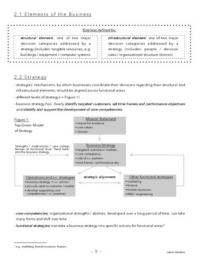
- different levels of strategy (g Figure 1)
- business strategy has: clearly identify targeted customers, set time frames and performance objectives
and identify and support the development of core competencies
Figure 1: Mission Statement
• reason for existence
Top-Down Model
• core values
of Strategy • domain
Strengths / weak-nesses / core compe- Business Strategy
tencies at functional level "feed back" • targeted customers / markets
into the business strategy
• core competency
• role of s.c. partners
• time frames / performance obj.
Operations and s.c. strategies strategic alignment Other functional strategies
• business strategy g s.c. actions • marketing
• provide value to customer / market • finance
• develop supporting core • human resources
competencies / s.c. practices • R&D / engineering
- core competencies: organizational strengths / abilities, developed over a long period of time; can take
many forms and shift over time
- functional strategies: translate a business strategy into specific actions for functional areas 1
1 e.g.: marketing, human resources, finance,...
9 -
- 11 Jannis Mertens
Business defined by:
structural element: one of two major infrastructural element: one of two major
decision categories addressed by a decision categories addressed by a
strategy (includes: tangible resources; e.g. strategy (includes: people / decision
buildings / equipment / computer systems rules / organizational structure choices)
2.2 Strategy
- strategies: mechanisms, by which businesses coordinate their decisions regarding their structural and
infrastructural elements; should be aligned across functional areas
- different levels of strategy (g Figure 1)
- business strategy has: clearly identify targeted customers, set time frames and performance objectives
and identify and support the development of core competencies
Figure 1: Mission Statement
• reason for existence
Top-Down Model
• core values
of Strategy • domain
Strengths / weak-nesses / core compe- Business Strategy
tencies at functional level "feed back" • targeted customers / markets
into the business strategy
• core competency
• role of s.c. partners
• time frames / performance obj.
Operations and s.c. strategies strategic alignment Other functional strategies
• business strategy g s.c. actions • marketing
• provide value to customer / market • finance
• develop supporting core • human resources
competencies / s.c. practices • R&D / engineering
- core competencies: organizational strengths / abilities, developed over a long period of time; can take
many forms and shift over time
- functional strategies: translate a business strategy into specific actions for functional areas 1
1 e.g.: marketing, human resources, finance,...
9 -
- 11 Jannis Mertens